Thursday, October 23rd 2025

Micron Delivers Industry's Highest Capacity SOCAMM2 for Low-Power DRAM in the AI Data Center
In an era of unprecedented AI innovation and growth, the entire data center ecosystem is transforming toward more energy-efficient infrastructure to support sustainable growth. With memory playing an increasingly critical role in AI systems, low-power memory solutions have become central to this transformation. Micron Technology, Inc. today announced customer sampling of 192 GB SOCAMM2 (small outline compression attached memory modules) to enable broader adoption of low-power memory within AI data centers. SOCAMM2 extends the capabilities of Micron's first-to-market LPDRAM SOCAMM, delivering 50% more capacity in the same compact footprint. The added capacity can significantly reduce time to first token (TTFT) by more than 80% in real-time inference workloads.
The 192 GB SOCAMM2 uses Micron's most advanced 1-gamma DRAM process technology to deliver greater than 20% improvement in power efficiency, further enabling power design optimization of large data center clusters. These savings become quite significant in full-rack AI installations, which can include more than 40 terabytes of CPU-attached low-power DRAM main memory. The modular design of SOCAMM2 improves serviceability and lays the groundwork for future capacity expansion.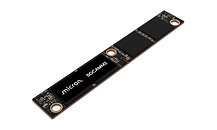 Building on a five-year collaboration with NVIDIA, Micron pioneered the use of low-power server memory in the data center. SOCAMM2 delivers LPDDR5X's inherent advantages - exceptionally low power consumption and high bandwidth - to the main memory of AI systems. Designed to meet the evolving demands of massive-context AI platforms, SOCAMM2 provides the high data throughput required for AI workloads while delivering new levels of energy efficiency, setting a new standard for AI training and inference systems. This combination of advantages will make SOCAMM2 a key memory solution for leading-edge AI platforms in the years ahead.
"As AI workloads become more complex and demanding, data center servers must achieve increased efficiency, delivering more tokens for every watt of power," said Raj Narasimhan, senior vice president and general manager of Micron's Cloud Memory Business Unit. "Micron's proven leadership in low-power DRAM ensures our SOCAMM2 modules provide the data throughput, energy efficiency, capacity and data center-class quality essential to powering the next generation of AI data center servers."
Through specialized design features and enhanced testing, Micron SOCAMM2 products transform low-power DRAM, initially designed for mobile phones, into data center-class solutions. Extensive experience in high-quality data center DDR memory helps Micron ensure that SOCAMM2 meets the stringent quality and reliability requirements of our data center customers.
SOCAMM2 improves power efficiency by more than two-thirds compared with equivalent RDIMMs, while packing its performance into a module one-third the size, optimizing data center footprint and maximizing capacity and bandwidth. SOCAMM's modular design and innovative stacking technology improves serviceability and aids the design of liquid-cooled servers.
Micron has been an active participant in the JEDEC SOCAMM2 specification definition and is working closely with industry partners to drive standards that will accelerate low-power adoption in AI data centers to improve power efficiency across the entire industry. SOCAMM2 customer samples are shipping now in capacities up to 192 GB per module and speeds up to 9.6 Gbps, with high-volume production aligned to customer launch schedules.
Source:
Micron
The 192 GB SOCAMM2 uses Micron's most advanced 1-gamma DRAM process technology to deliver greater than 20% improvement in power efficiency, further enabling power design optimization of large data center clusters. These savings become quite significant in full-rack AI installations, which can include more than 40 terabytes of CPU-attached low-power DRAM main memory. The modular design of SOCAMM2 improves serviceability and lays the groundwork for future capacity expansion.

"As AI workloads become more complex and demanding, data center servers must achieve increased efficiency, delivering more tokens for every watt of power," said Raj Narasimhan, senior vice president and general manager of Micron's Cloud Memory Business Unit. "Micron's proven leadership in low-power DRAM ensures our SOCAMM2 modules provide the data throughput, energy efficiency, capacity and data center-class quality essential to powering the next generation of AI data center servers."
Through specialized design features and enhanced testing, Micron SOCAMM2 products transform low-power DRAM, initially designed for mobile phones, into data center-class solutions. Extensive experience in high-quality data center DDR memory helps Micron ensure that SOCAMM2 meets the stringent quality and reliability requirements of our data center customers.
SOCAMM2 improves power efficiency by more than two-thirds compared with equivalent RDIMMs, while packing its performance into a module one-third the size, optimizing data center footprint and maximizing capacity and bandwidth. SOCAMM's modular design and innovative stacking technology improves serviceability and aids the design of liquid-cooled servers.
Micron has been an active participant in the JEDEC SOCAMM2 specification definition and is working closely with industry partners to drive standards that will accelerate low-power adoption in AI data centers to improve power efficiency across the entire industry. SOCAMM2 customer samples are shipping now in capacities up to 192 GB per module and speeds up to 9.6 Gbps, with high-volume production aligned to customer launch schedules.
15 Comments on Micron Delivers Industry's Highest Capacity SOCAMM2 for Low-Power DRAM in the AI Data Center
CAMM2 or LPCAMM2 is what will be used consumer PCs. The names are confusingly similar though, as all are compression attached memory modules, which means you have a "spacer" that has the pins on it, whereas the memory module and motherboard only has flat points of contacts. The three are then screwed together, hence the compression part in the name, as this is how the pins on the "spacer" makes contact with the motherboard and memory module.
That said, I would be glad if any of those to would finally make their way into notebooks. I'm totally against soldered RAM as it is very expensive if you wan't longlasting capacity, which often enough isn't even available (32GB atm, rarely 64GB, sometimes even 16GB only, which was most common one or two years ago).
SO-DIMM on the other side is now acitvely hampering performance in a market grwoing more despondend on IGP-performance with 5600MT/s on AMD an Intel upt to Raptor Lake and 6400MT/s on Arrow Lake with CSO-DIMMs.
Many laptops still ship with 8 GB of RAM... I'm with you 100% that either of these are better than soldered RAM.
Spark uses socamms, and it will be on upcoming n1x and n1 arm notebooks(same chip) so not entirely server only. Not sure about this socamm2 though, will it be backwards compatible with socamm?Edit: or was it, I could swear that I saw socamms on marketing materials, but it seems to have soldered lpddrs now!?
So far, there are no indications that this will happen.
In servers you need compactness because three modules sit on each side of the CPU with a 12-channel memory bus. (The industry apparently considers a "channel" to be a 64-bit unit regardless of technology.)
However, I don't see consumer models of either type going beyond 128 GB for now and with at least some server memory heading in the SOCAMM2 direction, it's not like you can decide to buy server memory for your desktop any more, if you want to see if it'll take more RAM.
I guess we'll just have to wait and see where things end up though, but there doesn't appear to be a massive difference between LPCAMM2 and SOCAMM2, beyond the more complex assembly/production of the latter.
As you can see the LPCAMM2 modules are using four giant 12.40 × 15.00mm packages. But it's absolutely possible to use eight 8.20 × 12.40mm packages instead.
I think LPDDR5X-packages are bigger than regular DDR5-packages by design.
There is a longer variant of CAMM2, supporting even more packages, and finally a variant that is stackable. Thus, CAMM2 allows for much higher memory capacity than LPCAMM2, which tops out at 96GB with the newest packages.
I don't know if the long variant of CAMM2 supports a higher capacity than 4xDIMM but I think the stacked one does.
However, LPCAMM2 offers enough capacity for every kind of laptop apart from really highend workstations, the kind that would have 4xSO-DIMM right now, while CAMM2 offers little benefit over 4xDIMM. So I hope LPCAMM2 succeeds, while I don't care for CAMM2.