Monday, November 3rd 2025

12V-2×6 Power Connector Burns on Sapphire Radeon RX 9070 XT GPU
The story of the 12V-2x6 power connector overheating is almost as old as the original 12VHPWR connector itself, and the improved 12V-2x6 still faces issues common to the 12-pin GPU power connector family. Recently, another instance of a burning 12V-2x6 connector was reported, this time on a Sapphire Radeon RX 9070 XT GPU. A user named u/ProfessionalHost3913 shared images on the r/AMD subreddit showing his Sapphire Radeon RX 9070 XT with a burned connector end on the GPU. According to the user, the GPU was running at its default settings, with no overclocking or increased power limits, during gaming sessions of Battlefield 6, Cyberpunk 2077, Outerworlds, Minecraft, and others.
The issue appears to arise from powering the GPU with a regular PSU that lacks a native 12V-2x6 output. Instead, the GPU was connected using a 3x8-pin adaptor rather than directly to an ATX 3.1 PSU. These adaptors have been known to cause melted connectors. This problem was first observed in August, highlighting a recurring theme for new builders: to prevent this situation, avoid using last-generation PSUs and opt for an ATX 3.1 PSU design whenever possible to eliminate the need for adaptors. As more companies adopt the 12V-2x6 power source for their GPU designs, gamers might consider investing in ATX 3.1 PSUs to ensure their systems can power future generations of GPUs.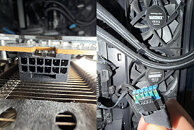
Source:
r/AMD Subreddit
The issue appears to arise from powering the GPU with a regular PSU that lacks a native 12V-2x6 output. Instead, the GPU was connected using a 3x8-pin adaptor rather than directly to an ATX 3.1 PSU. These adaptors have been known to cause melted connectors. This problem was first observed in August, highlighting a recurring theme for new builders: to prevent this situation, avoid using last-generation PSUs and opt for an ATX 3.1 PSU design whenever possible to eliminate the need for adaptors. As more companies adopt the 12V-2x6 power source for their GPU designs, gamers might consider investing in ATX 3.1 PSUs to ensure their systems can power future generations of GPUs.

109 Comments on 12V-2×6 Power Connector Burns on Sapphire Radeon RX 9070 XT GPU
And I'm not the one using that news as ammo against AMD at every chance to be a shield for the brand who designed the connector, but like I said I'm not surprised at the bias and double standards. If people still choose to bash one side while being dismissive of a dangerous power connector than nothing will shake your trust, definitely for those who decided to hand over money for such a flawed power connector.
Greetings from a former multi-GPU enthusiast,
Fred.
That "statement" meant nothing, it walked nothing back nor did it commit to anything.
Anyone still claiming it isn't an issue or that it's failure rate is equal to or lower than 8-pin is in complete denial.
None of these connectors have load balancing, the spec doesn't call for it. Heck it likely makes it impossible given even the Astral doesn't have it.Sapphire iwas thinking it could get away with it. At the end of the day it's just an extra pitfall now even AMD users have to worry about. I'd avoid any card that have the connector like a plague. Your build looking 1% prettier ain't worth the hassle.Do you know how PCI-SIG works?
It's a body of industry players wherein the companies themselves sponsor and then write standards the body produces. The only part that is handled by non-sponsors is the interoperability.
In the case of 12VHPWR and 12V2X6, the sponsors were Nvidia and Dell with Nvidia taking the lead on writing the standard.
This has got to be the 18th time I've pointed this out, even JohnnyGuru himself points out the sponsors: jongerow.com/12VHPWR/
PCI-SIG made a statement years ago pointing out that was / is Nvidia's fault: arstechnica.com/gadgets/2022/12/pci-standards-group-deflects-assigns-blame-for-melting-gpu-power-connectors/
And an wiki article pointing out that it was introduced by Nvidia: en.wikipedia.org/wiki/12VHPWR
Your "source" is nothing more than a random on the internet spreading misinformation. People really should know better than to use such a source.
Anyway, why bring this up under a totally unrelated article? Isn't it enough to discuss this where it should be?
This 12-pin connector has to go, that much is certain.
"they said it's stable, so it is!", do you believe in Santa Claus too? And I'm still waiting for "le big evil" power connector to burn my house down. 2 generations and 3 years with the same cable, I don't even have a little toast to show for it. so, in the midst of all the doomposting, why not bring up something tangible.
Excuse me for not trusting a word AMD says, even if I genuinely believe this is going to be a net positive in the future.
It was meant for those who thought that Battlefield 45923675 or CoD 359735 won't run on their 6700 XTs. Well guess what, it will.No, I believe my eyes. I never had any issue with any driver for RDNA 2, and I don't have a reason to believe that it'll change in the future.
You still haven't answered my question. Why talk about this here? There are more appropriate places to vent your unhinged hatred towards anything bearing the colour red, you know.
Nvidia designed/overspecified this safety margins lacking ATX12VHPWR/12V-2x6 mess.
With contact pins being significantly smaller their real current carrying capacity is below pins of 6/8 pin PCIe connectors, not higher.
Further tighter spacing of pins and hence heat being more focused would need some derating.
And with far more separate pins on connector without load balancing overcurrent becomes fast far higher compared to real current carrying capacity of pin.
As result it doesn't have real tolerance for things going wrong without approaching melting/burning risk.Your leatherjacket Messiah won't ever admit numbers.
And graphics card makers/brands again don't want to make themselves look worser than others by admitting anything.
600W is too much for these tiny contact pins and their tight spacing to have proper safety margins.
Even with proper load balancing in specification proper safety margins should be there.
Now it's like Chinese Tofu construction.
I'll never have it in my PC if I can help it, but I built a PC for a colleague once, using this new connector. Its pins are ridiculously tiny.
I don't understand the obsession with needing the latest driver every month, then again I don't buy the latest AAA un-optimized crapfest that probably needs up to date drivers.
But as I said people keep being dismissive and defending their favorite company with the "it doesn't melt for me so the connector is perfect" while doubling down on making sure everyone knows how much they hate the other brand.
my 2080 doesnt need new drivers for years now (nor my games), yet virtually every year there were drivers that improved/fixed things in one form or another,
not just limited to games.
i dont update to any (new) driver, unless release notes show i should.
ignoring that there is more than one game that was "optimized", that still got driver "updates", as not everything show every time you run the game, or to everyone testing it,
or that many games will get changes/updates/fixes, that might even require a driver update, to work.
not everything update wise is always about un-optimized AA.
and dont say anything about me defending anyone, company wise.
If you don't update your drivers without good reason yourself, then you know.
But again, this isn't the thread. Please, back to the connector.
My guess with 12VHPwr was to use more active monitoring and load balancing so the cable could be less overengineered (or "just enough engineered"), but most implementations avoided that.
4K, RTX, etc. would be mere thoughts.Tired old argument at this point but, not really wrong.Pretty much, yup.
PCIe 6-pin is electrically-equivalent in current-carrying ability to a 'P4' 4-pin +12V CPU Power connection (2x+12V 2xGND)
The P4 and EPS 8-pin are rated 8A/pin, 150W-192W. The 4+4/8-pin EPS is 235W-384W.
Given what we've seen 'pushed' on the 2x6, there's an insane amount of overhead left in Old-ATXspec PCIe 6-pin.
TBQH, I feel like the easiest and cheapest fix for this entire debacle, is revising the OG 6-pin to be "half a 2x6".
-No more sense pins (or, add them externally, like +12V-2x6; to maintain Gen1-6pin compatibility)
-6-pin gets 3x8.333A (300W) nominal current rating. 1:1 +12V:GND pinning.
-6+2/8-pin gets retired or reserved for the +1 'halo tier' AIB cards, as 2 extra ground pins may improve voltage stability when exceeding rating.
-Standardize the same high-temp conductors as +12VHPWR/+12V-2x6
Stack 2 of these 'ATX 3.2 +12V2x3' receptacles on a card ala GTX 680, and just about every issue is solved.
Even, in the odd case that someone plugs an ancient PSU w/ only PCI-E 6-pins in, most PSUs already were built 3x+12V and 3xGND on the 6-pins.
In the even-rarer case that someone 'blows something up' from using an ancient ATX 2.x PSU with an 'RTX 6090', that's 100% on the end-user.
-As-is, you can 100% follow spec, have the newest 1st-party kit, and it still burns up and the end-used is blamed :shadedshu:I'm really not exactly sure what-all happened.
IIRC, The rumor was that the extra pin-block on the +12V-2x6connector was for active current monitoring, just like the XBOX 360's power brick's monitored and maintained stabile voltage.
Turns out, it's just a passive 'hi-lo' pull-to-ground that indicates to the GPU/PSU whether there's a 450W limit or 600W (which, seems to do/mean jack-diddly-squat, anyway.)
The 9070xt, using pessimistic 9070xt sales numbers from Steam, that would be a 0.0014% failure rate. Oh no, the horror!
That's nothing. RMA rate for any given GPU is usually between 1-2% for good cards, upwards of 5% for cheap cards from cheap brands.
Same with nvidia. "hundreds". Uh huh. nvidia sells MILLIONS of geforce GPUs per year. Even a few thousand burnt cards would be a rounding error.So there is no factual evidence for any of these claims, just pure speculation.
As I linked earlier, the 8 pin can also melt. Not just on nVidia cards either.this is just wrong, in so many ways. If GPU manufacturers started using the 300w capability of 8 pins, you'd be crying about melted 8 pins instead. there are plenty of GPUs that need more power then an 8 pin can provide.
Having a greater than 100% safety margin is great to prevent user error from damaging hardware, but it is also wasteful of space and material.PCI-SIG ratified the design. AMD is a member of PCI-SIG.So in a failure state, the connector fails?
Well color me shocked!
The 8 pin would fail under the same conditions. All multi pin connectors need a design that balances the load being drawn. for some reason some manufacturers assume they could get away with not doing so with the 12v2, and are now failing in small numbers.Unless you have actual hard numbers, claiming anyone else is in denial is hilarious irony.Oh my goodness, does nobody read
the connector NEVER DOES THE LOAD BALANCING. That is the job of the device receiving power!!!!
the 8 pin didnt do load balancing either. The cards did. How do you think those 3x8 pin cards functioned?You are mad. And "worser" isnt a word.
I'm curious, do you thin that Jensen made the 6800xt? How about the 5800x3d? Should probably check the sig of someone before accusing them of worshiping Jensen....
600w is not too much, when balanced correctly. USB C is now pushing 240w over 4 pins, all WAY smaller then what is being used here, and you dont hear about those melting. Of course, the standard mandates proper load balancing and handshakes, so perhaps PCI SIG eeds to get more invasive and mandate more circuitry in the space.Problem with going 24v, or any other voltage, is that you break all backwards compatibility with everything. GPUs, motherboards, Blu ray drives, fans, the list goes on.
To do so, you have to get the whole industry on board and convince them to move in lockstep to the new standard. Intel couldnt do that in their heyday with BTX.
It's not that easy. You need to upgrade the backend bus architecture to the same voltage. Or you need to iclude an expensive VRM system to convert voltage back and forth, which takes up a lot of space and makes a lot of heat.
If it were that easy, we'd have made GPUs 24v ages ago, back in the Thermi days.
The point is the connector shouldn't be failing in the way it is, and this "but the sales numbers bro" nonsense is probably a reason why no one cares enough to make a better power connector when marketing and sales managers tell the engineers no, and why make it better when you can just hide the real issue with telling people they're plugging it wrong and they should buy a new PSU every time they buy a new GPU.Have any hard evidence on how many 8 pin connectors fail then? Or do you just want to a defend mega corporation for a shitty design?This makes no sense at all, and the 8 pin connector is so overbuilt it wouldn't melt because the pins are thicker, it doesn't take an EE degree to figure out thicker metal pins and wires equals more durable.
And no that's not how a safety margin works, having a safety margin means the connector is built better than it needs to be in an amount over the rated specs, not just functioning to the bare minimum of the spec. It's like expecting seatbelts alone to protect you when blind spot warning, auto braking, seatbelts and airbags are significantly better protection.
The wikipedia article points out how the safety margin on 12vhpwr is much lower. 1.68 for 8 pin molex, 1.14 for 12v2x6.
en.wikipedia.org/wiki/12VHPWRThe connector was sponsored, in other words paid to be approved and pushed to market by Nvidia and Dell.
I'm reposting this article that @evernessince posted above, since people still want to ignore it. PCI-SIG admits themselves that members are responsible for testing the standard themselves, it absolutely baffles me how a standards organization responsible for these standards doesn't bother to verify the sponsored connector for safety and quality vs. existing standards.
arstechnica.com/gadgets/2022/12/pci-standards-group-deflects-assigns-blame-for-melting-gpu-power-connectors/
AMD isn't forcing their partners to use 12v2x6, but for some reason Sapphire thought it would make their card look better, or assumed it would be fine at 350W but of course it's not.You mean in a failure state that shouldn't even be happening if the protections to prevent it from becoming unbalanced were apart of the standard, not needing to buy a $100 monitoring device to know when the connector is about to melt.
8 pin connectors didn't fail in the same way unless using a dumpster fire of a PSU, and yet reports of 12 pin connectors is happening almost every day, despite we're told the connector is better than the old 8 pin connector because it's smaller and more convenient to plug in than 2 or 3 8 pin connectors.
Mind you, that wasn't what I was saying. I was referring to the spec as a whole, not just the connector. Something I specifically pointed out in my comment. I could have worded that better but you likely would have found a reason to disagree anyways. People read, you are just being obtuse. Intentionally misinterpreting things because you refuse to admit the standard / connector is trash.You sure as heck didn't provide hard numbers for your 8-pin claim. I'm just going to point out that the evidence of constant reddit posts of melting 12VHPRW / 12V2X6 is far greater than the single instance you can muster. Reddit posts aren't the highest order of evidence for sure but their consistency and the issue's longevity lend credence to the idea that the issue is very real and impacting a far greater number of people than 8-pin melting ever has.
If you are going to call other claims out for lack of evidence, at least make sure your own are not significantly more deficient. If all you have is one example of 8-pin issues over decades of the standard being out, that just proves how reliable it is in comparison to 12VHPWR / 12V2X6. God knows why people defend this terrible standard, any increase in failure rate is bad.
GPU Tweak III may actually be better than MSI Afterburner/RivaTuner Statistics Server in this regard.