Monday, November 3rd 2025

12V-2×6 Power Connector Burns on Sapphire Radeon RX 9070 XT GPU
The story of the 12V-2x6 power connector overheating is almost as old as the original 12VHPWR connector itself, and the improved 12V-2x6 still faces issues common to the 12-pin GPU power connector family. Recently, another instance of a burning 12V-2x6 connector was reported, this time on a Sapphire Radeon RX 9070 XT GPU. A user named u/ProfessionalHost3913 shared images on the r/AMD subreddit showing his Sapphire Radeon RX 9070 XT with a burned connector end on the GPU. According to the user, the GPU was running at its default settings, with no overclocking or increased power limits, during gaming sessions of Battlefield 6, Cyberpunk 2077, Outerworlds, Minecraft, and others.
The issue appears to arise from powering the GPU with a regular PSU that lacks a native 12V-2x6 output. Instead, the GPU was connected using a 3x8-pin adaptor rather than directly to an ATX 3.1 PSU. These adaptors have been known to cause melted connectors. This problem was first observed in August, highlighting a recurring theme for new builders: to prevent this situation, avoid using last-generation PSUs and opt for an ATX 3.1 PSU design whenever possible to eliminate the need for adaptors. As more companies adopt the 12V-2x6 power source for their GPU designs, gamers might consider investing in ATX 3.1 PSUs to ensure their systems can power future generations of GPUs.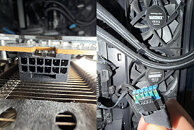
Source:
r/AMD Subreddit
The issue appears to arise from powering the GPU with a regular PSU that lacks a native 12V-2x6 output. Instead, the GPU was connected using a 3x8-pin adaptor rather than directly to an ATX 3.1 PSU. These adaptors have been known to cause melted connectors. This problem was first observed in August, highlighting a recurring theme for new builders: to prevent this situation, avoid using last-generation PSUs and opt for an ATX 3.1 PSU design whenever possible to eliminate the need for adaptors. As more companies adopt the 12V-2x6 power source for their GPU designs, gamers might consider investing in ATX 3.1 PSUs to ensure their systems can power future generations of GPUs.

109 Comments on 12V-2×6 Power Connector Burns on Sapphire Radeon RX 9070 XT GPU
Stick to 8 pin connectors, if your a GPU vendor and dont like the idea of 3+ 8pin connectors, lower the wattage of your card, simples. There is no place for 600 watt monstrosities.
Even 300 watts is a bite my tongue purchase, we need to get GPUs back down to 200w and below.
Also didn't AMD make a tweet making fun at Nvidia for this connector?
Reminds me of the time iPhone removed the charger in the box then Samsung made fun of it on twitter... just to do the same thing.
You figure, they would be using a AMP connector (Ones they use for powering golf carts or hot line connectors on Tractor Trailers) to power a GPU. They have 45Amp and 175Amp rating connectors which utilize two wires to carry the load which would suffice for a GPU. Just use the fine braid speaker wires and it will flex as needed in a computer. All a guy needs to do is solder the wire into the PSU. I routinely do that to properly supply current to high current hard drives (15Krpm). Did you know that a single strand of power going to those three SATA power connectors are only rated at 4 AMP? Even though the power supply can supply 35-80 AMPS (depending on rating of PSU) you often are completely unable to deliver that power because of the thing gauges of wire utilized to deliver the power.
It is a simple problem to solve, but then they won't be able to make money on planned obsolescence.
I mean my CPU draws 100+ amps... from the VRM. And if it's from the cable itself, if it's only for milliseconds at most and spaced apart well enough, it may not heat up the wiring to the point of catastrophic failure.
Video about it? Here you go!
HardwareDealz (de)
With a friendly smile,
Fred.
Also now that I've seen this, this explains why my video card doesn't take up a lot of power from the slot itself.