Tuesday, December 23rd 2025

AMD "Zen 6" SKUs with 3D V-Cache Could Pack Up to 288 MB of Cache
AMD's upcoming "Zen 6" client processors are expected to continue the trend of offering optional SKUs with 3D V-Cache, similar to their predecessors. However, these new processors might feature significantly larger cache capacities compared to the current "Zen 5" SKUs in the "Granite Ridge" family. According to HXL on X, the single-CCD version will include 144 MB of 3D V-Cache, while the dual-CCD configuration will have 288 MB of cache. This suggests that AMD will maintain its familiar CPU design with a client I/O die and two separate CCDs, each benefiting from increased cache capacity.
This approach is quite similar to Intel's upcoming "Nova Lake" processors, which are also set to receive a substantial boost in cache capacity through the big Last Level Cache (bLLC). Rumors suggest that these will offer 144 MB for SKUs with a single compute die and 288 MB for those with two compute dies. Intel already employs bLLC in its "Clearwater Forest" server processors as a passive interposer, integrating local cache beneath active tiles. Including this technology in standard gaming chips could significantly enhance performance, positioning them as strong competitors against the upcoming "Zen 6" processor family.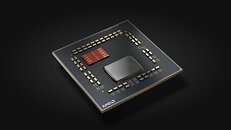 For "Zen 6," AMD plans to place the CPU CCD on TSMC's N2P 2 nm node variant and build the cIOD on the N3P 3 nm node. Additionally, the increased cache capacity will be complemented by advanced x86-64 instruction extensions like AVX512_BMM, AVX512_FP16, AVX_NE_CONVERT, AVX_IFMA, and AVX_VNNI_INT8, among others. This is particularly noteworthy because 16-bit AVX-512 calculations will now be possible on consumer-oriented desktop CPUs, providing an extra performance boost with a fast memory pool nearby.
Source:
HXL on X
This approach is quite similar to Intel's upcoming "Nova Lake" processors, which are also set to receive a substantial boost in cache capacity through the big Last Level Cache (bLLC). Rumors suggest that these will offer 144 MB for SKUs with a single compute die and 288 MB for those with two compute dies. Intel already employs bLLC in its "Clearwater Forest" server processors as a passive interposer, integrating local cache beneath active tiles. Including this technology in standard gaming chips could significantly enhance performance, positioning them as strong competitors against the upcoming "Zen 6" processor family.

77 Comments on AMD "Zen 6" SKUs with 3D V-Cache Could Pack Up to 288 MB of Cache
Other than that the thing most responsible for high idle power is motherboards overspeccing on the VRMs.
This will be a first gen intel cache solution vs Gen 3 by the time the Zen 6 version is out.
And with them having equal sizes the next battle will be who has the lowest latency cache.agree the 12 core single CCD part should have 144mb of cache.
By the way (AI reply)
Now we're gonna go 3 for 3.
More is better but there is just a select number of process task that benefit from large caches
L3 Hit Rate
Instructions Retired/Active Thread
L3 Hit Rate
Instructions Retired/Active Thread
The "Instructions retired/active thread" metric is similar to IPC; the higher the number, the more instructions were run to completion. They focused a little more on CoD because of its low IPC and found the biggest bottleneck was still the front end (which is basically instruction fetching, decoding, and branch prediction/speculation), which L3 cache doesn't necessarily help here.
In any case, considering that tripling the amount of L3 cache only really brought about maybe 15% on-average instruction throughput improvement, then I'd imagine tripling it again would do the same at best, if anything at all. Which honestly, I don't find sustainable in the long run.
For the record, I think there was a line of Epyc x3d cpus, and again, they were for specific use cases, and didn't do much for many tasks.
www.techpowerup.com/review/amd-ryzen-9-9950x3d/28.html
I’m surprised that the .NET 10 runtime already supports AVX10.2 given how long the team dragged out implementing AVX-512 intrinsics support.
The goal should always be make correct software first. You can add performance later.
Couldn't Agree More!
In my case, my stacks don’t give me the choice to use or avoid new CPU features. Either Oracle/Microsoft blesses the new LTS JVM/.NET runtimes with support and the existing application code gains the performance boost, or not. There is no choice in this matter for me.Is this your way of saying that the software will never be correct and the time to add performance will always be in the distant horizon. 😛