Wednesday, December 31st 2025

RTX 5090 With 1350 W OC Saved From Melted Connector by ASRock PSU
Reports of melting 12VHPWR and 12V-2x6 connectors on NVIDIA GPUs—as well as a handful of examples from AMD—have become so common that hardware vendors have started building in safeguards against the issue. One such safeguard is a thermal sensor found on some ASRock power supplies, like the Phantom Gaming PG-1300G, which happened to recently save a user the expense and heartbreak of losing a heavily overclocked NVIDIA GeForce RTX 5090.
The incident was reported by user motivman on the Overclock.net forums, and according to the account, the MSI Ventus NVIDIA GeForce RTX 5090 GPU was overclocked to a whopping 1350 W, which is well over the stock 575 W TDP—although it's not uncommon to exceed rated TDPs during boost scenarios anyway—and it had just completed a benchmark run in 3DMark Port Royal when the PSU triggered a shutdown. The PC would not restart until the cable had cooled down, which is a decent showing for the PSU's safety feature—at least mostly.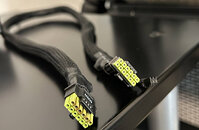
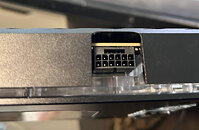
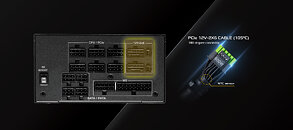 While the PSU and GPU were seemingly saved, the user explains further down in the post thread that the connector on the GPU side was still discolored after the near-meltdown, leading to speculation that ASRock may need to adjust the thermal shutdown threshold to better protect the hardware. They also note that benchmark scores seem to be noticeably lower after the thermal event, with the card no longer able to reach the same 47,800+ Port Royal scores as before.
Source:
Overclockers.net
The incident was reported by user motivman on the Overclock.net forums, and according to the account, the MSI Ventus NVIDIA GeForce RTX 5090 GPU was overclocked to a whopping 1350 W, which is well over the stock 575 W TDP—although it's not uncommon to exceed rated TDPs during boost scenarios anyway—and it had just completed a benchmark run in 3DMark Port Royal when the PSU triggered a shutdown. The PC would not restart until the cable had cooled down, which is a decent showing for the PSU's safety feature—at least mostly.


25 Comments on RTX 5090 With 1350 W OC Saved From Melted Connector by ASRock PSU
Looking forward to seeing this on a test bench.
If you take everything at face value:
575w TDP
600w Rated cable
Pushes 1350w starts to melt.
No shit bro? Golf clap?
I guess this thread should be speaking more to how the ASUS psu saved him. I am hoping he wasn’t any kind of shocked or worse looking for any kind of RMA like a scumbag.
But that wasn’t insinuated so I guess, cool glad the PSU did what it was supposed to?
Also interesting
The fact that the PSU did it's job (mostly) is the important part of this story. I say mostly because it didn't turn off in time to keep from discoloring the cable connector and pins on the GPU side. Wouldn't matter if you are pulling 500w or 1300w, if it decided to overheat this is what you'll get even with this PSU. The shutdown temp needs to be lower.
You OC it to 1350W power draw and be surprised when it begins said melting process.
With a friendly smile,
Fred.
Despite the fact that it is clearly not completely refined yet and in this particular case limits were crossed to extremes, it is a nice development.
I see it as a welcome addition to the other (partial) aftermarket solutions which were engineered already.
Still I think proper load balancing on the power lines of such power hungry (and expensive) graphic cards should almost be mandatory to start with.
Edit:
some extra context: www.notebookcheck.net/ASRock-s-new-L-shaped-PCIe-12V-2x6-cable-with-an-NTC-sensor-aims-to-eliminate-melting.1096165.0.html
This morning, I booted up my PC and it went straight to my desktop! Should I send the Swede a PM to get a TPU headline now?Possibly has potential... to not prevent the melting issue because that cable still looks like shit.
This is about as empty a shell as ... well, an empty shell
That PSU didn't save jack shit. It almost did its job right, and somehow this is news :D
Its just clickbait because it involves a melted 12v6
All these out of spec 'solutions' to somehow make this cable not a safety hazard are really doing it wrong - its supposed to give companies a unique selling point. Nobody is really fixing anything, because they're all dancing around the core issues and they all involve cable and GPU itself. The PSU can never fix this problem.
What we really need is a revised spec with much greater tolerances on the cable and possibly levels of wattage enforcing certain load regulation on the receiving side. This is all on Nvidia really, seeing as its the only company releasing >350W cards now that edge towards the danger zone. But even AMD will benefit on their current crop as we've already seen a few failures there too on 12v6.
It's kind of telling that even the PSU vendors know that the physical connector on the GPU is the exact spot that goes wrong every time; It's almost as if the design is f***ing stupid and everyone except Nvidia knows it....
And for the PSU they can all was make a new 12v6 cord for the GPU. Like instead of 16 gadge wires they can change them for 8 gadge or 10 gadge wires. Would be bulky. But they would give off no hear at all since the wattage would be going over a thick line so the cord it self and the connector on the wire it self would be rated for way more wattage.
Then it would be upto the GPU side. If they can't handle the wattage haha
I think this is a band-aid and someone needs to eat the crow and unfix this.
Well, you don't have to wonder. You can easily calculate it from whichever wire-gauge standard you want to use because they all largely agree on similar values.
8-pin 150W connectors are supposed to draw up to 4.2A per wire from connectors/cables rated at 13A (that rating includes an undisclosed safety margin already) and even if there's a worst-case failure and all the current is being pulled from a single wire pair rather than the three wire pairs, that's still only 12.5A on a 13A connector.
12V6X2 600W connectors are supposed to draw up to 8.3A per wire from connectors rated at 9.5A (with an obviously-smaller safety margin given their cross-sectional area and packing density) but that means that not even a single wire pair can fail before the whole system exceeds the rating, and there are twice as many wire pairs in the connector so a worst-case failure is 50A being carried by a single wire pair that is smaller and more tightly packed.
Safety margin? LOL nope. The safety margin is courtesy of your local fire department and RMA process. If Intel/Nvidia just downgraded the 12V6X2's connector's rating to a 300W connector, I suspect there would be a dramatic drop in the number of people making forum posts, tweets, youtube videos, and news articles on this week's selection of melted connectors. It would be powerful enough to supply an RTX 5080 and no consumer can afford to run a 5090 anyway (I hear they're $5000+ now!)
Its all really very simple, this connector is a subpar consumer solution to increase margins over our backs. It amazes me to this day that people actually pay money for this utter piece of shit. But they are part of the reason we're still looking at it and they should feel guilty. What we really should have done is collectively say FU, we simply do not accept such a major reduction in safety tolerances on power delivery. Right now, our only avenue is gov regulation. Maybe the EU can step in on this.