Tuesday, January 6th 2026
Broadcom Launches Unified Wi-Fi 8 Platform for Seamless AI Experiences in Homes
Broadcom Inc., a global leader in semiconductor and infrastructure software solutions, today announced the launch of its next-generation BCM4918 accelerated processing unit (APU) and two new dual-band Wi-Fi 8 devices, the BCM6714 and BCM6719, marking another milestone in its long legacy of Wi-Fi innovation. With the combination of higher throughput plus smart intelligence, Broadcom's unified Wi-Fi 8 platform allows operators to deliver new real-time agentic applications for residential consumers with built-in security and improved power efficiency.
Building on its first-to-market BCM6718 Wi-Fi 8 chipset, Broadcom continues to lead the industry in defining the next generation of wireless performance, intelligence, and efficiency. The new platform combines compute acceleration, advanced networking, and robust security, delivering the high throughput, low latency, and intelligent optimization needed for the emerging AI-driven connected ecosystem.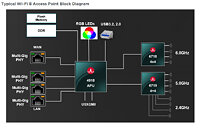
 "Wi-Fi 8 represents a turning point for the industry—where broadband, connectivity, compute, and intelligence truly converge," said Mark Gonikberg, senior vice president and general manager of Broadcom's Wireless and Broadband Communications Division. "Our new BCM4918 APU, along with our full portfolio of Wi-Fi 8 chipsets, form the foundation of an AI-ready platform that not only enables immersive, intelligent user experiences but also does so with efficiency, security, and sustainability at its core."
BCM4918 Wi-Fi 8 APU—Accelerator for the AI Edge
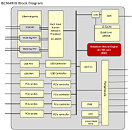
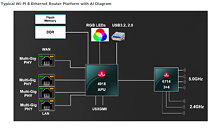
At the heart of Broadcom's new platform is the BCM4918 Wi-Fi 8 APU, a next-generation system-on-chip designed to unify high-performance computing, networking, and AI acceleration in a single, tightly integrated silicon.
Key features include:
BCM6714 and BCM6719—Integrated Dual-Band Wi-Fi 8 Radios
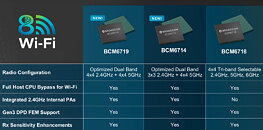
Complementing the BCM4918 APU are two new dual-band Wi-Fi 8 devices, the BCM6714 (three spatial stream 2.4 GHz radio + four spatial stream 5 GHz radio) and the BCM6719 (four spatial stream 2.4 GHz radio + four spatial stream 5 GHz radio). Each combines 2.4 GHz and 5 GHz operation into a single silicon, representing the world's most highly integrated Wi-Fi 8 radio solutions.
Highlights include:
The unified platform supercharges innovations, such as Seamless Roaming, Congestion Avoidance, and Inter-AP Coordination to life with secure Edge AI processing to deliver real-time telemetry that will deliver intelligent, reliable, and high-efficiency connectivity across every environment.
By combining the previously announced BCM6718 Wi-Fi 8 radio with Broadcom's new BCM6714 and BCM6719 dual-band devices, OEMs and service providers can build a tri-band Wi-Fi 8 platform that delivers unmatched integration, adaptability, and intelligence.
When paired with the BCM4918 APU, this platform establishes a unified compute-and-connectivity architecture that enables edge-AI processing, real-time optimization, and adaptive intelligence across all frequency bands.
This next-generation platform delivers:
Samples of the BCM4918 APU and the two new dual-band Wi-Fi 8 devices, the BCM6714 and BCM6719, are available to early access customers and partners.
Source:
Broadcom
Building on its first-to-market BCM6718 Wi-Fi 8 chipset, Broadcom continues to lead the industry in defining the next generation of wireless performance, intelligence, and efficiency. The new platform combines compute acceleration, advanced networking, and robust security, delivering the high throughput, low latency, and intelligent optimization needed for the emerging AI-driven connected ecosystem.


BCM4918 Wi-Fi 8 APU—Accelerator for the AI Edge
At the heart of Broadcom's new platform is the BCM4918 Wi-Fi 8 APU, a next-generation system-on-chip designed to unify high-performance computing, networking, and AI acceleration in a single, tightly integrated silicon.
Key features include:
- High-performance CPU complex for general-purpose software workloads.
- Integrated Broadcom Neural Engine (BNE) for on-device AI/ML inference and acceleration.
- Advanced networking engines to offload both wired and wireless data paths, enabling complete CPU bypass of all networking traffic.
- Integrated cryptographic protocol acceleration end-to-end data protection without performance compromise.
- Multi-gigabit Ethernet interfaces for seamless integration in high-throughput applications.
BCM6714 and BCM6719—Integrated Dual-Band Wi-Fi 8 Radios
Complementing the BCM4918 APU are two new dual-band Wi-Fi 8 devices, the BCM6714 (three spatial stream 2.4 GHz radio + four spatial stream 5 GHz radio) and the BCM6719 (four spatial stream 2.4 GHz radio + four spatial stream 5 GHz radio). Each combines 2.4 GHz and 5 GHz operation into a single silicon, representing the world's most highly integrated Wi-Fi 8 radio solutions.
Highlights include:
- Integrated multi-chain 2.4 GHz and 5 GHz functionality, simplifying system design and lowering cost.
- On-chip 2.4 GHz power amplifiers (PAs) for reduced external components and improved RF efficiency.
- Hardware-assisted telemetry engine, powering the capability introduced in the BCM6718, providing real-time network insights and analytics as input to edge-AI models for Quality of Experience (QoE) measurement, enhanced security, and reduced operational cost.
- Advanced eco-modes and power optimization for ultra-low energy consumption.
- Third-generation digital pre-distortion that reduces peak power by 25%.
The unified platform supercharges innovations, such as Seamless Roaming, Congestion Avoidance, and Inter-AP Coordination to life with secure Edge AI processing to deliver real-time telemetry that will deliver intelligent, reliable, and high-efficiency connectivity across every environment.
By combining the previously announced BCM6718 Wi-Fi 8 radio with Broadcom's new BCM6714 and BCM6719 dual-band devices, OEMs and service providers can build a tri-band Wi-Fi 8 platform that delivers unmatched integration, adaptability, and intelligence.
When paired with the BCM4918 APU, this platform establishes a unified compute-and-connectivity architecture that enables edge-AI processing, real-time optimization, and adaptive intelligence across all frequency bands.
This next-generation platform delivers:
- Tri-band Wi-Fi 8 connectivity with coordinated performance across 2.4, 5, and 6 GHz bands.
- AI-driven QoE measurement and optimization at the edge.
- Predictive maintenance and self-healing network behaviors
- Intelligent power and bandwidth management, delivering energy efficiency and ensuring green compliance with emerging sustainability standards
Samples of the BCM4918 APU and the two new dual-band Wi-Fi 8 devices, the BCM6714 and BCM6719, are available to early access customers and partners.
5 Comments on Broadcom Launches Unified Wi-Fi 8 Platform for Seamless AI Experiences in Homes
Even if you may not care now, you probably will several years later, when support ends and they will refuse to patch zero day backdoor in a firmware.
It shouldn't really require any major changes from a certification standpoint, since there are no new frequencies.Try some Pepto-Bismol?Or you know, you buy a router that is supported by the router manufacturer and it's not really an issue.
That said, the only Broadcom partner that seems to bother to support its routers, appear to be Asus. Add a touch of Merlin firmware to the mix and you're good.
I don't condone what Broadcom is doing, but a lot of people wouldn't even have the first clue when it comes to installing OpenWRT or DD-WRT on their router, even less when it comes to using either OS, as they don't even update the firmware on the router they own today.