Friday, January 16th 2026

"Core 7 253PE" CPU Gets PassMarked, 10 P-Core "Bartlett Lake-S" Model Nearing Launch?
Intel's "Bartlett Lake-S" (Performance) P-Core-only processor design has made a surprise appearance, after a long period of developmental silence. Earlier, today X86 is dead&back put a spotlight on the intriguing entry of Team Blue's unreleased "Core 7 253PE" SKU within PassMark's CPU benchmark database. The keen watcher of not-yet-released PC hardware believes that this particular unit is possibly the first sample of Team Blue's 10-core "Bartlett Lake-S" variant to appear in the wild. This further refinement of 14th Gen "Raptor Lake Refresh" tech popped up a few times last year, but the TechPowerUp news archive shows a dry period during third and fourth quarters. An August report alluded to an embedded market target, the existence of a flagship 12 P-core model, and a potential launch under the "Intel Core Series 2" banner—minus an Ultra tag, due to lack of onboard NPUs.
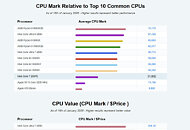
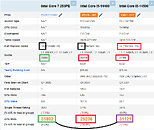
All P-Core configurations could appeal to budget-conscious PC gamers. Efficiency-oriented (E and LPE) units are considered superfluous for these purposes. X86 is dead&back was pleased to find PassMark data that signalled improved multicore performance over the related Core i5 14400 "Raptor Lake-R" processor. They exclaimed: "Core 7 253PE (has) more MT performance than Core i5 14400 (6P + 4E)!" Their comparison shows a 20.6% uplift here, but a slight regression in terms of single-core scores (-2.73%). The sole "Core 7 253PE" sample's PassMark multi-thread rating, of 31802, closes in on the 14-core (6P + 8E) Core i5-14500 model's tally (31121). According yesterday's PassMark diagnostic, the newer chip utilizes Intel's UHD Graphics 770 integrated solution (akin to Core i5-14500), whilst the Core i5 14400 makes do with the UHD 730 iGPU. There are apparent differences across the various levels of cache, but the "Core 7 253PE" SKU seems to enjoy a larger overall pool—36 MB—when cross-examined with its older relatives.

Sources:
x86deadandback Tweet, PassMark CPU Benchmark, Wccftech
All P-Core configurations could appeal to budget-conscious PC gamers. Efficiency-oriented (E and LPE) units are considered superfluous for these purposes. X86 is dead&back was pleased to find PassMark data that signalled improved multicore performance over the related Core i5 14400 "Raptor Lake-R" processor. They exclaimed: "Core 7 253PE (has) more MT performance than Core i5 14400 (6P + 4E)!" Their comparison shows a 20.6% uplift here, but a slight regression in terms of single-core scores (-2.73%). The sole "Core 7 253PE" sample's PassMark multi-thread rating, of 31802, closes in on the 14-core (6P + 8E) Core i5-14500 model's tally (31121). According yesterday's PassMark diagnostic, the newer chip utilizes Intel's UHD Graphics 770 integrated solution (akin to Core i5-14500), whilst the Core i5 14400 makes do with the UHD 730 iGPU. There are apparent differences across the various levels of cache, but the "Core 7 253PE" SKU seems to enjoy a larger overall pool—36 MB—when cross-examined with its older relatives.


24 Comments on "Core 7 253PE" CPU Gets PassMarked, 10 P-Core "Bartlett Lake-S" Model Nearing Launch?
Those can come in handy nowadays.
Strange times...
• Intel Core 9 processor 273PE (36M Cache, up to 5.70 GHz)
• Intel Core 9 processor 273PTE (36M Cache, up to 5.50 GHz)
source: https://www.mouser.in/
Well, now we know. A 10 P cores only Intel, equals to a 14 cores(6P +8E) Intel Hybrid in Passmark. In reality having a 12P cores CPU makes the platform much more future proof, than topping out at 8P cores, no matter the benchmark scores.
Will have no problem to side grade if I can get better pref on a more refined process and no potential degradation.
Maybe the temp can be more easily under control on such configuration.
the non-Ultra 200 series, same like non-K 13th and 14th generation Core chips, the so-called Raptor Lake, are not based on the Raptor Cove architecture, but are rebranded 12th generation Alder Lake chips on the Golden Cove architecture with additional e-cores. You can check by the L2/P-core and L2/4 e-core cache):
actual 13th/14th gen (Raptor Cove core) have 2MB/P + 4MB/4e
while 12th gen, non-K 13th and 14th generation Core and non-Ultra 200 series (Golden Cove) have 1.25MB/P + 2MB/4e
According to PassMark, if Barlett Lake were released instead of RPL, it would have been trashed by Zen 4. A 10-core Barlett would have been soundly beaten by an 8-core Zen 4. It would still use more power while being generally slower. Those CPUs wouldn't have been able to sell without a hefty discount.
Also, no CPU can be futureproof, future-resistant at best.
They may not be compatible with all LGA1700 motherboards.And why would you want them? The rest of them are 35-65W TDP, and are not consumer products.
But gaming is supposedly too small of a market too care. But if it is why would they not want to release if it it smokes Arrow Lake in gaming if gaming is too small of a market anyways. Double edged sword??And some want more than 8 homogenous cores with strong IPC and good latency for gaming on a single node. No product exists and will not aside form this (if it comes out and has even partial unlocked) at least until Zen 6 and even Zen 6 we do not know if they are gonna be on one CCX within a CCD or more like Zen 2 which had to 4 core CCXs in a CCX. Could Zen 6 really have 2 6 core CCXs in a 12 core CCD which would be very disappointing!! Not sure if the case though though AI Google rumors says its one CCX but AI is often wrong though.
This Bartlett would be a dream chip if it came out and is unlocked even partially unlocked.
I tried Arrow Lake as seen in another thread and it really sucked. Back on 9800X3D.
There is no overclocking, no memory overclocking and not even boosting up to ~200-250W for a few seconds. The named "Core 7 253PE" will be fixed to a TDP of 65W, judging by the pattern of previous models. If they were to launch a 125W TDP model, it will still be locked to that TDP.
I don't see the point of pretending for this to be something that it isn't, you'll be overpaying for the CPU, struggling to find a compatible motherboard, and probably get a disappointing gaming experience. You'd be much better off buying something like a Xeon W then.
This platform is meant for "industrial use", with a 10 year platform support. If you plan to design factory machines, medical equipment, ATMs, networking equipment etc. this is the platform to choose, but not for gaming or general desktop use. It will be a very stable platform though, especially when combined with hard-to-find ECC UDIMMs, but I wouldn't be surprised if someone like LGR would build a nostalgic gaming rig out of this in a decade or so…
but buying a more expensive and inferior product to avoid the E-cores isn't smarter.
The lower ones yes many just reused Raptors and Alders. But a real die without any e-cores does not exist on consumer market except the Alder 6 + 0 die which in some is reused as Raptor.
Yes as you stated Bartlett exists with only P core dies on a ring bus and great. But not for consumer and appears will not support consumer boards. And even then it has not yet been officially released to the NEX Edge industrial though it may be any minute now.
MSI Z690 Unify X from experience by far most stable DDR5 XMP and tuning. Other boards 4 dimmers issues with OCCT Large Data set failing with WHEA or CPU core errors even Asus 2 DIMM boards. Asus was by far the worst for 13th and 14th Gen XMP DDR5 stability in my experience.
Not sure how unlocked they will be if at all or if you will be able to do 7200 XMP 2 X 24GB DDR5 full stable on them with locked SA.