Monday, February 16th 2026

Sony PS6 To Use Cut-Back RDNA 5 Architecture
It's been widely reported that the next-gen Sony PlayStation 6 is in the works, with AMD once again in charge of the APU that will power gaming experiences, even if rumors suggest that the next-gen console launch may be pushed back as far as 2029. It's also common knowledge by now that RDNA 5 will power the PS6, but a new rumor that originated from prolific leaker, KeplerL2 on the NeoGAF forum, suggest that the architecture in the PS6 will not be the full-fledged RDNA 5.
The leaker does not expand on this further, other than to remind that the PS5 doesn't use the full RDNA 2 architecture either, but consoles have always used custom APUs, so the idea that the PS6 won't use the full RDNA 5 feature stack isn't unreasonable. Some have postulated that one feature that wouldn't make the cut is the NPU, since that may not get used in a modern console. It's also possible that certain productivity features or video encoders, although even a lot of the AI improvements in RDNA 4 have been marketed as gaming upgrades.
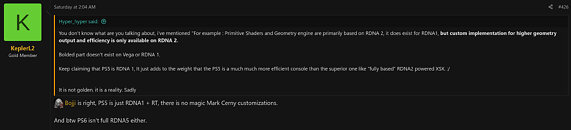
Source:
KeplerL2 on NeoGAF forum
The leaker does not expand on this further, other than to remind that the PS5 doesn't use the full RDNA 2 architecture either, but consoles have always used custom APUs, so the idea that the PS6 won't use the full RDNA 5 feature stack isn't unreasonable. Some have postulated that one feature that wouldn't make the cut is the NPU, since that may not get used in a modern console. It's also possible that certain productivity features or video encoders, although even a lot of the AI improvements in RDNA 4 have been marketed as gaming upgrades.


36 Comments on Sony PS6 To Use Cut-Back RDNA 5 Architecture
Eew.
PS5 base also has a cut down version of both Zen2(no AVX) and RDNA2(also missing some instructions).
It's not unreasonable PS6 would use only parts of the current architecture. Though I suspect they'll keep the NPU.
it's understandable that there is a lead time on an soc before the product but making prediction at this time is even hard for amd and sony
PS5 despite it's supposedly dated hardware is very decent today even when compared to average machine on Steam.
I dont think any game can claim that PS5 is weak or inadequate for it.
Unlike Xbox Series S that is genuinely weak or even the new Switch 2 that cuts corners everywhere.
And given so many games cannot maintain 30 FPS on PS5 without frame dips or upscaling, yeas, I think we can claim it is weak and inadequate.
That's pathetic, actually.
I've literally not seen a common sentiment that PS5 is somehow weak or inadequate.
Frankly i dont see the need for PS6 before 2030 anyway.I see most games maintaining 30fps easily and many games going for 60fps instead. 30fps is actually becoming less common.
Sop much so that some developers now get flak for releasing 30fps games. Especially if the game is not graphically demanding.
Game that cant maintain 30fps on PS5 is just badly made. It's not the fault of the hardware.
I could bring an analogue on PC with UE5. Even people with 5090's cant get smooth performance i every UE5 game.
Does that mean a 5090 is weak or is it the fault of the game engine? Obviously it's not the hardware fault.
People also seem to forget consoles have to be priced reasonably, you can't build a PC faster than a PS5 pro for the same price.
I don't really see a need for a PS6 so soon, not until ram prices return to normal.
Game devs need to better optimize for the hardware instead of launching unfinished titles barely hitting 30 fps. Plenty of games looked good 10 years ago, there's no reason devs can't do that with more powerful hardware now, but laziness with inefficient game engines, and cutting costs are the focus over quality.
XB was RDNA 2.
www.pcgamer.com/ps5-die-shots-reveal-missing-zen-2-rdna-2-features/
It performs similar to the 6700, in fact, even lower on average, so it performs like the 3060.
If you add the fact that the PS5 always uses the upscaler, a 3060 blows it away, and it doesn't even have any VRAM issues.
I discovered a few days ago lightning returns is completely stutter free on an Xbox Series S, yet on PC it needs a 9800 X3D and even then it has some occasional micro stutters. Put the Xbox Series S CPU in a PC and the game struggles in highly populated areas and zone switching.
The selling point of a console isnt really the hardware. its the overall platform, to me PS5 has been a poor generation, and PS6 they will be praying the AI bubble bursts, because the thing wont sell much at 1000USD a unit.
We should be at the point now hardware is good enough for gaming forever, the main thing driving forward demand is gimmicks like RT, and very bad game engines/optimisation.
Would you really want to compare a 9800X3D in the other 99% of cases?
With XSS often failing to even sustain 30fps?
It might be useful to highlight the typical exception that proves the rule, but nothing more.
It makes sense that Sony would cut features from the RDNA 2 GPU and CPU that have little to no benefit for the gaming performance.
gitlab.freedesktop.org/mesa/mesa/-/merge_requests/33116
elektricm.github.io/amd-bc250-docs/drivers/radv/#what-is-radv
www.phoronix.com/news/AMD-RADV-PS5-BC-250
www.phoronix.com/news/AMD-More-Cyan-Skillfish-2025