Monday, May 18th 2026

Insider Confirms Sony Ditching PC Ports: "You'll Be Seeing Fewer Single Player Games Arrive on PC."
We recently reported on news that Sony will all but stop releasing PC ports of its single-player games on PC, and while those previous reports were from Jason Schreier, a journalist previously shown to have reputable insider sources, another insider has corroborated these claims, adding additional context in the process. According to NateTheHate2 on X, Sony made the decision in 2025 to shift its release strategy, with the result of launching fewer first-party single-player games on PC. The leaker adds that this means there will be "fewer single-player games" on PC from Sony, implying both that Sony may still port single-player games to PC—only significantly fewer of them—and that this new policy may not apply to live-service and multiplayer games.
He also mentioned that there are still single-player PC ports in development at Sony, which may eventually launch, depending on how far they are in the development process, but that these ports are no longer a priority for the Japanese gaming giant. Addressing questions about the justification for the strategy shift, NateTheHate2 commented that, while there have been a few commercially successful PC ports, they haven't been a huge revenue driver for Sony. Looking at the Steam charts data for Insomniac Games, one of Sony's most notable first-party studios, the data lends credence to these comments. The best-performing PC port from the studio is Marvel's Spider-Man Remastered, which peaked at 66,436 players on Steam. Meanwhile, the next-best performer is Marvel's Spider-Man 2, which peaked at 28,189. Nixxes Software, the studio responsible for many Sony PC ports, has seen similar successes, with the likes of Ghost of Tsushima topping the charts at 77,154 peak concurrent players, ahead of the aforementioned Spider-Man Remastered, with Horizon Forbidden West and The Last of Us Part II Remastered bringing in peaks or 40,462 and 30,690 players, respectively.
Update May 18th: In a leaked internal memo seen by Jason Schreier of Bloomberg, PlayStation Studio Business CEO, Herman Hulst, apparently confirmed to staff that, starting with Ghost of Yōtei, all of the company's narrative-driven single-player games will be exclusive to PlayStation.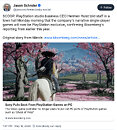
 Part of this lack of commercial success may be due the delay between console and PC launches, which would stem from Sony attempting to protect its hardware sales and ecosystem, which is the opposite of the strategy we've seen Xbox take recently, with its shift to a multi-platform approach that leans heavily on first-party game sales instead of hardware sales and exclusivity. Death Stranding 2: On the Beach is expected to launch for PC on March 19, after nine months as a PS5 exclusive, and while it is not a first-party title, it has been an exclusive for long enough that it may suffer the same fate. According to SteamDB, Death Stranding 2 is currently in 10th position on the Steam Wishlist Activity rankings and has 23,412 followers on Steam, with a lot of activity in the days leading up to the launch. This suggests that it should have a healthy PC launch, but it remains to be seen. It should also be noted that there will likely be no changes for games like Death Stranding 2, which are IPs owned and produced by external studios with close ties to PlayStation and not Sony's own IPs.

Sources:
NateTheHate2 on X, Jason Schreier on Bluesky
He also mentioned that there are still single-player PC ports in development at Sony, which may eventually launch, depending on how far they are in the development process, but that these ports are no longer a priority for the Japanese gaming giant. Addressing questions about the justification for the strategy shift, NateTheHate2 commented that, while there have been a few commercially successful PC ports, they haven't been a huge revenue driver for Sony. Looking at the Steam charts data for Insomniac Games, one of Sony's most notable first-party studios, the data lends credence to these comments. The best-performing PC port from the studio is Marvel's Spider-Man Remastered, which peaked at 66,436 players on Steam. Meanwhile, the next-best performer is Marvel's Spider-Man 2, which peaked at 28,189. Nixxes Software, the studio responsible for many Sony PC ports, has seen similar successes, with the likes of Ghost of Tsushima topping the charts at 77,154 peak concurrent players, ahead of the aforementioned Spider-Man Remastered, with Horizon Forbidden West and The Last of Us Part II Remastered bringing in peaks or 40,462 and 30,690 players, respectively.
Update May 18th: In a leaked internal memo seen by Jason Schreier of Bloomberg, PlayStation Studio Business CEO, Herman Hulst, apparently confirmed to staff that, starting with Ghost of Yōtei, all of the company's narrative-driven single-player games will be exclusive to PlayStation.


135 Comments on Insider Confirms Sony Ditching PC Ports: "You'll Be Seeing Fewer Single Player Games Arrive on PC."
There's also the option of doing what they did with Nier Automata; exclusive to PS4 and Windows, but later ported to XBOX after the console exclusivity period ended. Still technically exclusive to Sony's console, but also immediately available on Windows. Immediate sales from both major platforms.Could have fooled me; half the game sites I visit love the elitism of being able to afford a Nintendo console and play the exclusives and lording it over the rest (in their words; you can afford a 5090 but can't afford a Switch?), also citing Nintendo's significant sales even despite being exclusives. And despite all those complaints about Nintendo's refusal to go multiplatform, you also see that no one's been able to bully Nintendo to embrace multiplatform releases, the way Windows+Xbox was able to coerce Sony into doing up until Sony's recent change of heart.You're not looking far enough back then; the console wars of the PS1 and PS2 era saw plenty of exclusives limited to one console, and plenty of rivalry back then in terms of games. Back then, each console maker had to have both a large number of games to play, and a good number of high quality games enticing enough, to encourage buying a console in the first place. Great games on one console often inspired a clone or same-genre rival on another console. Sony and Nintendo and Sega competed hard and aggressively negotiated with studios for games they hoped would catch interest and draw the crowds to them.
Studios and game devs for their part also competed to make games interesting enough to get a Sony or Nintendo (or Sega, back then) deal and get their game funded enough to complete and release. They usually tried to optimized their games to showcase the console's performance as well as their own skills. Once Sony and MS started playing nice and jointly sharing games between consoles (+ PC in Xbox's later years), the competition between them gradually stagnated, and many exclusives were either forgettable, or in Sony's case, never released outside of Japan, while Nintendo carried on curating exclusives that continued to sell their hardware domestically and internationally.
Had Xbox just stuck to making great consoles, opportunistically supporting popular games, and even partnered with steam, they would have been wildly successful.
What is really happening, is Sony and MS are protecting their hardware. People are not excited to be spending so much on a console. They have literally priced millions out from being able to afford their consoles. If MS and Sony don't protect their hardware, it could cost them a lot more and force them to basically do a Sega.
This is why we are getting the fake uptick in "exclusives of any kind are good" chatter. No one wants to spend $700 to buy a few exclusive games. And then do it again. And then do it again.
And there's also the possibility of MS licensing out the XBOX brand and access to the XBOX network to certified handhelds and mini-PCs in an effort to keep up with the Steam Box and Valve's plans to also license out the Steam Box branding and certification to 3rd party mini-PCs that meet the requirements.
It'll be weird eventually seeing an XBOX Steam Edition if it comes to pass. XBOX SteamBox? Steam XBOX? ValveXBOX (prounounced ValveBox; with a silent X)?