Wednesday, April 1st 2026

ASUS Announces UGen300 USB AI Accelerator
ASUS today announced the UGen300 USB AI Accelerator—the first AI USB device from ASUS, bringing inference performance directly to any device. An M.2 version is also available. This slim AI accelerator measures 105 x 50 x 18 mm and features the Hailo-10H AI processor that delivers 40 AI TOPS of dedicated power to support large language models such as LLMs, VLMs, and more. UGen300 includes 8 GB LPDDR4 dedicated memory and connects to other devices via a USB-C interface, consuming just 2.5 watts of power under typical workloads. The convenient plug-and-play design ensures cross-platform compatibility with Windows, Linux, and Android. UGen300 also supports major AI frameworks like TensorFlow, PyTorch, and ONNX—right out of the box.
"By integrating the Hailo-10H into a ubiquitous USB device, ASUS brings the full power of AI and generative AI to everyone" said Max Glover, Chief Revenue Officer of Hailo. "We're excited to see how our developer community will use this plug-and-play accelerator to push the boundaries of on-device AI. This is exactly how Hailo envisions the future of AI: accessible, affordable, and designed for anyone to build with."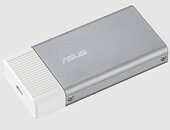

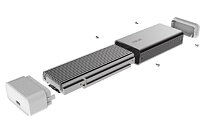 Unmatched edge Gen AI performance
The ASUS UGen300 USB AI Accelerator has a built-in Hailo-10H AI processor delivering 40 AI TOPS of dedicated performance and is optimized for generative AI workloads, including LLM inference and vision-language tasks. It supplements the host device's CPU and NPUs and provides AI acceleration to free up system resources, enabling on-device generative AI inference without dependence on cloud computing.
Compared to cloud-based AI, UGen300 users pay no monthly subscription, experience no latency, and enjoy unmatched reliability and privacy. The UGen300 can run demanding Gen AI applications such as text generation, video summarization, event triggering, voice to action, and real-time perception. Its low-power design consumes just 2.5 watts of power to enable efficient, high-performance AI at the edge.
8 GB LPDDR4 memory
ASUS UGen300 has integrated 8 GB LPDDR4 dedicated memory for stable AI computations and large model executions. It empowers host systems that lack AI capabilities to run AI tools effectively, picking up heavy AI workloads to ensure optimal system balance while maximizing efficiency and multitasking potential. Unlike typical NPUs that share system memory, the dedicated RAM architecture of UGen300 prevents bottlenecks and ensures consistent throughput for developers and professionals running complex AI pipelines.
Plug-and-play convenience
The USB 3.1 Gen 2 Type-C interface offers plug-and-play convenience to provide a truly platform-agnostic edge AI accelerator that's compatible with consumer and industrial devices. ASUS UGen300 offers cross-platform support across Windows, Linux, and Android ecosystems, as well as broad compatibility with major AI frameworks including TensorFlow, PyTorch, and ONNX. UGen300 is ideal for developers, educators, and embedded-solutions providers who need scalable and portable computing power.
UGen300 is supported by a streamlined ecosystem designed to accelerate AI development. The upcoming UGen Utility will enable quick validation using over 100 pre-trained models for an easy start. Users can also connect to the Hailo Developer Community for tutorials, reference designs, and shared insights to help developers build and deploy edge AI applications faster.
Source:
ASUS
"By integrating the Hailo-10H into a ubiquitous USB device, ASUS brings the full power of AI and generative AI to everyone" said Max Glover, Chief Revenue Officer of Hailo. "We're excited to see how our developer community will use this plug-and-play accelerator to push the boundaries of on-device AI. This is exactly how Hailo envisions the future of AI: accessible, affordable, and designed for anyone to build with."


The ASUS UGen300 USB AI Accelerator has a built-in Hailo-10H AI processor delivering 40 AI TOPS of dedicated performance and is optimized for generative AI workloads, including LLM inference and vision-language tasks. It supplements the host device's CPU and NPUs and provides AI acceleration to free up system resources, enabling on-device generative AI inference without dependence on cloud computing.
Compared to cloud-based AI, UGen300 users pay no monthly subscription, experience no latency, and enjoy unmatched reliability and privacy. The UGen300 can run demanding Gen AI applications such as text generation, video summarization, event triggering, voice to action, and real-time perception. Its low-power design consumes just 2.5 watts of power to enable efficient, high-performance AI at the edge.
8 GB LPDDR4 memory
ASUS UGen300 has integrated 8 GB LPDDR4 dedicated memory for stable AI computations and large model executions. It empowers host systems that lack AI capabilities to run AI tools effectively, picking up heavy AI workloads to ensure optimal system balance while maximizing efficiency and multitasking potential. Unlike typical NPUs that share system memory, the dedicated RAM architecture of UGen300 prevents bottlenecks and ensures consistent throughput for developers and professionals running complex AI pipelines.
Plug-and-play convenience
The USB 3.1 Gen 2 Type-C interface offers plug-and-play convenience to provide a truly platform-agnostic edge AI accelerator that's compatible with consumer and industrial devices. ASUS UGen300 offers cross-platform support across Windows, Linux, and Android ecosystems, as well as broad compatibility with major AI frameworks including TensorFlow, PyTorch, and ONNX. UGen300 is ideal for developers, educators, and embedded-solutions providers who need scalable and portable computing power.
UGen300 is supported by a streamlined ecosystem designed to accelerate AI development. The upcoming UGen Utility will enable quick validation using over 100 pre-trained models for an easy start. Users can also connect to the Hailo Developer Community for tutorials, reference designs, and shared insights to help developers build and deploy edge AI applications faster.
10 Comments on ASUS Announces UGen300 USB AI Accelerator
Can anyone comment on that? I'm guessing it's either not designed to get very hot or it's going to thermal trottle six ways to Sunday if used for anything serious.
Is this a low key april fools joke?It's just 2.5W, it won't get very hot. Just for show I guess
Thunderbolt 4 or 5, more tops and more rams seem to be the obvious improvements for a version that might see adoption.
🤷♂️
This seems like a bad investment.