Wednesday, May 13th 2026

Kioxia Unveils High Performance XG10 Series SSDs for PC OEMs
KIOXIA America, Inc. today announced the KIOXIA XG10 Series solid-state drives (SSDs), its latest high-performance client storage solution engineered for PC OEMs. Targeting the performance segment, the new KIOXIA XG10 Series leverages PCIe 5.0 technology to significantly elevate speed and responsiveness across data-intensive client applications.
Designed as the successor to the KIOXIA XG8 Series, the KIOXIA XG10 Series adopts a PCIe 5.0 interface, enabling improvements in both sequential and random performance. Compared to the previous generation, the new drives achieve up to 2x sequential read, more than 2x sequential write, and increases of approximately 122% in random read and 158% in random write performance - supporting faster data access and improved system responsiveness.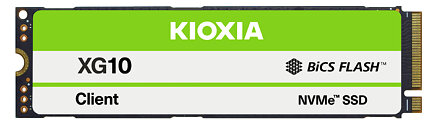 The KIOXIA XG10 Series is engineered to meet the needs of high-performance client system environments. These include professional applications, private AI training and inference, content creation and editing workflows, and immersive gaming experiences. With sequential read speeds of up to 14,000 MB/s and sequential write speeds reaching up to 12,000 MB/s, along with random read performance of up to 2,000 KIOPS and random write performance up to 1,600 KIOPS, the KIOXIA XG10 Series enables high-throughput performance for modern computing demands.
Additional features include:
The KIOXIA XG10 Series is currently sampling to select PC OEM customers, with PC shipments equipped with the SSD expected to begin from the second quarter of 2026. The new drives will be showcased at Dell Technologies World, taking place May 18 - 21 in Las Vegas.
Source:
Kioxia
Designed as the successor to the KIOXIA XG8 Series, the KIOXIA XG10 Series adopts a PCIe 5.0 interface, enabling improvements in both sequential and random performance. Compared to the previous generation, the new drives achieve up to 2x sequential read, more than 2x sequential write, and increases of approximately 122% in random read and 158% in random write performance - supporting faster data access and improved system responsiveness.

Additional features include:
- PCIe 5.0 (Gen5 x4) and NVMe 2.0d compliant
- Self-Encrypting Drive (SED) support based on TCG Opal version 2.02
- Recommended for high-performance PC systems including AI PCs, workstations and gaming platforms
- M.2 Type 2280 form factor
- Capacities of 512 GB, 1024 GB, 2048 GB, and 4096 GB
The KIOXIA XG10 Series is currently sampling to select PC OEM customers, with PC shipments equipped with the SSD expected to begin from the second quarter of 2026. The new drives will be showcased at Dell Technologies World, taking place May 18 - 21 in Las Vegas.
8 Comments on Kioxia Unveils High Performance XG10 Series SSDs for PC OEMs
Otherwise, there's no point in over-hyping the drive and making wild, unsubstantiated claims before it's even released and can be tested independently :)
Heck, even the 1TB PCIe 4 SSD I bought back in early 2021 costs nearly 50% more now than it did well over 5 years ago. smh
Even games struggle to use the extra speed. You can have the fastest drive in the world, but if your CPU isn't fast enough to process the data, it's going to bottleneck the SSD's transfer speeds in the game. This is why I'm happy with all of my Gen 4 SSDs and am more interested in capacity than any increase in speed. For example, when you use Steam to verify a game install, you'd think it'd be faster on a faster SSD, but that is only partly true. I noticed that I'm CPU limit in this user case, as Steam only verifies with a single thread and I can only get about 1.4GB/s with a 9800x3d.
- Processing speed - read / write speeds of drives aren't really limiting in many situations, even at SATA speeds.
- Low queue depth naturally isn't as fast as best case high queue we get served as drive specification, and the difference is getting bigger with every generation.
- Small file transfer speeds, latencies haven't improved nearly as much as sequential large file transfer speeds. Old Optane drives that excelled in these were really faster than all of today's drives, even if their sequential speeds aren't impressive.
- In consumer space we're getting served dramless QLC drives even as high performance models now, masking their low native speeds with caching and other workarounds, and some drives have really horrible performance when this runs out.