Friday, May 15th 2026
Mobile DRAM Contract Prices Continue Rising in 2Q26, Pressuring Smartphone Production
Surging mobile DRAM contract prices in 2Q26 continue to place even greater cost pressure on smartphone brands, according to TrendForce's latest memory market research. The two major Korean suppliers may have adopted different pricing strategies: Samsung Electronics is pursuing a more aggressive one-step pricing approach with sharper increases, while preliminary quotations from SK hynix indicate relatively milder hikes through a gradual price-raising strategy, with final pricing expected to be completed in late May. Overall, TrendForce estimates that the ASP of LPDDR4X solutions will jump by at least 70-75% QoQ for 2Q26, while the ASP of LPDDR5X solutions will see a QoQ surge of 78-83%.
Notably, several consecutive quarters of steep price increases have significantly intensified cost burdens for smartphone vendors. Under such conditions, brands are expected not only to reduce total smartphone production in 2026, but may also struggle to fulfill the bit procurement volumes stipulated in the LTAs (or MoUs) arranged with suppliers at the end of last year.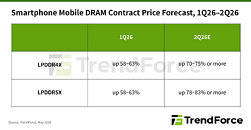 High-price environment reshapes smartphone DRAM configurations, limiting high-capacity options
Persistently elevated DRAM prices are forcing smartphone makers to readjust memory configurations across product tiers. In the high-end segment, 12 GB is becoming the mainstream configuration while 16 GB adoption declines. Meanwhile, mid-range devices are reverting to 8 GB as the core specification, and entry-level models mostly settle around 4 GB.
Average smartphone DRAM capacity is still projected to increase to 8.5 GB in 2026—representing annual growth of 10%—despite the gradual phase-out of 2 GB and 3 GB models and reduced production of low-spec devices.
This supplier-driven memory price surge will continue exerting deep and sustained pressure on the global smartphone industry over the coming quarters.
TrendForce notes that smartphone brands are being forced to adopt more aggressive countermeasures, including working with app developers to reduce memory consumption and expanding service models that rely more heavily on cloud resources. Only by optimizing software and system architecture in parallel can vendors maintain operational resilience and competitiveness amid mounting cost pressures and slowing demand.
Source:
TrendForce
Notably, several consecutive quarters of steep price increases have significantly intensified cost burdens for smartphone vendors. Under such conditions, brands are expected not only to reduce total smartphone production in 2026, but may also struggle to fulfill the bit procurement volumes stipulated in the LTAs (or MoUs) arranged with suppliers at the end of last year.

Persistently elevated DRAM prices are forcing smartphone makers to readjust memory configurations across product tiers. In the high-end segment, 12 GB is becoming the mainstream configuration while 16 GB adoption declines. Meanwhile, mid-range devices are reverting to 8 GB as the core specification, and entry-level models mostly settle around 4 GB.
Average smartphone DRAM capacity is still projected to increase to 8.5 GB in 2026—representing annual growth of 10%—despite the gradual phase-out of 2 GB and 3 GB models and reduced production of low-spec devices.
This supplier-driven memory price surge will continue exerting deep and sustained pressure on the global smartphone industry over the coming quarters.
TrendForce notes that smartphone brands are being forced to adopt more aggressive countermeasures, including working with app developers to reduce memory consumption and expanding service models that rely more heavily on cloud resources. Only by optimizing software and system architecture in parallel can vendors maintain operational resilience and competitiveness amid mounting cost pressures and slowing demand.
7 Comments on Mobile DRAM Contract Prices Continue Rising in 2Q26, Pressuring Smartphone Production
Mobile phone manufacturers are amount one of the biggest proliferators of e-waste. But consumerism and consumers also need to be taken down a notch or two with a baseball bat to the head.
There is nothing wrong with holding on to the same handset for 3-4years. There is also no reason for anyone to own an flagship device unless its for bragging rights. i.e big folding phones.. Those things are hella expensive and sure it would be cool to have but the average joe really doesnt need it or use all if not most of the features that make it a flagship that it comes with.
Then we have chinese companies who are just shitting out new products every few months. This has got to stop. Consumerism is a cancer.
Until a few years ago, that wasn't the case, so after around two years, you ended up being forced to change phone if you at all cared about your device being secure.
People can use and spend their money how they want, be it phones, cars, computers, or whatever else, and yes, sometimes it is for bragging rights, but, so what, if they want to brag, let them, it's their $
you are also assuming too much and think it all goes to trash ("e-waste"), which isn't the case, lots of phones that people trade-in are sold to other companies to sell them again
They will try to convince you, worst than a vegan, that buying a new phone is cheaper, since they are using that Apple Care scheme, or whatever, that you can buy a new phone every new generation, or some similar retarded brainwashing marketing campaign...Indeed. Mine is going strong into it's 6 year, and works the same as the day I bought it.
People buy more than what they actually need quite often. You don't need much more than a 3060 to feasibly play games but people still buy newer, more powerful stuff for the same task because, well, they find that capability valuable, whether it's because they want it to hold up to future standards or just to have more. Most people also don't actually need more than a studio apartment, but god forbid you float the idea that that's all they should be able to afford.
To some degree, people should be able to enjoy spending money frivolously. The world becomes miserable when all that's ever bought and sold is subsistence. The matter of the waste produced is somewhat separate, and on that front I agree. People churn through their possessions too quickly, and don't think to ever pass it on to a second pair of hands.
Insurance companies have noticed miraculous trend that when ever new iToy is released, older models magically suffer suddenly more accidents.