Thursday, July 9th 2026

AMD Confirms EPYC "Venice" Zen 6 CPUs Launch on July 22-23 at Advancing AI Event
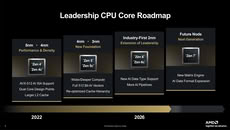
AMD CTO Mark Papermaster has confirmed that EPYC "Venice," the company's first Zen 6 server CPU, will be officially introduced at AMD's Advancing AI event on July 22nd and 23rd. In a recent interview, Papermaster described the upcoming CPUs as optimized for traditional x86 enterprise workloads, noting that enterprise customers aren't moving away from x86. EPYC "Venice" is built on TSMC's 2 nm process, making it the first high-performance computing processor to reach production on that node. Currently, manufacturing is ramping in Taiwan, as AMD announced back in May, with future production planned at TSMC's Arizona facility. The flagship configuration goes up to 256 Zen 6 cores, a 33% jump over the current 192-core EPYC "Turin" lineup. AMD claims over 70% higher performance and efficiency compared to the Zen 5-based predecessor.
On the platform side, "Venice" moves to the new SP7 socket with 16-channel memory support delivering up to 1.6 TB/s of bandwidth, and adopts PCIe Gen 6 for improved CPU-to-GPU communication. This is mostly relevant for the AI accelerator workloads that the EPYC "Venice" Zen 6 CPUs are targeting alongside traditional x86 tasks. These CPUs when installed in Helios racks, will be paired with new AMD Instinct MI455 GPUs. If you're wondering about the mainstream Zen 6 desktop and mobile chips, those are a separate story. Related to those, there's no shortage of rumors and leaks, whether we are talking about the confirmed Ryzen Threadripper TR6 "Mustang Peak", the Ryzen 10000 series "Olympic Ridge" or the "Medusa Point" APUs. However, consumer parts aren't expected before the end of the year at the earliest, with CES 2027 in January being the most likely debut window.
Sources:
Wccftech, Overclock3d
On the platform side, "Venice" moves to the new SP7 socket with 16-channel memory support delivering up to 1.6 TB/s of bandwidth, and adopts PCIe Gen 6 for improved CPU-to-GPU communication. This is mostly relevant for the AI accelerator workloads that the EPYC "Venice" Zen 6 CPUs are targeting alongside traditional x86 tasks. These CPUs when installed in Helios racks, will be paired with new AMD Instinct MI455 GPUs. If you're wondering about the mainstream Zen 6 desktop and mobile chips, those are a separate story. Related to those, there's no shortage of rumors and leaks, whether we are talking about the confirmed Ryzen Threadripper TR6 "Mustang Peak", the Ryzen 10000 series "Olympic Ridge" or the "Medusa Point" APUs. However, consumer parts aren't expected before the end of the year at the earliest, with CES 2027 in January being the most likely debut window.


AMD's Mark Papermaster - Chief Technology Officer and Executive Vice President"I'll say for me, every enterprise conversation I'm having now, this comes up. Because enterprises have, you know, decades of running x86. They're not going to move that install base. And what we've done at AMD, you know, since we launched the new Zen processor back in 2017. We're now on our sixth generation. So, at our Advancing AI event on July 22nd and 23rd, we're rolling out this new generation. You know, it continues the kind of leadership x86 CPU, but it's designed in such a way that it matches what I just described a moment ago. It's optimized for standalone x86 traditional workloads."
36 Comments on AMD Confirms EPYC "Venice" Zen 6 CPUs Launch on July 22-23 at Advancing AI Event
Turin's IMC is definitely superior for maitaining 6400 1:1 across 12 channels all while having 2 GMI links and double the write data rate.
Zen 6 - 12 core CCD (all segments) and 32c core CCD (EPYC only)
Zen 7 - 8 core and 16 core CCDs (all segments) and 36c core CCD (EPYC only)
If you look at EPYC 9965 (Turin Dense) and 9754 (Bergamo) specs, you will see that c cores are not mentioned either on Zen 4 or Zen 5 specs. It only reads '192 cores' and '128 cores' respectively, aka twelve 16 c core CCDs on Turin and eight 16 c core CCDs on Bergamo.
www.amd.com/en/products/processors/server/epyc/9005-series/amd-epyc-9965.html
www.amd.com/en/products/processors/server/epyc/4th-generation-9004-and-8004-series/amd-epyc-9754.html
If you look at Ryzen 370, both Zen 5 and Zen 5c cores are explicitly mentioned in a hybrid product.
www.amd.com/en/products/processors/laptop/ryzen/ai-300-series/amd-ryzen-ai-9-hx-370.html
Expect the same on Zen 6.