Sunday, July 12th 2026
AMD FSR Multi-Frame Generation With Up to 8x Mode in Development

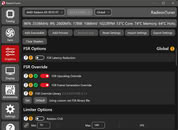
AMD has reportedly been testing a new and highly anticipated FSR multi-frame generation (MFG) technology for its Radeon RX GPUs. This information comes from a third-party software called RadeonTuner, which allows access to Radeon driver settings without using the AMD Software: Adrenalin Edition application. RadeonTuner has revealed that AMD is already incorporating preliminary support for multi-frame generation into its Radeon drivers, though the feature remains hidden until the software is finalized. According to the tool's developer, AMD often places placeholders for features like this well in advance of their release, indicating that the company is extensively testing the multi-frame generation feature with options for 1x to 8x variants, which are expected to be available once the feature is fully developed.

One user attempted to enable the multi-frame generation feature using the latest driver installation and a Radeon RX 9060 XT graphics card to see if it could work with any game. However, the user discovered that the feature is currently non-functional, as AMD has not yet released the necessary model to support multi-frame generation at any setting. This suggests that only the placeholder for the feature has been included, with no underlying driver support to make it operational. Even when testing games that frequently receive FSR updates, such as Forza Horizon 6, Pragmata, Resident Evil 9, Crimson Desert, and Death Stranding 2, the feature could not be activated. It seems we are still months away from the final release of multi-frame generation support.

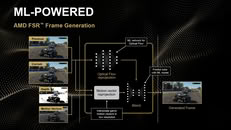
It's worth noting that AMD is late to the MFG game, as NVIDIA has already released its DLSS Dynamic MFG feature with up to 6x generation capability, and Intel has been offering XeSS MFG with a 4x setting for several months as part of the XeSS 3 release. Additionally, AMD GPUs currently lack hardware-based flip metering for frame pacing, relying instead on software pacing to maintain consistent frame generation. Therefore, it makes sense for MFG to be included in the current Radeon RX 9000 series and potentially in future RDNA 5 / UDNA GPU IP if they incorporate dedicated hardware-based flip metering for frame pacing.
Sources: Chiphell, RadeonTuner
Add your own comment

78 Comments on AMD FSR Multi-Frame Generation With Up to 8x Mode in Development

#26
AusWolf
wolfI wonder, will MFG attract praise once AMD does it...
Not from me. The input latency with normal frame generation is bad enough, I don't want more fake frames.

It's sad to see AMD copy yet another useless Nvidia feature instead of making something truly unique to Radeon.
Posted on Reply
#27
poopoopeepee
TheDeeGeeWow, so you move your mouse in 2026, but then the cursor is still in 1996.

That's kind of mouse lag i image.
You know that after the first 50ms hit from the first frame is the worst and it's relatively negligible with each added frame, right? We've all watched the very comprehensive video on this subject, right?
Posted on Reply
#28
tsurugi
For 5090, the base latency is 6ms + 1000/FPS, and the total system latency increases by an additional 14ms.
Taking DLSS MFG with a native FPS of around 120 as an example, a 2x increase adds 2ms, and then each additional 1x adds around 1ms of latency, native FPS drop. This means that the latency from FG itself barely exists, and the latency is almost entirely caused by the decrease in native FPS.
the total system latency will be reduced due to reflex, further offsetting the non-FG latency advantage. Comparing mfg 3x 180fps to native 180fps, the latency increases by 13ms, while the latency difference caused by the gap in native frame rates is 10ms, so the extra latency brought by 60fps input and mfg 3x output is 3-4ms.
Reflex plays an important role, so even though MFG relies on calculating the next frame and is expected to bring 16.7ms of latency at 60fps, the actual latency of MFG is far below this value.
Although MFG introduces some latency, DLSS slashes latency significantly, leading to an overall reduction in latency. Without these technologies, you could not play AAA RT at 4k 240hz. Visual quality, resolution, and smoothness have all improved compared to the past, and latency is also lower than before.
Posted on Reply
#29
chrkeller
I can't speak to technical specifications, but I hate FG with Nvidia. The few times I tried it, laggy and ghosting; which defeats the purpose of high fps. I love upscaling but FG, no thanks, at least for now.

I would greatly prefer to drop resolution and setting for real frame.
Posted on Reply
#30
PixelTech
Is FG not just so GPU manufactures can delay pushing out a new generation?
Posted on Reply
#31
chrkeller
PixelTechIs FG not just so GPU manufactures can delay pushing out a new generation?
I think it is a crutch for developers so they don't have to optimize. If I render at 120 fps FG (2x), my latency is the same as 60 fps. The whole point of 120 fps is to have latency lower than 60 fps. If I wanted 60 fps, i would render at 60 fps. I could rant all day on why FG is stupid, but alas, not worth it (not directed at anyone, just a general comment).
Posted on Reply
#32
Red Hood
vbq7qK68eyYAH4iRCurious how you came to the understanding that MFG, up to 8x, is a "highly anticipated" technology?
It is for studios that don't optimise their games
Posted on Reply
#33
THU31
I just hope the PS6 gets good frame gen support, and that it can be added to PS5 titles with updates (or maybe even on a system level).

60 FPS will probably still be the main target, so frame gen would definitely be useful on 120 Hz screens (and HDMI 2.2 with 240 Hz support should be out by then).
Posted on Reply
#34
wheresmycar
chrkellerI think it is a crutch for developers so they don't have to optimize. If I render at 120 fps FG (2x), my latency is the same as 60 fps. The whole point of 120 fps is to have latency lower than 60 fps. If I wanted 60 fps, i would render at 60 fps. I could rant all day on why FG is stupid, but alas, not worth it (not directed at anyone, just a general comment).
This is where I take issue with FG too, especially in fast paced games. I'm pretty sensitive to higher input latency and inconsistent frame pacing so its a no-go for me.

Where it does seem to add value is if you're playing single player games where responsiveness isn't prioritised, or enabling RT or running 4K where rendering every frame natively is massively demanding. I guess FG/MFG has its uses, as long as you're happy to live with the trade offs. A mate of mine runs a high refresh rate 4K tele and he's proper into RPGs/story driven titles. According to him, FG can work really well in some titles as long as the FG implementation is on point. Other titles still have pretty poor FG support and you can end up with visual artefacts, judder/stutter, etc... the sort of stuff that breaks the immersion. Me personally, I'm still smooth sailing at native in all types of games.

I don't mind FG as another tool in the toolbox. Thats all it should be, a tool! The issue was never the tech but the marketing fluff that came with it. It shouldn't be used to make small native performance gains look like front page massive generational jumps or definitely not to justify significantly higher GPU prices. If that sort of marketing works on the mainstream market, you can bet it will further reduce the pressure to deliver proper native perf with future Generations. Imagine that convo with some average joe and his mate dave popping into his local store with the sales guy saying "yes sir, you read that correctly, these new cards are 8x faster"... Joe and Dave would lose their butter chucking minds lol.
Posted on Reply
#35
zus
chrkellerThe whole point of 120 fps is to have latency lower than 60 fps.
No, it’s not. Some people enjoy the extra smoothness of 120 FPS, and that’s why frame generation exists. Lower latency is one of the reasons to have higher framerate, but it’s not the only one.
Posted on Reply
#36
wolf
Better Than Native
zusNo, it’s not. Some people enjoy the extra smoothness of 120 FPS, and that’s why frame generation exists. Lower latency is one of the reasons to have higher framerate, but it’s not the only one.
Precisely, it can absolutely still be a net positive to the experience, certainly so when implemented well with Reflex (or similar input latency reduction tech) which can net essentially the same input lag as pre-fg.

In my example earlier with LSFG 4x for emulation locked at 30, it's only a positive (presuming no distracting artefacts, which is my experience), as you can't increase the framerate / lower the latency, so the game feels identical while looking 4x smoother.

These features certainly have utility, can be used with effectively no downside, and of course are always optional anyway.

Who wouldn't just desire more base FPS, of course that's what everyone would want, I'd still rather have FG tech as an option in the menu rather than not.
Posted on Reply
#37
AusWolf
wolfWho wouldn't just desire more base FPS, of course that's what everyone would want, I'd still rather have FG tech as an option in the menu rather than not.
In my limited experience with frame gen in The Talos Principle 2, while it gave me double the FPS, it also gave me an unhealthy dose of input lag. So if I can choose between a stable, even 50 FPS and a laggy, slow 90, I'll choose 50. One can argue that having options is good, but if the option isn't good, then what's the point?
Posted on Reply
#38
wolf
Better Than Native
AusWolfIn my limited experience with frame gen in The Talos Principle 2, while it gave me double the FPS, it also gave me an unhealthy dose of input lag. So if I can choose between a stable, even 50 FPS and a laggy, slow 90, I'll choose 50. One can argue that having options is good, but if the option isn't good, then what's the point?
I'm not sure how many different ways Please, leave me alone needs to be phrased, but I'll try it again:

Please, leave me alone.
Posted on Reply
#39
AusWolf
wolfI'm not sure how many different ways Please, leave me alone needs to be phrased, but I'll try it again:

Please, leave me alone.
I commented on the topic of frame generation, and not about you, in case you haven't noticed. There is nothing personal about what I said.

While I fully respect your opinion, please excuse me if I also wish to express mine. Will you let me? Please? :)
Posted on Reply
#40
wolf
Better Than Native
AusWolfI commented on the topic of frame generation, and not about you, in case you haven't noticed. There is nothing personal about what I said.

While I fully respect your opinion, please excuse me if I also wish to express mine. Will you let me? Please? :)
I kindly ask that if you have an opinion to express, do so without quoting or involving me directly. Please.
Posted on Reply
#41
AusWolf
wolfI kindly ask that if you have an opinion to express, do so without quoting or involving me directly. Please.
I expressed my opinion in relation to yours, which I equally respect. But if that makes you feel better, so be it.
Posted on Reply
#42
Prima.Vera
Anything above 2x is garbage anyways, since it induces too many motion artifacts and stuttering.
Posted on Reply
#43
Fatloader
chrkellerI think it is a crutch for developers so they don't have to optimize.
On this I completely agree. I miss 2017 graphics. They look good (honestly better than a lot of modern-day titles), they run good (at least on newer cards), and they were artifact free (vs nowaday's smearing and ghosting). I recently played Star Wars Battlefront II with some friends and was astounded at how good it looked. Ignoring EA's best efforts to kill it, the game looks amazing. Shadows were anti-aliased and had realistic softening, global illumination was on par with Subliminal (store.steampowered.com/app/2300840/Subliminal/), and the framerate put Borderlands 4 to shame.
chrkellerIf I render at 120 fps FG (2x), my latency is the same as 60 fps. The whole point of 120 fps is to have latency lower than 60 fps.
On this, not necessarily. When rendering at 120FPS with frame gen, your latency is actually slightly Higher than that of 60FPS (keyboard/mouse, monitor latency excluded). The GPU has to render the normal two frames and then the AI one. The fake frame is quite a bit less expensive to make than a full scene render, but it is nonetheless an operation the GPU has to perform. The GPU does, of course, have AI cores, but the other hardware still has to give data to the cores. The overall reduction in base framerate and latency is quite small, but it does nonetheless translate to a framerate that isn't actually 8x higher. (I'd estimate about 7-7.5x higher for most games)

Secondly, I don't think that 120 FPS only exists for lower latency. I agree that it is a major point, but smoothness contributes hugely to a game's experience too. If I could have 60 FPS or 120 FPS (with no other changes to latency or image stability) then I would pick 120 every time.

EDIT: I accidentally said lower when I meant higher.
Posted on Reply
#44
Vya Domus
A gorillion interpolated frames, super exciting stuff.
Posted on Reply
#45
Dukenukemx
windwhirlNot from me.
Me either. Who wants something that will make playing a game worse?
Posted on Reply
#46
Dr. Dro
Tomorrow
It is a fact that RDNA 4 lacks this hardware capability. AMD's software solution is of incredibly poor quality, not that this is of particular detriment because even with flip metering and frame pacing, DLSS MFG on Blackwell is less than desirable IMO. It isn't something you can replicate through a video, you have to experience it for yourself. It just feels off, and the image will look wrong here and there.
Posted on Reply
#47
MondoMike
SWEET! FRAME GEN THAT WONT BE USED! YAY! Anything beyond 2-3x frame gen is wild and will likely have even more noticeable latency. 3x is PLENTY!
Posted on Reply
#48
Ihnako
I like the idea of FG x240. So you only need to calculate one frame per second and you get butter smooth 240 fps.

FG is a complicated business, as it depends on what you want to do with it.
A fast-paced game where the game has to react instantly, or a more relaxed approach where a tenth of a second doesn’t matter?

Or even a film or animation, where everything is ‘pre-programmed’ and you can’t ‘feel’ any difference at all at more than 30 fps.

I think we can all agree that FG has its uses, just not in situations where every millisecond counts. Every frame that gets ‘squeezed in’ is one that delays my response and makes the gameplay feel sluggish.

However, if I’m happy with the response at 30–60 FPS, why not make use of the technology?

That said, it would be far more interesting to keep the FPS (more) constant – in other words, an average of 120 FPS without the usual outliers in the 1% range from 60 to 180 FPS. Which can sometimes feel like stuttering.
Posted on Reply
#49
Doctor Who
Multi-frame generation, something that Nvidia pushed into the marketplace (which forced AMD to concede & follow) due to their unfortunate dominance, has the potential to make game development lazy.
It would have been better if the industry had been steered into a more positive direction in terms of graphics and technological advancements over these "fake frames."
Posted on Reply
#50
chrkeller
FatloaderOn this I completely agree. I miss 2017 graphics. They look good (honestly better than a lot of modern-day titles), they run good (at least on newer cards), and they were artifact free (vs nowaday's smearing and ghosting). I recently played Star Wars Battlefront II with some friends and was astounded at how good it looked. Ignoring EA's best efforts to kill it, the game looks amazing. Shadows were anti-aliased and had realistic softening, global illumination was on par with Subliminal (store.steampowered.com/app/2300840/Subliminal/), and the framerate put Borderlands 4 to shame.


On this, not necessarily. When rendering at 120FPS with frame gen, your latency is actually slightly lower than that of 60FPS (keyboard/mouse, monitor latency excluded). The GPU has to render the normal two frames and then the AI one. The fake frame is quite a bit less expensive to make than a full scene render, but it is nonetheless an operation the GPU has to perform. The GPU does, of course, have AI cores, but the other hardware still has to give data to the cores. The overall reduction in base framerate and latency is quite small, but it does nonetheless translate to a framerate that isn't actually 8x higher. (I'd estimate about 7-7.5x higher for most games)

Secondly, I don't think that 120 FPS only exists for lower latency. I agree that it is a major point, but smoothness contributes hugely to a game's experience too. If I could have 60 FPS or 120 FPS (with no other changes to latency or image stability) then I would pick 120 every time.
I don't see how it can be lower. If I am rendering 120 FG, 60 fps are real (so 60 fps latency) + minor time to generate 60 fake frames. My latency is right around that of 60 fps because latency can never be lower than my rendered frames. While 120 fps rendered has half the latency of 60 fps + FG.

And smoothness is good, I just (personal opinion) think the responsive controls is the bigger gain. Even stuff like rpgs, menus are just much faster. I have gotten addicted to 120 fps rendered. Plus, the artifiacts defeat the purpose of smoothness.

Anything that is optional, by default doesn't bother me. But when I see Lego Batman putting FG as part of requirements.. plus seeing how well Monster Hunter Wilds and BL4 perform. DLSS might be a curse because developers will just phone it in.
Posted on Reply
Add your own comment
Nov 12th, 2026 06:32 PST change timezone

New Forum Posts

Popular Reviews

TPU on YouTube

Controversial News Posts