Monday, July 20th 2026

Per-Module GDDR7 Temperature Reading Unlocked on NVIDIA GeForce RTX 50 "Blackwell"
More individual readings are being unlocked on NVIDIA's GeForce RTX 50 series "Blackwell" graphics cards, as the modding community has started exploring GDDR7 temperature monitoring on a per-module basis. Interestingly, the modding community is diverse this time, including contributions from Brazilian GPU repair specialist Paulo Gomes, MSI Afterburner developer "Unwinder," Overclock.net member "asder00," HWiNFO creator Martin "Mumak" Malík, and Linux code developer "olealgoritme." By joining forces, the team managed to create a plugin for MSI Afterburner that provides access to individual, per-module GDDR7 temperature readings.
This new Hotspot.dll plugin, which previously only provided access to the hidden "Blackwell" GPU die, is now updated to handle GDDR7 temperature readings, unlocking the GDDR7 thermal sensors hidden inside memory ICs. For example, on the GeForce RTX 5090 GPU, there are 16 GDDR7 memory modules, each with a 2 GB capacity. Since there are 16 chips, the tool can read 16 temperature sensors and provide 16 individual readings. However, some GDDR7-equipped "Blackwell" GPUs use a clamshell memory configuration, meaning the GDDR memory is on both sides of the PCB. For example, in the case of the RTX PRO 6000 "Blackwell", this would mean only half the measurement points, as the GDDR7 memory is present in 16 locations on both sides of the PCB, for a total of 32 memory modules.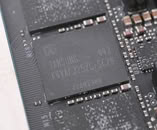
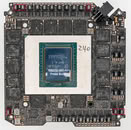
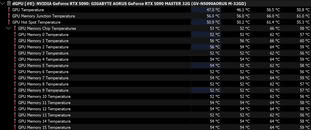
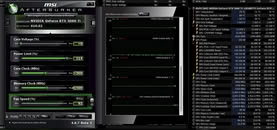
 Nonetheless, the addition of individual memory IC temperature readings is very helpful, especially when troubleshooting the GPU. When a GDDR7 memory module is not properly cooled, particularly if the thermal pad that should be present wears out or is missing, the module can overheat and reach the end of its life. Therefore, proper detection is always a good idea. With hotspot readings on the GPU die, hotspot delta, memory junction, and GDDR7 memory readings, NVIDIA's "Blackwell" is finally fully unlocked in terms of measurement.
Source:
via VideoCardz
This new Hotspot.dll plugin, which previously only provided access to the hidden "Blackwell" GPU die, is now updated to handle GDDR7 temperature readings, unlocking the GDDR7 thermal sensors hidden inside memory ICs. For example, on the GeForce RTX 5090 GPU, there are 16 GDDR7 memory modules, each with a 2 GB capacity. Since there are 16 chips, the tool can read 16 temperature sensors and provide 16 individual readings. However, some GDDR7-equipped "Blackwell" GPUs use a clamshell memory configuration, meaning the GDDR memory is on both sides of the PCB. For example, in the case of the RTX PRO 6000 "Blackwell", this would mean only half the measurement points, as the GDDR7 memory is present in 16 locations on both sides of the PCB, for a total of 32 memory modules.


36 Comments on Per-Module GDDR7 Temperature Reading Unlocked on NVIDIA GeForce RTX 50 "Blackwell"
But how do you go about linking each VRAM sensor's name, to an actual VRAM die ?
Is A0 always the first sensor that get's picked up by software ?
Does the program lists sensors the same way NV counts memory dies or is it changed depending on which sensor shows up first ?
I would assume people will figure it out pretty fast, since all it should take is someone pulling a GPU apart and testing by applying heat to a chip and seeing which sensor shows it, that we will get the order pretty quickly. I would assume the sensors are on each VRAM module, which in turn is read by the core which I guess would be the same across the entire 50 series family, but..it could also be by core family, so GB202 (5090) has one order, while GB203 (5080) ,and so on may have a different orders but that doesn't really make sense to me.
As you said, it may be as simple as the channel order so first sensor is module Channel A0, sensor 2 is Channel A1, and so on, but again, confirmation will be needed.
It's all speculation at this point. I mean...you could test it for us 😉
Here's a link for the Beta for the per chip temp :)
One of those is far more likely to be interpreted as evidence of a defective product and result in unnecessary RMAs.
What you're presenting is a false equivalence, followed by an all-or-nothing fallacy: "If one sensor can create support noise, then all telemetry should be removed." That's not logic, that's exaggerating a position until it becomes absurd.
Using this new beta for per module temps, it's nothing exciting. All of them basically stay the same temp, except for the one that's closest to the GPU VRM, and that's only 2C more than the rest under load.
Lets pick the one number, that Nvidia allegedly thinks has the most impact on the Consumer, and has therefore the most potential to create, as you called it, "support noise from people".
With other words, your position is, that the reason why Nvidia is censoring the Hotspot Data (as answer of my question why Nvidia is doing this), that most people are simply to stupid to correctly understand that number, and therefore it is convenient for Nvidia to not expose that number to those stupid people, who do not have the understanding of what they are seeing with the hotspot data, to reduce "RMA rates".
So less critical data points exposed, less RMA rates. That is your assumption, that you present as an argument.
We do not know if your assumption is actually true or not, because you actually do not present any reliable data to proof it. So we should just believe it is true?
On the other side, fact is, exposing the Hotspot data, can actually reduce the RMA rates! So for example, my 4080S became very loud. So a Problem. I looked at the telemetry in HWinfo, and instantly identified the Problem, based on the exposed hotspot data! The diagnosis was pump-out of TIM, because the card was fine moths ago. With this information, i was able to fix the problem myself, by applying a PTM7950. Problem solved, RMA PREVENTED, RMA-Rate reduced.
All because of the Hotspot data.
So then your argument basically becomes, most people are stupid, and we should not give those idiots the (critical) data.
I do not think that this is a position that i can accept, of why Nvidia is not exposing Hotspot Data, especially, as i have have demonstrated with real world empirical data, that the exact opposite of what you assume can actually be true.
Issue would show up as cards breaking within 6-12 months from purchase - due to next gen smaller transistors not being able to take spot temp in 120C+ ranges at "stock" ~1V voltages with prelong periods of time (a.k.a. "SDNS" from Northwood in 2.0 revision).
Maybe then we could get a proper next gen of not pushing power envelopes yet again...
I'm not quite a fan of the way you carry my example forward to a thought I never had, "So then your argument basically becomes, most people are stupid, and we should not give those idiots the (critical) data.", I don't think most users are stupid, just that high temperature readings, even when in the safe range, can and do alarm people. If they are unsafe and the card throttles from temp, even without hotspot exposed that would be evident though the other telemetry like "Temperature Limit 0/1", or dropping clock speeds and power consumption.
Indeed you gave a great example of why the opposite can be true, which is why I never stated my position with any degree of certainty, and the reality which neither of us will likely ever know, at least in which quantities, would be a mixture of both scenario's.
Unless Nvidia actually tell us why it was obfuscated (and we assume that's 100% truthful), the speculation continues. I'd wager fairly heavily that Nvidia, AMD, Intel and even more hardware makers do not surface every single telemetry point available to end users for all their products either - to what end? that's the million dollar question. The only reason this has caused a stir is because it was visible for multiple generations, then wasn't.