Monday, September 7th 2026

Mod Revives Multi-GPU Gaming With Dedicated DLSS 5 GPU for Impressive FPS Gain
If you were around during what many consider the golden age of PC gaming, back when SLI was still possible, and, going back even further, when gamers put dedicated PhysX cards into their PCs, the latest trick shown off by modder, Marcelo Guibout, on YouTube. Guibot showed off a gaming setup using two NVIDIA RTX 5060 Ti 16 GB GPUs in tandem to split the rendering and Neural Rendering workloads.
[Editor's note: Our in-depth analysis of the DLSS 5 model leaked in the NBA2K27 and in use here is now live]
Similarly to the example of PhysX cards, the idea is to split the workloads between two GPUs, theoretically allowing for improved performance on the GPU doing the primary rendering, since it will be able to use resources on raster or ray tracing rendering that might otherwise be used for DLSS 5 Neural Rendering. With the Neural Coprocessor enabled using the multi-GPU processing setup, frame rates improved anywhere from 59% to 125% compared to running DLSS 5 on the same GPU—performance was still down compared to DLSS 5 off, however.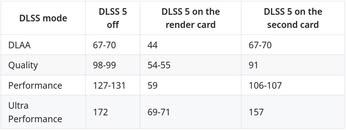 The modder used Neural Coprocessor (or MGPU Bridge), a public add-on for ReShade, to test DLSS 5 in Cyberpunk 2077 and The Blood of Dawnwalker, whose results can be seen below in the embedded YouTube videos. The add-on basically uses the PCIe link to pass the completely rendered frame from the primary GPU to the dedicated Neural Rendering GPU, which then outputs the resulting frame to the monitor after the DLSS 5 pass. It can also be tweaked in the same control ReShade control panel that DLSS 5 Swapper uses, in order to refine performance and quality.
Sources:
Marcelo Guibout on YouTube, via VideoCardz, Neural Coprocessor GitHub
[Editor's note: Our in-depth analysis of the DLSS 5 model leaked in the NBA2K27 and in use here is now live]
Similarly to the example of PhysX cards, the idea is to split the workloads between two GPUs, theoretically allowing for improved performance on the GPU doing the primary rendering, since it will be able to use resources on raster or ray tracing rendering that might otherwise be used for DLSS 5 Neural Rendering. With the Neural Coprocessor enabled using the multi-GPU processing setup, frame rates improved anywhere from 59% to 125% compared to running DLSS 5 on the same GPU—performance was still down compared to DLSS 5 off, however.

86 Comments on Mod Revives Multi-GPU Gaming With Dedicated DLSS 5 GPU for Impressive FPS Gain
I had a bug with Nvidia, which was fixed after about 3 months, I got a bug with AMD, after 2 years of waiting, that bug was never fixed.
there is a reason they still sell gaming cards, and its not because its what investors want.
The 7.9ms number for the 5090 @ 4k also tracks with Nvidia's own paper on DLSS5 (page 17).
Then tell me which ones to use, because I tried, mail, forums, report tool, etc. Guess what?? Two years and no fix for that bug.Yes, except the bug I reported.So should I cry with you with my unresolved AMD issue?
At least your bug with with an old video card, my card was a just released RX 6400.
If investors didn't want gaming cards sold then Nvidia would stop selling gaming cards. But Nvidia is so bold as to go against their investors and serve the wants of less than 7% of their overall revenue, praise be the man in leather!
I rest my case.Standing on more than one foot, cooking more than one soup, putting their money on more than one card, whatever you want to call it. If one market dries up, they still have presence in another.
Why does Volvo sell trucks as well as consumer vehicles? Why does Samsung sell phones and TVs? Why does McDonalds have burgers as well as chicken nuggets?
Nvidia can all but abandon the gaming market by cutting supply to shift more wafers and memory to further inflate their AI bubble, yet still keep gamers paying 40-50% more for cards which launched nearly 2 years ago, it's a win win for Nvidia.
Thank you for proving my point.But the profits are far lower then what they could be making. Investors tend to care about that.
So why are they prioritizing the 1/50th sized profit of gaming cards? Why have they not stopped making anything over the 5060ti?
The problem Ihave here is this speaking out of both sides, have your cake and eat it too cynicism this forum keeps producing. We have to simultaneously believe that nvidia is this hyper greedy ultra capitalist entity that HATES its consumers and wants to destroy PC gaming and is going to abandon consumers any day now; and that nvidia is intentionally reserving millions of dies and terrabytes of RAM to produce gaming GPUs that sell for 2% of what the AI models sell for, and continue to invest in consumer software and gaming, despite the demands of their investors to legally maximize returns at all times.
This is pure doublespeak. These cannot both be true at the same time, yet we still hear the same mantra repeated over and over and over in every nvidia related article.
An example: Team Penske competes in both Nascar, and Indycar, the latter of which is on a much lower budget. Why? Because a lot of profit is good, but a little bit more is even better.
It's not that Nvidia is doing us any favours by selling us the cards that they could to AI farms for more money. For one, there are different bins of a GPU. For two, maintaining market presence is good business.
Glad you're enjoying your Nvidia card!
We aren't looking for native 200 fps. And the resolution doesn't even need to be 1440p. Sorry, but I thought DLSS 4.x works wonders and is amazing even in performance mode. Isn't that what they say? And if I'm not mistaken, performance mode upscales from 1080p. So we're totally fine. The RTX 5060—or maybe even the RTX 5050—could serve as a solid baseline for someone to start seeing how DLSS 5 transforms the graphics on their screen, without having to empty their bank account or throw away their old hi end card.
Am I making sense, or am I persisting in a flawed logic, if it really is flawed? The numbers I mentioned above follow this rationale: if a card running at a relatively low resolution—1080p, or let's drop to 960p if necessary—can deliver at least 30 fps in DLSS 5 while also handling the main graphics rendering pipeline, then acting as a dedicated coprocessor purely for DLSS 5 and MFG, it might push that to 35–40 fps. It achieves these bare minimum 35–40 fps today, with DLSS 5 as it currently stands. In 6 months, Nvidia might speed it up by another 15–30%. Now, if upscaling is applied *after* the DLSS 5 filter, the numbers for an RTX 5050 would look like this:
30 fps minimum at 1080p with DLSS 5 applied ---------(DLSS 4.5 performance upscaling to 4K)---------> presumably 30 fps at 4K ---------( MFG )---------> theoretically 60–180 fps on screen.
If the above scenario is overly optimistic, an RTX 5050 could be considered capable of 1440p DLSS 5 instead of 4K DLSS 5. An RTX 5060, in my view, would be more than enough even for 4K.
When could a scenario like this actually happen, though? When Nvidia decides to allow running dual GPUs side by side, with one functioning as a dedicated DLSS 5 filter application coprocessor or something along those lines. And let's assume we're strictly talking about RTX cards—so nobody jumps in to claim I'm demanding it work with an AMD primary card. Unlocking MFG on older RTX generations would also be useful. That would free up the humble RTX 5050 from our example to handle the MFG role as well. Of course, the scenario above assumes Nvidia will officially allow what modders are already doing: letting upscaling run *after* applying DLSS 5. They could just call that "Performance DLSS 5 mode."
Generally speaking, a lot could be done here. Even if it adds latency or the visual result is at 80–90% quality, the user should be the one to decide whether that's good enough or if they want perfection. Imagine if saving images in .jpg format had been rejected just because it doesn't retain 100% of the quality! I don't know if the roadblock lies elsewhere—whether it's a business decision or if allowing such tricks significantly increases driver complexity.
P.S. Sorry for the long post.
As for the .jpg, the example was meant to show that not everyone is looking for what is considered the absolute best at that moment in terms of quality, latency, or any other parameter someone might set. So, what I wanted to say here is that some people might want the result of DLSS 5 on their screen even if it is applied before upscaling, or they might want to try a two-card setup, even if that means increased latency.
By the way AMD "killed" (reduced) support for integrated graphic cards on recently released devices like ASUS Rog Xbox Ally.
Again, glad you're happy.
RDNA 1 and 2 GPUs are now on a secondary driver update channel. What that means is, they still get regular updates, but the driver core only gets updated when there's a major feature update coming, or if there's a bug that needs to be fixed. These are old, mature GPUs, what they needed fixed is pretty much fixed. You don't need new drivers every time a new game comes out. You only need stuff fixed, which it is. Having a "game ready" driver for every release is an illusion. What happens most of the time is that the driver team tests the existing driver with the game, and if it works, they just re-release it as "game ready".
Also don't forget that FSR 4 is still coming for these GPUs, which will probably warrant a major driver update.
We'll see if they really give new drivers (core) for those GPUs when they release FSR 4.
Why do you need the newest driver core anyway?