Friday, September 11th 2026

Cooler Master GPU Shield Adapter Officially Launches in the US
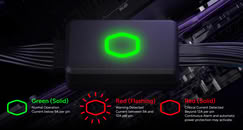
Cooler Master previously showed off the GPU Shield adapter cable at CES 2026, demonstrating the small 12V-2×6 adapter that is able to not only alert the user with a visual and auditory warning when there are anomalies in the current in the GPU power cable, but also actively intervene and reduce current when higher-than-normal current is detected. GPU Shield has officially launched in the US after showing up in China in early August 2026, and it is available on the Cooler Master online shop for $49.99.
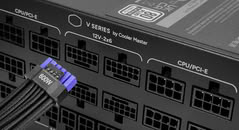
In addition to monitoring high current, which is often the cause of the melted 12V-2×6 GPU connectors, GPU Shield also attempts to mitigate the meltdowns in the first place with dual-color connector tips that are an easy indicator to ensure proper cable insertion in the GPU and PSU. The adapter itself comes with 200 mm of total cable length, which should be enough for most DIY PC cases with conventional PSU placement, and it improves on Cooler Master's GPU Shield tech that is built into the PSU itself, since that is often not visible in many modern PC cases.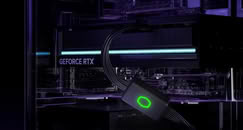
Source:
Cooler Master
In addition to monitoring high current, which is often the cause of the melted 12V-2×6 GPU connectors, GPU Shield also attempts to mitigate the meltdowns in the first place with dual-color connector tips that are an easy indicator to ensure proper cable insertion in the GPU and PSU. The adapter itself comes with 200 mm of total cable length, which should be enough for most DIY PC cases with conventional PSU placement, and it improves on Cooler Master's GPU Shield tech that is built into the PSU itself, since that is often not visible in many modern PC cases.


75 Comments on Cooler Master GPU Shield Adapter Officially Launches in the US
In all 3 scenarios cards will still burn.
1. Lower wattage will only delay
2. Plugging it in properly, until the pins move through microvibrations
3. Expensive Monitoring gadgets still very prone and potentially even more so to degradation/movement due to extra resistance.
Work around, get a cable that can tolerate the faulty state because the connector will never not be faulty. 😂
Solution need a connector that grips the pins and will never move.
The PCIe bus provides 75 W max.
An 8-pin provides 150 W max.
So three 8-pins allows for a card of up to 525 W. The 5090 has a TDP of 575 W. That's 50 W over the theoretical maximum. And that didn't take the fact into consideration that 50-series GPUs pull very little power through the PCIe bus, and take most of what they eat through the power plugs.
So whoever thought 3 8-pins would work on a 5090 is a moron.
With such power hungry cards like RTX 5090, it'd be wise to include both load balancing and more than 10% power safety margin that 12V2x6 has. (In case load balancing does not work properly.)
And if load balancing is too costy, then low cost division of single power rail into 6 separate smaller rails with shunts would do the trick, provided each of the rail is connected straight to single pin of the connector. This was the approach with RTX 3090 (Ti), but there were just 2 rails. Separate rail.per each pin would further extend the safety factor.
As for this new CM "invention", yet another thing that does not solve the fundamental thing about the melting problem. The amount of these so called "splutions" only proves the problem does indeed exist, despite some users not acknowledging the situation and rather pointing to user erros (user abusing the connector).
I work in heavy industry. After what I've seen so far (fatalities, severed or crushed limbs), there is NO excuse for omitting safety-related equipment.
Similarly, there is no excuse for your GPU setting your room on fire because it lacks equipment it previously used to have.
Source: VideoCardz.com
videocardz.com/newz/cooler-master-launches-50-gpu-shield-in-us-warranty-drops-to-one-year
However, there are other alternatives with higher ampacity ratings.
But, the Molex has been an industry standard for so many years... Change is difficult sometimes.Unfortunately, nVIDIA has apparently adopted Microsofts motto; 'If it ain't broke, fix it 'til it is'.
From what i read, this one will beep and will shut off if overloaded. Where as the equalizer also has the shut of feature, but requires what seems to be a windows only software installed to get the warnings.
I obviously want whichever one will protect me the best, but it looks like they are about the same hardware wise? and warnings-wise the beep is more likely to alert me, than a software warning, since the hwardware shutoff will most likely black out my screen?
www.jongerow.com/PCIe/index.html
The Molex Mini-Fit Jr. specs say that using 16AWG it can do 8A per pin with brass contacts. The connector has 8 slots, but it's really a 6 pin since it only has 3x 12V lines.
8A means 288 W.
Using the mechanically compatible Mini-Fit Plus HCS it can do 10A per pin. That means 360 W per connector.
The 75 W for the 6 pin and 150 W for the 8 pin is a thing of the past, or better said it's made to account for very low quality equipment (especially compared to today) from 10-15 years ago. These specs are for the lowest common denominator, but again not from today (unless maybe you actively seek those) instead from the past (when they were somewhat more common).
By the way you can easily spot the bullshit.
The HCS specs say that for 12 terminal slots (like the 12Vhighfailure) with 16AWG it's 9A.
The 12Vhighfailure cable uses 16AWG but it doesn't use big boned HCS pitch and terminals.
And the Amphenol Minitek specs say 9.5A.
But somehow only 50 mating cycles instead of 100 for HCS.
Lying through their teeth!
Because the 12Vhighfailure terminals are closer together and are smaller than HCS ones (which have greater conductivity and lower resistivity) means they can't do 9.5A which is actually a bit more than a 12 slot HCS. Lol, lmao even.
They most likely can't even do the 6A of a 12 slot Molex Mini-Fit Jr. That would be 432 W.
It's way too obvious.
The 3090 Ti implementation was relatively fine because of the greater margins and load balancing. Not ideal but serviceable. The 5090 implementation is built to fail. Officially it's a different story:tpucdn.com/review/nvidia-geforce-rtx-5090-founders-edition/images/front.jpg
tpucdn.com/review/nvidia-geforce-rtx-5090-founders-edition/images/back.jpg
Seems legit!
Those with plenty of experience have said the connector and 12v2x6 standard are flawed, this connector needs recalled since Nvidia decided to cheap out on the 12vhpwr standard by eliminating load balancing from the specifications.
Good to know.
And using that logic, AMD accepts bad quality power connectors. Good to know.
Clearly you people are not reacting the way you are cause there is nvidia in the title. Totally not. You are really worried about those GPUs burning someones house :D
Those are the max currents. Just like the 12Vhighfailure claiming 9.5A max (for Amphenol, while for Molex it's 9.2A).
Of course you always want comfortable margins.
So if I take the max for the Molex Mini-Fit Jr. config above we have 8A (288 W) but the PCI-SIG rating is 4.16A (150 W). That is 92% room for maneuver. Playing it a bit too safe, but as I said it was in order to account for the lowest common denominator and the wire/terminal variation that could be encountered in those days.
If I increase the rating to 5.55A (200 W) then the safety margins are at 44%.
Okay let's move to the HCS connector.
That was 10A for both 8 pin PCIe (360 W) and EPS (480 W).
What if I put a PCI-SIG like rating of 7A in order to have some margins? Then 10A is 42.8% higher, almost the same margins as with the Molex Mini-Fit Jr. above.
7A means 252 W for 8 pin PCIe and 336 W for 8 pin EPS again using HCS connectors and 16AWG.
Now let's see how the 12Vhighfailure does.
The 575 W 5090 FE TDP translates to 8A per pin.
9.5A is 18.8% higher. So the safety margins are less than half of those presented above.
And we know other AIB 5090 implementations use 600 W default.
But anyway the halved safety margins are assuming the terminals can actually do 9.5A max.
Like I said previously using the HCS table a 12 slot/pin connector would be rated at 9A max.
How exactly is the 12 pin 12V-2x6 which uses smaller terminals which are closer together capable of similar performance?
www.techpowerup.com/forums/attachments/1688409852822-png.303371/
It doesn't pass the visual test.
Imagining a 12 pin HCS instead of that 8 pin next to the 12Vhighfailure makes it immediately clear that both cannot have the same capability. Well actually it's 9.5A vs 9A so even more head scratching.
This is probably the most "cool story bro" of the last 10 years or something.44% safety margins for 432 W max would translate to 300 W (4.16A, which is equivalent to two 8 pin PCIe of the "PCI-SIG play-it-safe variety").
And as I said even 6A might be optimistic, if I drop it to 5A max, then 3.5A (252 W) has 42.8% safety margins.
rog.asus.com/power-supply-units/rog-equalizer/rog-equalizer/
Somehow 17A for such small terminals. Mmmkay... :confused::confused::confused:
That is 84.8% higher. Such an increase in durability is astounding, realistically you could expect 20 maybe 30% increase but simply pulling almost 85% more out of the hat is ridiculous.
Nice that they're at least quoting the lower (but still overconfident) 9.2A rating that Molex uses.