Saturday, September 19th 2026

AMD Claims EPYC "Venice" Beats NVIDIA Vera by 2.24x in New White Paper
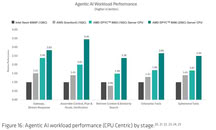
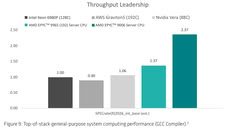
AMD has published a white paper on its 6th Gen EPYC 9006 "Venice" server CPUs, and it takes direct aim at NVIDIA's Vera. These are first-party figures from AMD, so it is important to be cautious about their validity. In SPECrate 2026 Integer, AMD says the 256-core EPYC 9996 delivers 2.24 times the platform-level performance of an 88-core Vera system, while a 96-core, high-frequency Venice chip is claimed to be 1.2 times faster per core. Against Intel's Xeon 6980P, AMD reports gains of 2.4x to 3.7x in server-side Java, OpenSSL, MongoDB, Redis, NGINX and transaction processing, and up to 3.13x in HPC tests like GROMACS. Neither AMD nor NVIDIA can publish official SPEC results yet, so all of it is estimated.
The Vera figures come from NVIDIA's own white paper, and the 96-core part is an EPYC 9996 with several of its cores turned off. The per-subtest results also used GCC 16.1 on the AMD side against GCC 15.2 for NVIDIA, which Tom's Hardware notes is not best practice. The 2.24x figure compares a 512-thread flagship with Vera's 176 threads, so it is not a like-for-like matchup. AMD says Venice is in production, with major OEM platforms on track to launch and cloud providers starting deployments later this year. It's likely we will only get a real answer once independent reviewers get both chips on the same test bench.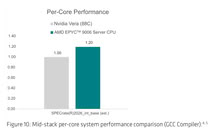
Sources:
AMD, Tom's Hardware
The Vera figures come from NVIDIA's own white paper, and the 96-core part is an EPYC 9996 with several of its cores turned off. The per-subtest results also used GCC 16.1 on the AMD side against GCC 15.2 for NVIDIA, which Tom's Hardware notes is not best practice. The 2.24x figure compares a 512-thread flagship with Vera's 176 threads, so it is not a like-for-like matchup. AMD says Venice is in production, with major OEM platforms on track to launch and cloud providers starting deployments later this year. It's likely we will only get a real answer once independent reviewers get both chips on the same test bench.


8 Comments on AMD Claims EPYC "Venice" Beats NVIDIA Vera by 2.24x in New White Paper
Independent third party reviews should paint the correct picture for specific workloads.
Unfortunately "old" Zen 4 and EMR/GNR Epycs/Xeons won't trickle down as affordable chips for us, and BDW's not getting any younger... miss home servers, man.Nice to see FRED and AVX10 confirmed. Hope they make it to Ryzen too. That Zen 6 X3D2, mmm, haven't salivated to buy a new CPU for a while
Also, perf/W is not discussed. Considering it's an important metric for servers, we can guess why.
On paper Nvidia is ahead on TDP on the comparable models, for 88c vera vs 96c model.
9686F shows 500w tdp default with 400-600w ctdp. and Vera is 250-450w across all models, 88c being 450w standard set.
I would assume for benchmarks.... AMD set it to 600w vs Vera 450w.
LPDDR5x gives Vera a further edge on platform tdp but they throw that edge away on the GPUs.
AMD uses 2nm on the mi450x vs 3nm on Nvidia's Rubin
So a 72 GPU rack of Helios is expected to use 20% less power than an NVL72 VeraRubin.
Nvidia got nervous with AMDs initial Mi450 announcement and overclocked rubin and got the imc to work with faster hbm... it got a major revision pre-launch.
Nvidia wins heartily on FP4 performance but loses at FP6 and FP8 and has half the HBM capacity, and less bandwidth.
OG Rubin specs... of Note AMD also was targeting 18TB/s before Nvidia adjusted, and they responded with a more moderate increase from 18-23.3, instead of the nearly doubling of 13 to 22TB/s
So, in summary, Vera surprised the heck out of the industry... and Helios surprised the heck out of Nviida.
Neither expected such competition and the end results is rather close from a Tflops perspective and interesting tradeoffs at the platform level.