Friday, September 25th 2026

Microsoft CEO Satya Nadella Calls Updated Copilot a "New OS for Work"
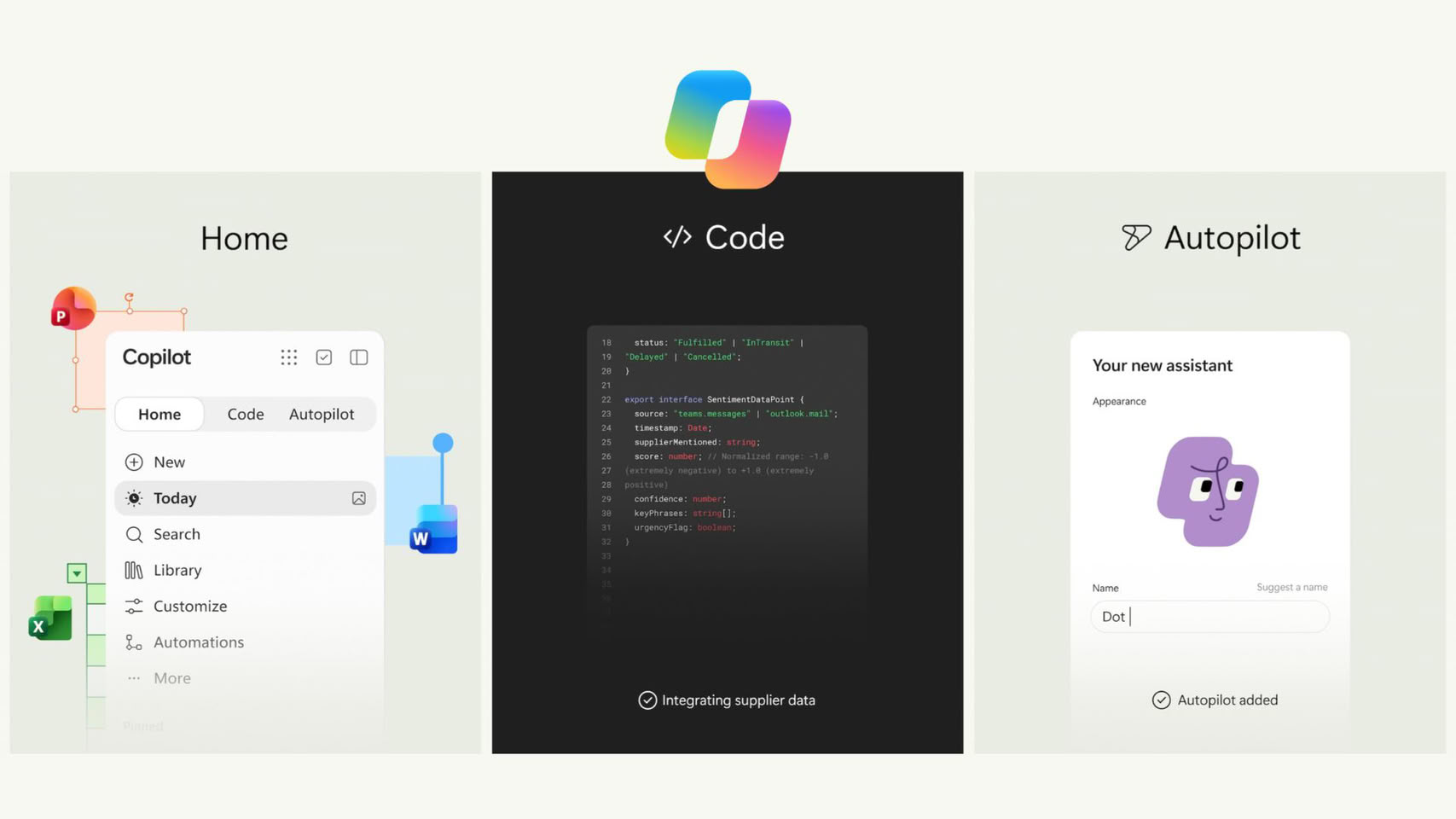
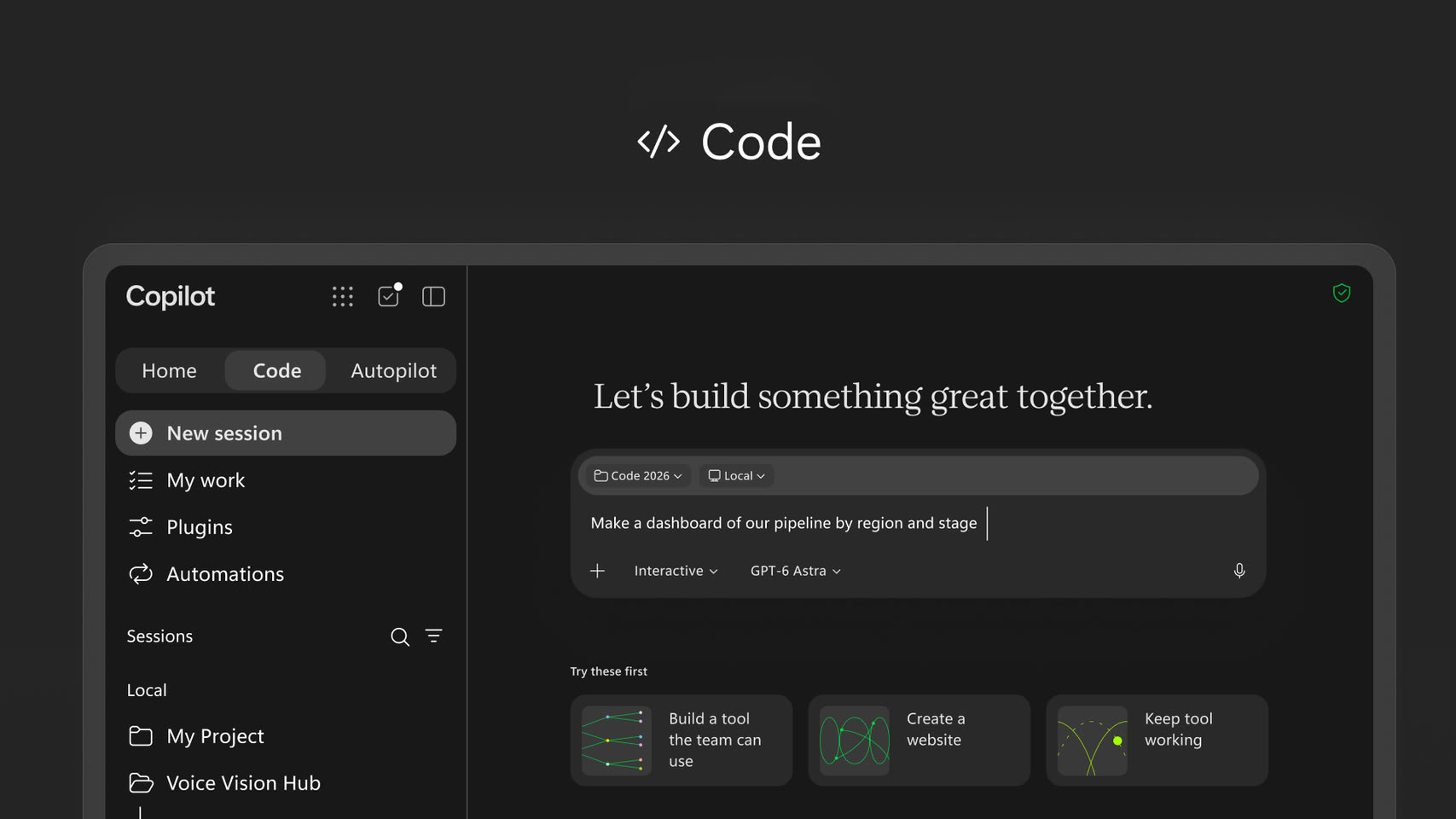
Microsoft CEO Satya Nadella has laid out his most direct pitch yet for what Copilot is supposed to become, calling it a "new OS for work that spans every model, every form factor, and every task." The comment came alongside Microsoft's biggest Copilot overhaul to date, which merges four pieces into one app: Autopilot (a long-running enterprise agent), Code (an in-app builder that hosts apps inside a company's own tenant), Home (which combines Chat and Cowork), and Office, with Word, Excel, and PowerPoint now built directly into Copilot. Nadella also mentioned Copilot support inside Teams, plus a new feature called Today that pulls relevant information from across Microsoft 365 without the user having to ask.
It looks like Microsoft wants Copilot to work more like a proactive layer sitting across a person's entire workday instead of a chat window they open on demand (or by accident). Interestingly, Microsoft avoided calling Copilot part of the Windows 11 operating system this time, a year after its "agentic OS" framing for Windows drew a fairly rough reception from users. This is not even the first time Microsoft has thought about expanding Copilot in this way. Microsoft did explore a full Copilot-centered operating system internally, under the codename Project Aion, though that reportedly dates back to 2024 and there's no word on whether it's still active.

 As for the new Copilot experience, Code expands within Frontier by the end of September, Autopilot enters private preview around the same time, and Office inside Copilot reaches consumers and Frontier customers in the coming weeks. Pricing is also changing, with the heavier agentic features, Cowork, Code, and Autopilot, moving to usage-based billing that's off by default. This move also comes as Microsoft has been pulling back Copilot+ branding from its newest Surface PCs, even as it pushes the Copilot app itself to do more. Microsoft also confirmed it's retiring the Microsoft 365 Companion apps for Calendar, People, and Files, nudging users toward Copilot and its existing apps instead.
Sources:
Satya Nadella on X, Microsoft
It looks like Microsoft wants Copilot to work more like a proactive layer sitting across a person's entire workday instead of a chat window they open on demand (or by accident). Interestingly, Microsoft avoided calling Copilot part of the Windows 11 operating system this time, a year after its "agentic OS" framing for Windows drew a fairly rough reception from users. This is not even the first time Microsoft has thought about expanding Copilot in this way. Microsoft did explore a full Copilot-centered operating system internally, under the codename Project Aion, though that reportedly dates back to 2024 and there's no word on whether it's still active.

50 Comments on Microsoft CEO Satya Nadella Calls Updated Copilot a "New OS for Work"
He is going to be end of Microsoft.
So updates gets done and program gets installed. Good but then they open the program and need to change some settings to make it more like how they worked on Windows. Well half the stuff they can't find because it's in a config file. They don't know how to use it oh and on top of that they can't save it because for some dumb reason the developer made it so only root users can edit the config file (yeah been there more than once)
And then you're basically just 5 minutes in. Not even gonna start how the other half of the programs is that you got to get the repo in first and by then you lost 99% of the people again who wanted to switch beforehand.
They still won't even know of the tons of linux masochists who demand that you compile the stuff yourself.
And yes this is still the case in 2026 and the case on the big platforms as Ubuntu, Debian and Fedora.
Linux is great if you are willing to learn stuff but it's not and won't be a platform for average joe and the average gamer because the yes the simple base is low but beyond that there no path going down. Every linux philosophy is just push them off the edge and see who survives the fall.
Learn the new way we want you to use our software or disconnect from updates.
For the systems I administer the latter is the path I have taken. I may put Linux on my main rig as a second boot and start the process of migration, two servers I run could have Linux, database and multi user support with some tweaking, but simply locking out windows updates through a firewall is easier for now.
I lay it out for you, spoiler alert: Windows, the clicking layer you are so fond off - is not the operating system, you do understand that, right? Linux is also not a mystery console or as you say - 48 random updates (I have a lot more daily on a rolling system, funny thing - those work and don't cripple it, they actually work a lot more ofthen then M$ update-roulette of fix 2 brake 3 comedy)
I get it, life is hard, reading anything is a torture, processing information with understanding is too much - I get it, no one is forcing you to read any manuals or dig into docs. If you expect the M$ Windows attitude to the User, where the User is a tenant - that is fine, but you need to understand that on a unixish system this philosophy is not existing- it was made for the user who can use it, not for a sulking tenant that pays for the ability to trash a support line about BSODS or other problems of yours. System that work require a different approach and are build from a different perspective- if you are fine with your bovine role in your daily user experience that is fine, its your choice - but don't judge a system you basically have no means to understand - linux is just a part of a broader system spectra btw. - and - imagine that 99.9% of the infrastructure connected to the internet is running on the exact family of systems, and Windows is nowhere to be seen around.
I let you figure out that answer on your own,
There is no need to be rude, btw. Those two are just OSes, not your or his friends or family...
I think he is not sane enough to properly run Microslop.
M365 Copilot Premium is mid, but E365 (note the difference) Copilot Cowork uses OpenAI Astra and Claude Fable so it's actually really good. When combined with the fact that it can search everything you have access to in a E365 cloud tenant* it's actually extremely effective at work. In fact I'd say Copilot Cowork is actually more seamless than Claude Cowork in the Claude app.
*I have access to a gazillion folders, SharePoint locations, etc. and can't keep track of them or their contents.
And therefore, Copilot is next to non-existent in personal PC space, yet apparently going strong in enterprise space - I do not know that, I could only judge Copilot based on what is available to me.E365 is out of reach for home users and majority of users in small companies.
Yet, Microsoft apparently do not care about that, targeting enterprises as their main goal... They do have most money, so it makes sense...
However, here's the thing: nearly all Microsoft mobile apps are basically the same thing under the hood, and they're all gateways to the same AI functionality. For example, Copilot and Bing present as browsers on Android, just like Edge. All 3 have Copilot integrated. Thus, while Copilot itself isn't in the Top 20 AI apps, Microsoft owns 3 of the Top 50 apps, including 1 of the Top 10 and 2 in the Top 25:
They're also the largest single OpenAI shareholder, at 27%.