Wednesday, November 4th 2026

Intel Readies "Moon Lake" and "Wildcat Lake Refresh" Built on 18A Node
Intel is reportedly preparing two new processor SKUs focused on extremely low-power computing. The first, called "Moon Lake," is designed as a pure low-power efficiency (LPE) core SoC. The "Moon Lake" generation features no P-Cores and up to 4 "Darkmont" LPE-Cores on the Intel 18A die. Unlike "Wildcat Lake," which includes at least 2 P-Cores, "Moon Lake" is intended to be a much smaller design for embedded devices like NAS. The base power of "Moon Lake" is reportedly rated at 6 W, similar to an SoC typically used in smartphones. The number of Xe3 cores in this SKU is unknown, but since "Wildcat Lake" has up to 2 Xe3 cores, we expect "Moon Lake" to have half of that to maintain its 6 W TDP. Intel has manufactured "Moon Lake" on its 18A node and placed it on the BGA1516 package, the same platform used by "Wildcat Lake." The official moniker for "Moon Lake" is MNL, and it could be a successor to the N-Series, like the previous "Alder Lake-N" series of low-power processors.
Additionally, Intel is preparing an overhaul of "Wildcat Lake" with the new "Wildcat Lake Refresh." When Intel launched the Core 300 Series "Wildcat Lake" earlier this year, these processors came with up to 2 P-Cores, 4 E-Cores, and up to 2 Xe3 GPU cores, with a package reaching up to 35 W. However, the new "Wildcat Lake Refresh" is expected to increase the number of P-Cores to 4 while keeping the same base microarchitecture of "Cougar Cove" and maintaining 4 "Darkmont" LPE-Cores. The integrated graphics remain similar, with up to 2 Xe3 cores. Importantly, this refresh adds support for Intel's vPro technology, meaning that enterprise customers are in for a surprise with a new low-cost option for their PCs.
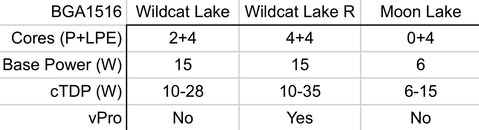 All three platforms—"Wildcat Lake," "Wildcat Lake Refresh," and "Moon Lake"—are reportedly well-received in the low-power computing space, as Intel is actively pushing their development. All three are based on the
18A node for manufacturing, with Intel Foundry handling the work, and they share the BGA1516 package.
Update November 4: Famous Intel leaker Jaykihn notes that "Wildcat Lake Refresh" will use 18A-P node, which is an enhanced version of the vanilla 18A, while the "Moon Lake" design remains on the regular 18A. Launch date for "Wildcat Lake Refresh" is scheduled for Q2 2027, while "Moon Lake" is arriving a bit later in Q4 2027.
Source:
Jaykihn on X
Additionally, Intel is preparing an overhaul of "Wildcat Lake" with the new "Wildcat Lake Refresh." When Intel launched the Core 300 Series "Wildcat Lake" earlier this year, these processors came with up to 2 P-Cores, 4 E-Cores, and up to 2 Xe3 GPU cores, with a package reaching up to 35 W. However, the new "Wildcat Lake Refresh" is expected to increase the number of P-Cores to 4 while keeping the same base microarchitecture of "Cougar Cove" and maintaining 4 "Darkmont" LPE-Cores. The integrated graphics remain similar, with up to 2 Xe3 cores. Importantly, this refresh adds support for Intel's vPro technology, meaning that enterprise customers are in for a surprise with a new low-cost option for their PCs.


Update November 4: Famous Intel leaker Jaykihn notes that "Wildcat Lake Refresh" will use 18A-P node, which is an enhanced version of the vanilla 18A, while the "Moon Lake" design remains on the regular 18A. Launch date for "Wildcat Lake Refresh" is scheduled for Q2 2027, while "Moon Lake" is arriving a bit later in Q4 2027.
30 Comments on Intel Readies "Moon Lake" and "Wildcat Lake Refresh" Built on 18A Node
The Darkmont cores are as performant as P cores from just a couple years ago at iso-frequency, minus a couple instructions like AVX 512 IIRC. So a passively cooled chip with four of them is quite compelling. Do need an 0+8 variant eventually or a 1+8, to fully replace Alder Lake N. I've got a 15 W i3-305 Alder Lake NAS, and it's pretty zippy even with single channel memory.How? These are very performant cores, I understand for a gaming/workstation it wouldn't be enough due to just four threads and relatively low clocks, but what else can you find at 5-15 W that isn't Apple Silicon? These low wattage existing Wildcat Lake chips already perform better than most Alder Lake and even some Raptor Lake laptops, which are significantly higher TDP/silicon size.
Edit: One of the lowest Wildcat Lake CPUs against the highest tier Alder Lake-U SKU. It's outperforming it with half the threads.
The bottom Wildcat Lake SKU with only 1 P core still does pretty well. Wouldn't expect a major difference, maybe 20% lower, with just the 4 E cores even after the P core goes bye-bye.
This chip is most likely going to be paired with Windows 11, probably with 8GB RAM, and is going to throttle like crazy when loaded.
If it were to be paired with a more lightweight OS, it could probably offer a decent experience.
For the average consumer though, with Windows being Windows, background services are going to be eating away a good chunk of performance before you even start trying to do anything, and pretty much anything running in the background is very likely to overload the CPU and its 6W power budget 🤷🏻♂️
Hopefully I am wrong, though.
Have to wait for reviews to see!
LNL are chips that can idle at ~1 W, even with the 4 P+4 E silicon. Wildcat Lake doesn't idle as nicely due to no MoP, but pushed those load numbers down even further. Without a high-boosting P core, I'm expecting really interesting efficiency/performance.
Wildcat lake R is probably going to be more than enough for everyone only doing light office like tasks
EDIT: Meant Moon Lake and Dark Mont
I've needed passive cooled laptop on the cheap just for watching stuff in bed and it has been serving me well. These newer cores do a lot more work per clock so they can't exactly be compared to older ones. Even N200 were already much faster though it's interesting that N300 only has 1W higher budget at 7W and packs 8 of those cores at slightly higher clock.
The CPU performance should be close to any fast quad-core from Skylake to Comet Lake. I think the iGPU would be faster than UHD 630 even with only one Xe3 core. More interesting if given two Xe3 cores. If it comes in a Mini PC with a DDR5 SODIMM slot, you could eventually upgrade it to have up to 64 GB in single-channel, with bandwidth comparable to old dual-channel DDR4 devices.
So it's a fine product that will be made more or less interesting by pricing, and could be a good replacement for Alder Lake-N devices. You lose the P-core single-threaded performance from Wildcat Lake, but save some money and power.
Still, it's a shame (given how much money was invested in 18A) TSMC gets to make big chips and 18A is left for producing crumbs.
Now if there were cheap PCIe 4.0 switches/bridges things would be different because MNL/WCL with 6 PCIe 4.0 lanes has a third more bandwidth than ADL-N with 9 PCIe 3.0.
Lunarlake/Wildcatlake/Pantherlake are same battery life and power wise. XPS 13 on Pantherlake does 27 hours without VRR and 41 with while web browsing, not idle. That's actually lot better than Lunarlake XPS 13 as it has similar efficiency to the Pantherlake without VRR, and Wildcatlake has same basic advances.No Wildcatlake has 8 LPE cores. They all have 4.It'll be faster than quad core from those gens as these chips can actually hold their clocks, whereas Sky to Comet can only do for a short time.
1 Xe3 core is 2-2.5x the performance of UHD 630, nevermind having support for XeSS, meaning you can adjust for further gains.
www.notebookcheck.net/HD-Graphics-620-vs-Intel-Graphics-1-Xe3-WCL_7435_13536.247598.0.html
It's over 3x the performance in GTA V, with Core 3 304 on Med 768p settings getting 70 fps and outperforming HD 620 1024x768 Low getting miserly 27.8 fps. Also you'll get much better compatibility and less errors.If 3.6GHz Darkmont cores are shitty, so are 3.6GHz Zen 5 or 3.6GHz Lion Cove(Arrowlake) cores.
Unfortunately, this strong performance is limited to the Windows 8.1 platform. Even the 3770K, which offers twice the performance, doesn’t provide as good an experience on Windows 10 as the J4105 does on Windows 8.1. I really have no idea how much bloated junk Micro$oft has crammed into Windows 10.
Instead, my criticism is more about performance at the 6W TDP of the chips.
Yes, they may be super-efficient, but 6W is still an incredibly low power budget, and it applies to the full chip, not just the CPU cores.
I have not been able to find any information about frequency scaling for Darkmont LPE cores, but with a1~1.25W power budget for each core (leaving only 1-2W for the IGP and the rest of the SOC), I really doubt they can sustain usable clocks.
Sure, you could argue that Intel allows up to 15W for the chips, and probably some manufacturers will use this for PL2.
But, I am also sure many will not give the chip a sufficient PL2, especially for budget/passively cooled laptops.
Even then, with a higher PL2, what kind of Tau will they allow?
Once you hit Tau, you need to unload the chip for a while, before it lets you boost up to PL2 again.
With only four overloaded cores, and with Windows services always running, recharging your Tau could be an uncommon event...
I am sure there are some great fits for this chip (NAS, Firewall, Appliances, TV Streamer, etc.), but I am still sceptical about how it will actually perform in real consumer computers.
For sure it will be manufacturer dependent, but with these ultra-low-cost chips, I am not really hopeful that there will be any well optimized designs.
Only time and reviews will tell!
Now I'm thinking Moon Lake is using the same tiles as Wildcat Lake, with the P-cores disabled. As if it's just Wildcat Lake binned down for power efficiency and lower price points, with a new name. They are already confirmed to use the same BGA package.
The multi-threaded performance of Moon Lake should be similar to the i3-N305, while being more responsive from the single-threaded increase, and more efficient.Nice.There's more bloat running in the background, but also Spectre/Meltdown/Foreshadow mitigations in W10 that could disproportionately impact those old processors. And no Intel Speed Shift.
The legendary Skylake is good for Windows 10, while Kaby Lake's addition of MBEC makes it better for Windows 11 even though the desktop CPUs are officially unsupported. Kaby Lake is the oldest generation most people should bother with on the used market. As a bonus, it has improved video decode support.