Wednesday, December 3rd 2025

Samsung Could Convert Some HBM3E Capacity to Regular DRAM to Meet Demand
As Samsung transitions from its HBM3 and HBM3E variations of HBM memory to HBM4, the company is reportedly reallocating some of its HBM production capacity to regular DRAM to meet demand. Discussions within the company focus on converting approximately 30-40% of the current capacity from the 10 nm-class, fourth-generation 1a DRAM process to the 10 nm-class, fifth-generation 1b lines used for general-purpose DRAM. This includes DDR5, LPDDR5X, LPDDR6, and GDDR7 memory. With additional investment to repurpose mature process nodes like 1z, Samsung expects to free up the equivalent of about 80,000 wafers per month of 1b capacity.
While HBM typically offers higher margins for companies like Micron and SK Hynix, Samsung's internal estimates show that the operating profit for a 12-hi HBM3E stack is around 30%. In contrast, the near-term expectations for general-purpose DRAM exceed 60%. These margin differences, along with forecasts of a significant decline in average selling prices for 12-hi HBM3E and limited incremental demand from the largest HBM customer, have reduced the incentive to expand HBM3E production.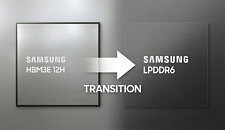 With DRAM demand reaching record highs, Samsung stands to lose nothing, as all available DRAM will be absorbed by the AI industry. Any remaining HBM3E capacity will be taken up by ASIC designers such as Google, Broadcom, MediaTek, and others. For standard DRAM like DDR5, hyperscalers will be eager to see increased capacity for their data center expansion projects. However, it will take months for any changes to manifest in the supply chain, as transitioning from near-zero to a finished DRAM chip requires months of manufacturing.
Sources:
DealSite Korea, via @jukan05 on X
While HBM typically offers higher margins for companies like Micron and SK Hynix, Samsung's internal estimates show that the operating profit for a 12-hi HBM3E stack is around 30%. In contrast, the near-term expectations for general-purpose DRAM exceed 60%. These margin differences, along with forecasts of a significant decline in average selling prices for 12-hi HBM3E and limited incremental demand from the largest HBM customer, have reduced the incentive to expand HBM3E production.

7 Comments on Samsung Could Convert Some HBM3E Capacity to Regular DRAM to Meet Demand
The state doesn't care as long as domestic supply is guaranteed (which it is thanks to Micron) and in general has been robbed and starved of state capacity for decades that could have managed this crisis (if the administration cared, which it doesn't).
And you can use the "AI needs this to succeed" excuse on every single business and government actor here and it will work.