News Posts matching #price

Return to Keyword Browsing

TSMC Could Charge Up to 20% More for CoWoS Packaging Amid AI Crunch

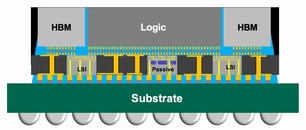
TSMC is reportedly considering raising prices for its CoWoS (Chip on Wafer on Substrate) advanced packaging by as much as 20%, according to supply chain sources cited by Taiwan's Commercial Times. Foundries and outsourced packaging firms are apparently weighing another round of 10% to 20% increases, as CoWoS demand has spread beyond AI GPUs to server CPUs and custom ASICs, leaving a growing backlog of unfilled orders. TSMC hasn't confirmed anything yet.

Testing is turning into a bottleneck of its own. Nomura estimates, via Seoul Economic Daily, that NVIDIA's Blackwell takes roughly four times longer than Hopper in final testing, while Rubin could need seven times as long. Packages keep growing too, with TSMC already mass producing CoWoS-L at 5.5 times the reticle limit. Tool lead times have reportedly stretched from three to six months to as long as eight months. TSMC, which usually negotiates for discounts or extra features, apparently placed this year's equipment orders at existing prices instead, which says a lot about how tight things are.

Samsung 8LPU+ Gets Floated as the Node for a Future Switch 2 Lite

Samsung Foundry will present 8LPU+, the second generation of its 8LPU platform, at IEDM 2026 on December 14, and Nintendo Patents Watch has already pegged it as a possible fit for a Switch 2 Lite. It's speculation for now. Nintendo hasn't announced a Switch 2 Lite, and Samsung's material doesn't mention Nintendo or NVIDIA. The link exists because the Switch 2's NVIDIA T239 SoC is built on Samsung's 8 nm node, so a refined version of that process is an obvious candidate for a cheaper handheld-only model.

Samsung's IEDM abstract lists 12% higher performance, 15% lower power, and an 8% area shrink over 8LPU, along with roughly 10% smaller I/O area and lower standby leakage. It's a DUV-only node, and Samsung pitches it at automotive, robotics and edge AI chips. Korea's Electronic Times reports the platform should arrive before year's end, and quoted an industry official who named existing 8 nm customers as likely candidates. Of course, these are process-level figures, so they don't directly translate into a future Switch 2 Lite that runs 12% faster or lasts 15% longer per charge. We also don't know how closely NVIDIA's custom 8N variant maps onto 8LPU+.

Anthropic Files to Go Public on Nasdaq, Reveals $16.3 Billion in First-Half Revenue

Anthropic has publicly filed for an IPO, submitting an S-1 to the SEC on October 26 with plans to list on the Nasdaq under the ticker "ANT." The filing leaves the price range and share count blank for now, but the Wall Street Journal reports the offering could raise $100 billion or more at a valuation of $1.5 to $2 trillion. If that ends up being the case, it would top the record SpaceX set with its June IPO. Goldman Sachs and Morgan Stanley head a long list of underwriters, and trading is reportedly targeted for the week of November 16. The prospectus also gives the first official look at Anthropic's books.

Revenue for the first half of 2026 came in at a massive $16.3 billion, up from $1.16 billion a year earlier. The company also posted an $80.7 billion net loss. However, about $72.4 billion of that is a non-cash charge tied to the changing value of convertible notes and similar instruments, and the operating loss was a much smaller $693 million. Anthropic says more than 11,900 customers now spend at least $100,000 a year, and it holds about $131.7 billion in cash and short-term investments. It has also signed huge compute commitments, including up to $114.5 billion with Google, at least $110 billion with Amazon, and a separate deal for AMD Instinct MI450 GPUs. Of course, the filing comes with the usual warnings, as Anthropic says it may not reach or sustain profitability and expects costs to keep rising. OpenAI, meanwhile, says it doesn't expect to go public until next year.

Netflix Reportedly Walked Away After Xbox Asked $800 Million for Its Game IP

Netflix reportedly offered Microsoft $500 million for seven years of exclusive film and TV adaptation rights to Xbox games, but the two sides never reached a middle ground. According to Matthew Belloni's What I'm Hearing newsletter at Puck, which cites three sources, the offer came from Bela Bajaria, Netflix's chief content officer at the time. Xbox CEO Asha Sharma and her business affairs team apparently countered at $800 million. Bajaria was recently let go and is being replaced by former Disney and Fox executive Peter Rice, and with her gone, the Netflix offer is said to be off the table. Netflix CFO Spence Neumann was reportedly one of the people who thought the price was too high.

Netflix has not commented on the deal, while Xbox told Puck it has seen "record-breaking interest" in its IP and still considers Netflix a valued partner. The two already have Minecraft and Diablo animated series on the way, and Netflix is also working on a Gears of War movie. Instead of one big exclusive package, Xbox is now said to be chasing smaller deals with more partners, which is pretty much what its new XP division was set up to handle earlier this month. That extra licensing money would probably be welcome right now. Xbox has missed Microsoft's executive pay target for the fifth time in six years, just lost its first chief operating officer, and Sharma recently told staff the division won't survive without new IP. Rice is also expected to go after more IP deals at Netflix, so we can expect the two companies to end up talking again.

NVIDIA Eyes Software Revenue With a $2,000 per GPU Yearly Figure From Huang

NVIDIA CEO Jensen Huang has put a rough price on the software side of the company's AI business. During a Q&A session at GTC Berlin last week, Huang said software licensing will become a growing part of NVIDIA's business, and that it costs about $2,000 per GPU per year to run all the NVIDIA software that powers agents in AI factories. The Register was first to report it, and Huang seems to have offered it as an example rather than a formal price.

The number is a bit confusing, since NVIDIA already sells its AI Enterprise suite on a per-GPU basis. The company's own licensing guide lists it at $4,500 per GPU for a one-year subscription with support, or $18,000 per GPU for five years. NVIDIA hasn't said whether Huang's $2,000 figure covers the same software, a narrower agent-focused bundle, or a future licensing model, so it probably shouldn't be read as a price cut. There's also no word on timing.

ASUS and Gigabyte Bump RTX 5080 Prices in China, RTX 5070 Ti Also Sees Wholesale Increase

Rumors of the RTX 5080 16 GB being discontinued are picking up steam, and the effects are starting to show. RTX 5080 16 GB wholesale prices in China have jumped by around 2,000 yuan (roughly $300), according to new information from Board Channels. The card previously traded at 12,700 to 13,500 yuan (~$1,900 to $2,020) and now sits at 14,500 to 15,000 yuan (~$2,170 to $2,240). Board Channels blames tighter upstream supply and the reported discontinuation of the 16 GB model. A leaker recently claimed that NVIDIA has set January discontinuation dates for the card, though NVIDIA hasn't confirmed anything.

Along with the RTX 5080 16 GB, the RTX 5070 Ti, which uses the same 16 GB of GDDR7, is also facing price hikes. It is now going for 9,650 to 9,850 yuan (~$1,440 to $1,470), compared to 9,000 to 9,150 yuan (~$1,350 to $1,370) before, a roughly $100 bump. Board partners are adjusting too. ASUS has reportedly added 1,000 yuan (~$150) to all of its RTX 5080 16 GB models and 200 yuan (~$30) to the RTX 5070 Ti, RTX 5070, and RTX 5060 Ti 16 GB cards. Gigabyte went further, with 1,200 yuan (~$180) on its RTX 5080 cards and 200 yuan (~$30) on the RTX 5070 Ti and RTX 5070. Cheaper RTX 5060-class cards from both brands saw smaller bumps of 200 yuan (~$30) or less, and ASUS reportedly raised prices on its Radeon cards as well, between $15 and $50.

PlayStation 6 Predicted to Undercut Xbox Helix by $200

The rumor mill has long been abuzz with estimations and updates about the supposed price of both the Xbox Helix and the PlayStation 6. The latest update from notable leaker, Kepler_L2 on X, suggests that Sony may have the upper-hand on pricing for the next console generation. According to the leaker, Sony's PS6 bill of materials cost is slated to be as much as $200 lower than that of the Xbox Helix, which will reportedly cost somewhere between $1,200 and $1,800.

This Helix price bracket theoretically puts the PlayStation 6 somewhere around the $1,000-1,100 price point, if Sony decides to price the PS6 as competitively as possible. However, it seems as though the pricing strategy for the upcoming console generation is changing, with Sony's Hideaki Nishino commenting in a June financial report that "we do not intend to sell hardware at significant losses," suggesting that the days of low console prices subsidized by subsequent game sales are behind us.

Super Flower's 12V-2x6 OCP Dongle Watches Every Pin, Blacks Out Your Screen on Overcurrent

Super Flower has launched the VGA 12+4PIN OCP Dongle, a small inline box that sits between the PSU cable and a graphics card's 12V-2x6 connector and keeps an eye on the current running through each 12 V line. It was first shown at Computex 2026, and can now be seen on Super Flower's website, priced at NT$1,190 (roughly $38) in Taiwan. However, you can't buy it on its own just yet. For now, it's only offered as part of a limited promotional bundle with Leadex VIII power supplies, and there's no word on standalone sales or a wider release.

As for the protection part, each alert needs to hold for 10 seconds before it fires. Between 9.5 A and 12 A on any line, or if two lines drift more than 6 A apart, the LED turns orange and the buzzer starts beeping. Past 12 A, it flashes red with a continuous tone for 180 seconds, stays solid red for another 15, and then triggers "VGA Black Screen Protection." That mode stays active even if the current settles. Super Flower doesn't say how the black screen works or whether power is cut, and simply advises shutting down and checking the cables. That part can be a bit unreliable, but it's safe to assume that most users will suspect something is wrong if the screen blacks out for a significant bit of time.

Xbox Cloud Gaming Goes Prepaid, Prices Start at $3.99

Microsoft has started selling Xbox Cloud Gaming time to people who don't pay for Game Pass. Starting today, Xbox Insiders without an active subscription can buy prepaid playtime and stream games on supported devices, with a broader rollout planned for November. There are three packs at what Microsoft calls introductory launch pricing: 10 hours for $3.99, 25 hours for $7.99, and 50 hours for $11.99. The packs are ad-free and come with shorter wait times, and the purchased hours don't expire until they are used up. Insiders can also keep using the free, ad-supported option Microsoft began testing in July. These pay-as-you-go plans arrive right before the monthly hour limits Microsoft announced in September kick in.

Starting in November, Game Pass Ultimate ($22.99) includes 15 hours of cloud gaming per month, Premium ($14.99) gets 10 hours, and Essential ($9.99) gets just five. Microsoft expects the caps to affect around 4% of subscribers, and said those who run out will be able to buy extra playtime through the Xbox Store. It seems likely these packs will double as top-ups for subscribers, though Microsoft hasn't confirmed that yet. On paper, $11.99 gets you more than three times the streaming hours Ultimate includes each month. Of course, Ultimate also comes with the Game Pass library, while the packs are meant for streaming eligible games you already own. More details on eligible games and market availability should follow in November. Since the current prices are labeled introductory, they could very well change later.

Dell CEO Says the Memory Shortage Will Get Worse in 2027

Michael Dell doesn't think the memory shortage is anywhere near over. Speaking with The Wall Street Journal, Dell's chairman and CEO said things will get worse next year, as the AI data center buildout keeps soaking up DRAM and HBM supply. According to him, the bottleneck for Dell isn't demand, since the company is sitting on roughly $95 billion worth of AI server orders it hasn't delivered yet, the largest backlog in its history. Memory is what's holding those shipments back, as AI accelerators need plenty of HBM, while the servers around them still rely on conventional DRAM.

Relief also looks quite far away. New memory fabs take around four years to build, so Dell apparently doesn't expect meaningful new supply until 2029 or 2030. That aligns with Micron's CEO, who recently said supply will be much tighter in 2027 and 2028 than it is this year. Interestingly, SK hynix's CEO said something similar, expecting the memory shortage to last through 2030. Dell is reportedly coping by buying DRAM only when final assembly is close and by locking in long-term supply agreements, though there's no word on how much of that applies to its consumer products.

Xbox Helix Console Reportedly Headed for Holiday 2028 at $1,200 to $1,800

Microsoft's next-gen Xbox console could cost a lot more than anyone hoped. A new Fortune profile of Xbox CEO Asha Sharma says the Project Helix console has internally been projected to cost consumers between $1,200 and $1,800, unless Microsoft decides to subsidize it. For reference, the current Xbox Series X with a disc drive sells for $799.99, and that is after the recent price hikes. The report also says Sharma plans to release a next-gen handheld by the 2027 holiday season, followed by the console in time for the 2028 holidays. Apparently, Helix engineering deadlines have been moved up by at least several months, according to people familiar with the matter, which is putting extra pressure on development teams.

The handheld has also caused some friction inside Microsoft. Windows leaders reportedly wanted it to run a trimmed-down version of Windows Home, while Sharma's team wanted its own software for better gaming performance. It got heated enough that a senior Xbox executive reportedly threatened to scrap the handheld rather than ship the Windows build, though Xbox now seems to be steering the OS. Sharma, for her part, says the teams still work together, noting, "We can't build Helix on our own." Microsoft hasn't confirmed any pricing, and a subsidy could bring the final number down a bit. However, Fortune puts Xbox's profit margin at around 3%, which probably doesn't leave much room for one. Elsewhere, memory makers expect supply to get even tighter in 2027 and 2028, while rival Sony also struggles with rising costs, so a cheap next-gen console looks unlikely from either side.

GTA 6 Digital Pre-Orders Climb to 6.45 Million, PlayStation Holds 74% Share

GTA 6 has now racked up an estimated 6.45 million digital pre-orders worldwide, worth roughly $630 million net of returns, according to the latest weekly update from Sensor Tower's sales tracker. PlayStation accounts for 74% of the total, or about 4.80 million copies and $468 million, while Xbox sits at 1.66 million copies and $162 million. The tracker's October 13 figures had GTA 6 at 6.08 million pre-orders and $594 million, so around 370,000 more people locked in their copy in about a week. In the US, Sensor Tower says GTA 6's digital pre-orders are 148% ahead of Call of Duty: Modern Warfare 2 (2022) at the same point before launch, the best performer among the big releases it tracked over the past six years.

Of course, these are third-party estimates covering digital copies only, and Take-Two hasn't confirmed any figures. CEO Strauss Zelnick did say in August that pre-orders were skewing toward the $100 Ultimate Edition, and Sensor Tower now says the vast majority of buyers went for that version. PlayStation has led since tracking began in June, and in late August Sensor Tower had it at about 77% of 4.86 million pre-orders. The firm tweaked its estimation model on October 5, however, so those older numbers aren't a perfect like-for-like comparison. Xbox's smaller share probably isn't helped by US Xbox hardware sales sitting at an all-time low this year. GTA 6 launches on November 19 for PS5 and Xbox Series X|S, so expect these numbers to keep climbing.

Xbox Is Asking Inactive Owners to Sell Their Consoles to Best Buy

Microsoft is reportedly emailing Xbox Series X|S owners who haven't touched their consoles in a while, nudging them to trade those consoles in at Best Buy. The email, first shared by Nintendeal on X, opens with "Haven't played on your console in a while?" and tells owners who have moved to other platforms that they can get "up to $375 back." Per Gizmodo, Xbox has confirmed the email is genuine. That $375 applies to a Series X in good condition with its cables and controller, while a Series S apparently tops out at $200. Payment comes as a Best Buy eGift Card, and the campaign seems limited to the US for now.

It looks like this is the trade-in program Microsoft promised in June, when it announced another round of price hikes and said traded-in consoles would be resold at lower prices. Those hikes pushed the 1 TB Series X with a disc drive to $799.99, and the 512 GB Series S to $499.99. Unsurprisingly, Circana data later showed US Xbox hardware sales hit an all-time low through August. Stock is the other problem, as new units are reportedly scarce in mainland Europe, Asia, the Middle East, and South America, while GTA 6's November launch is expected to drain shelves even further. Owners thinking about trading in should note that used Series X consoles have recently sold for over $500 on eBay, so Best Buy's offer is more about convenience than value.

Rumor: NVIDIA RTX 6060 May Be Years Away, and Possibly Slower Than the PS6

Anyone holding out for an affordable next-gen NVIDIA card might have a long wait. Hardware leaker Kepler_L2 claims on NeoGAF that the GeForce RTX 6060 will "launch much later," adding that, based on recent trends, he doubts it will even match the PlayStation 6. He was replying to a forum member who argued the PS6 would compete with the RTX 6060, in the same thread where he claimed the console's RAM and storage alone cost over $680. Kepler didn't give an actual date, and the 2029 figure going around seems to be an extrapolation. Both Kepler and kopite7kimi have placed NVIDIA's Rubin-based RTX 60 series in 2028, and the x60 cards usually trail the flagship by a few months. The RTX 5060 arrived under four months after the RTX 5090, while the RTX 4060 took over eight months to follow the RTX 4090.

With a flagship launch around mid-2028 or later, that could push the RTX 6060 into 2029. That said, the "much later" comment seems to be relative to the PS6, which is reportedly targeting late 2027, so the exact timing is still anyone's guess. Kepler didn't say why, but the ongoing memory shortage looks like the obvious suspect. NVIDIA reportedly postponed its RTX 50 SUPER refresh earlier this year to prioritize AI products that use the same GDDR7 memory, and the company recently admitted that RTX 5090 supply is tight. Of course, NVIDIA hasn't announced the RTX 60 series officially yet, so treat this as a rumor. Anyone looking to buy a new NVIDIA GPU should probably expect the current RTX 50 lineup to stick around for quite a while.

Dell Reportedly Raising Monitor Prices This Month, Entry-Level Models Spared

Dell's monitor division has reportedly issued an internal notice raising shipping prices on its displays, with the change taking effect this month. The leak comes from ChannelGate and was first reported by IT Home, and it points to an increase of around 3% to 5% for most affected models. Mid-range and high-end monitors take the hit, and some of the pricier models could go up by more than that, while entry-level models are reportedly left alone for now. Dell hasn't confirmed anything, and there's no word on specific models or regions. Apparently, costs first went up back in July, and Dell chose to absorb them at the time instead of passing them on to buyers. This looks like the first time those costs are being moved downstream, and the source expects more price revisions if costs keep climbing.

The report doesn't name a specific cause, though TrendForce's early October panel update notes that upstream component costs are rising sharply, leaving monitor panel makers little room to cut prices even as demand weakens. Keep in mind this is a shipping price, so how much of it reaches store shelves will depend on distributors and retailers. The timing also isn't great for Dell. The company already raised PC prices by 15% to 20% late last year as memory costs climbed, and more recently, PC shipments dropped 20.1% in Q3 2026, with HP and Dell reportedly taking the biggest hits. A 3% to 5% bump is small in comparison, but readers planning to pick up a Dell monitor are advised to keep an eye on current listings before the new pricing trickles down to retail.

PS6 RAM and Storage Alone Reportedly Cost Sony Over $680, Claims Leaker

The memory crunch looks like it is hitting the PlayStation 6 harder than expected. Hardware leaker KeplerL2 claims on NeoGAF that the RAM and NAND flash storage in Sony's next console alone cost over $680. He posted it as a reply to a forum member who floated $680 as a possible subsidized retail price, which pretty much puts that idea to rest. Keep in mind that figure covers only memory and storage, before the APU, cooling, power supply, and the rest of the hardware are counted. This is not the first time Kepler has updated his estimate. Back in March, he put the console's bill of materials at around $760, and by July, that had climbed to roughly $960.

Current leaks suggest the PS6 uses GDDR7 memory on a 160-bit bus with support for up to 40 GB, with 30 GB considered the more likely configuration. There have also been reports that Sony looked into cutting memory capacity to keep costs down, and the culprit is the same as everywhere else: AI data centers are soaking up DRAM and NAND supply, which pushes prices up for everyone. Sony has said nothing official about PS6 pricing, so it's reasonable to treat all of this with some caution. That said, if memory prices stay where they are, a PS6 that costs significantly more than the PS5 Pro seems likely, and a $1,000 price tag now looks quite possible.

NVIDIA Denies RTX 5090 Discontinuation Rumors, Admits Supply Is Tight

NVIDIA has finally responded to reports that the GeForce RTX 5090 is being discontinued. Jeff Fisher, senior vice president of NVIDIA's personal computing business, told Taiwanese media after the RTX Spark launch party in Taipei on October 16 that the rumors aren't true, as reported by 4Gamers and the Central News Agency (CNA). The whole thing kicked off last week when leakers claimed NVIDIA had stopped allocating GB202 silicon to the RTX 5090, and BenchLife later added that board partners were no longer receiving GB202 chips for the card. The RTX 5090 also seemingly vanished from NVIDIA's own marketplace and from Micro Center shelves, which only added fuel to the fire. Here's what Fisher said, translated from 4Gamers' Chinese report:
The supply chain (capacity) is indeed somewhat constrained, but NVIDIA is going all out to bring products to market. Although there are other variants of the RTX 5090 (chip), it has definitely not been discontinued. NVIDIA will continue to ship it, and this is very important.

HWiNFO Lists PTL-080, a Smaller Panther Lake Chip for Arc G-Series Handhelds

Intel seems to be preparing a smaller chip for its Arc G-series handheld lineup, and the first trace of it has appeared in HWiNFO. The monitoring tool's list of upcoming changes now includes support for "Panter Lake-H 080," typo and all. Leaker Jaykihn spotted the entry on X and says the chip, PTL-080, is an Arc G-series part with a 0+8+0+4 configuration. If that follows the same P-core, E-core, LPE core and Xe3 order Jaykihn has used before, it works out to eight E-cores, no P-cores or LPE cores, and a four-core Xe3 GPU. For comparison, the Arc G3 and Arc G3 Extreme both use a 14-core 2+8+4 CPU, paired with 10 and 12 Xe3 cores respectively.

This isn't the first smaller Arc G chip to surface. Back in August, Jaykihn posted a "4+0+4+4" handheld layout, which pointed to an entry-level part with four P-cores, four LPE cores and the same four Xe3 cores, and a later report put its power target at 8 W to 25 W. The new listing keeps the GPU size but drops the P-cores entirely. Apparently, the two might not ship side by side either. In a follow-up post, Jaykihn said the 4+0+4+4 design may be wholly replaced by 0+8+0+4, and that he'll share an update if and when that's finalized. Intel hasn't announced anything officially yet, so clocks, power limits, naming and pricing are all unknown. A four-core Xe3 GPU will likely trail the G3 parts by a wide margin in games, so it's reasonable to expect this chip in lower-priced devices.

Micro Center Reportedly Drops the RTX 5090 From Its Catalog as End-of-Life Rumors Pile Up

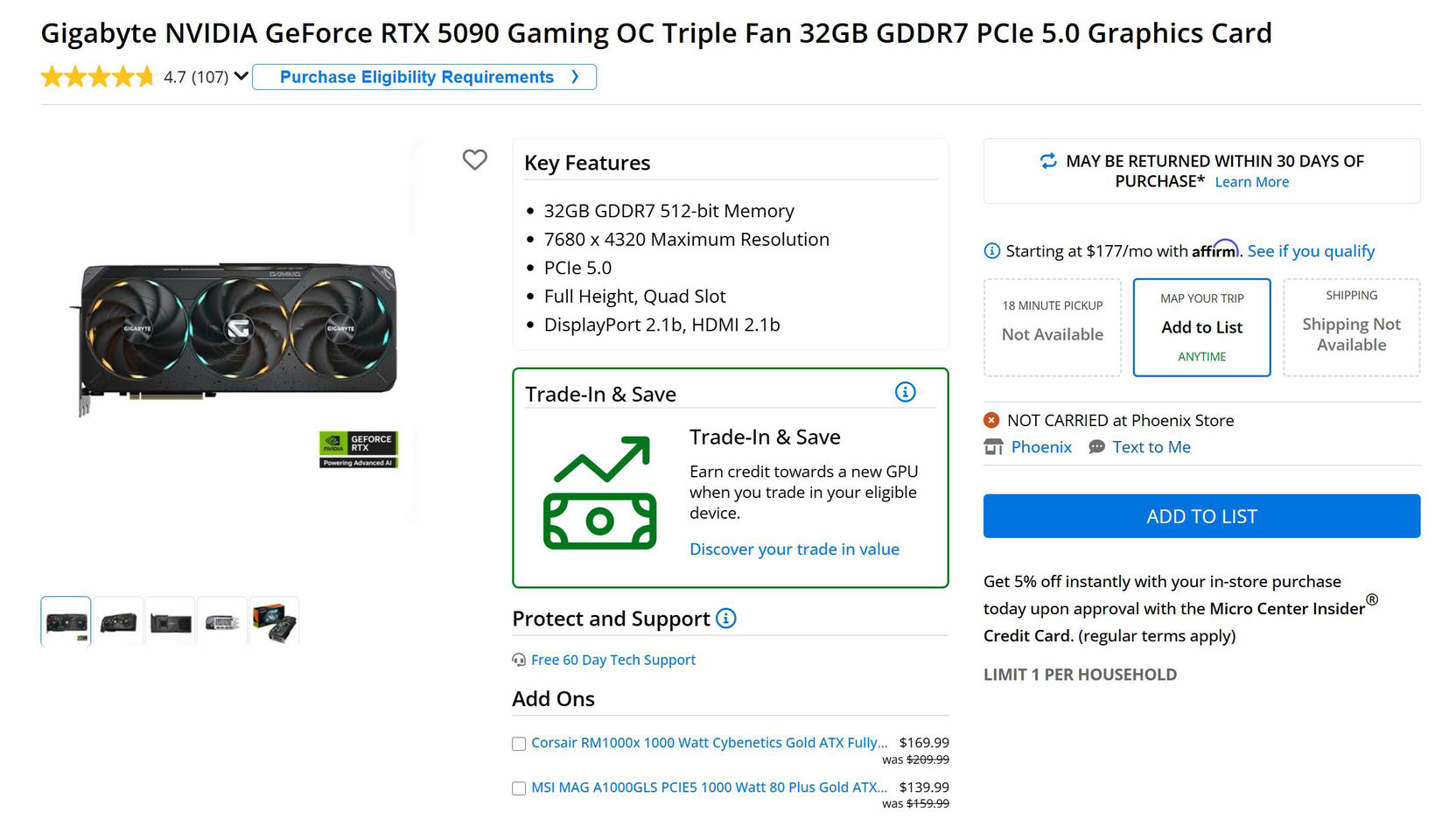
Micro Center seems to have quietly stopped selling the GeForce RTX 5090. Several RTX 5090 listings on the retailer's US website now show as "Not Carried," and a post on r/gpu claims every single one of them does. That label usually means a product has been dropped from the active catalog and won't be restocked. Custom models from ASUS, MSI, and Gigabyte are still listed but out of stock at physical stores, and the only RTX 5090 reportedly still sitting on shelves at most locations is an ASUS ROG Astral sold inside a 20th Anniversary bundle for almost $11,000. Neither NVIDIA nor Micro Center has commented on the situation yet, and NVIDIA's own website still lists the RTX 5090 at the now-mythical price of $1,999.

Separately, Redditor johnnyphotog on r/Microcenter says staff were already pulling RTX 5090 cards from the shelves on October 9. Apparently, a manager told him the cards were being sent somewhere else, and while he did manage to buy one, an employee told him it was probably the last RTX 5090 the store would sell. That timing is interesting, since it came a day before leakers claimed NVIDIA stopped allocating GB202 silicon to the RTX 5090 and is saving it for far pricier workstation cards like the RTX PRO 5500. Of course, the MSRP of the RTX 5090 hasn't meant much for a while, with the card selling out at Walmart for $4,299 last month. If GB202 supply has really dried up, whatever partner stock is left will likely get even pricier, so readers set on buying one shouldn't expect prices to come down anytime soon.

Valve Index Gets Discontinued, Remaining Stock Drops to $399

Valve's Steam store listing for the Valve Index now states that the headset is no longer being produced, with remaining headsets, controllers, and accessories up for sale while supplies last. On the US store, the Index headset is down 20% to $399.20 from its usual $499, and the Replacement Left Controller and Replacement Tether are 20% off as well. Valve says nothing changes for existing owners, and the Index will continue to be supported through Steam and SteamVR. The headset launched back in June 2019, when the full kit went for $999 on preorder. Its successor, the Steam Frame, opened for preorders on September 14 at $1,059 for the 256 GB model and $1,299 for the 1 TB version.

This isn't a sudden decision. Valve's Lawrence Yang already confirmed to The Verge in November 2025 that the company had stopped manufacturing the Index, around the same time Valve announced the Steam Frame. The store page update seems to be the formal send-off for the Index. However, the Steam Frame is currently available only through a reservation lottery system. It also uses camera-based inside-out tracking and doesn't support the Lighthouse base stations the Index relies on, so Index owners can't carry their base stations over to the new headset. Anyone still interested in a Lighthouse-tracked Valve headset, at a lower price than the Frame, should probably act soon, since there is no word on how much stock is left.

Xbox Nano Controller Shrinks the Gamepad to Pocket Size for $49.99

Microsoft has announced the Xbox Nano Controller, a pocket-sized gamepad priced at $49.99 (£44.99) that it calls its smallest controller yet. It measures just over five inches long and weighs a tiny 3.5 ounces, yet still packs all 18 standard gameplay inputs, plus a programmable Action Button for screenshots and gameplay capture. It connects over Xbox Wireless and Bluetooth, runs on a built-in rechargeable battery, and works with Xbox consoles, Windows PCs, iOS and Android devices, and select smart TVs. Microsoft hasn't shared battery life or color options yet, and there's no word on rumble or impulse triggers either. Pre-orders are open now, with the controller launching on November 4 across 36 markets, including the US, UK, Japan, and much of Europe.

Xbox is also lining up US holiday bundles, with select Samsung TVs and Meta Quest headsets coming with a Nano Controller and two months of Game Pass Ultimate for new members. A compact controller for TVs and VR headsets makes the most sense for cloud gaming, though the timing isn't great. Starting in November, Xbox Cloud Gaming gets monthly time limits, with Ultimate subscribers capped at 15 hours, Premium at 10, and Essential at 5, and extra hours costing more. At $49.99, the Nano also costs noticeably more than other compact controllers, such as CRKD's Atom+ at $29.99 and 8BitDo's Lite 2 at $34.99. Native Xbox Wireless support might justify some of that premium, but battery life will probably decide whether it's worth it.

Sony's "Midnight Black" PS5 Digital Edition Launches November 19, Exclusive to Japan

Sony has announced a Midnight Black version of its Japan-only PS5 Digital Edition through the Japanese PlayStation Blog, and it goes on sale on November 19 for ¥55,000 (roughly $350) including tax. That's the same day GTA 6 launches, and Sony mentions the game right alongside the console in its announcement. Pre-orders open on October 20 at PlayStation retailers and online stores in Japan. The new model, CFI-2200B02S, comes with the same catch as the white Japan-only version from last November: the system language is locked to Japanese, and the console only works with PlayStation accounts registered to Japan. Other than that, it's a regular PS5 Digital Edition with an 825 GB SSD. A matching Midnight Black disc drive also launches on November 19 for ¥11,980 (about $76).

The pricing is the more interesting part. When Sony raised PS5 prices worldwide in April, the Japan-only model stayed at ¥55,000 (~$350), while the standard Digital Edition in Japan jumped to ¥89,980 (~$570). In the US, the Digital Edition now sells for $599.99, so the region lock seems to be there mostly to stop these units from being exported. Sony also used the announcement to repeat that new PlayStation games will be digital only from January 2028. That's a slightly awkward message to pair with a brand-new disc drive, especially since physical copies still bring in a sizeable share of revenue for its biggest exclusives. There's no word about a release outside Japan, and with US console prices sitting at record highs, it's reasonable to expect that this cheaper black PS5 stays a Japan-only affair.

Cooler Master GPU Shield Gets Lower Price and Warranty Period in EU

A month after Cooler Master launched its GPU Shield 12v-2×6 power cable monitoring solution in the US, it has finally released the safety accessory in the EU, where it received a €29.99 price tag—compared to $49.99 in the US.

Along with the lower price, however, Cooler Master has also reduced the warranty period on the GPU Shield adaptor cable from three years in the US and China to just two years in the EU—just barely covering the minimum threshold for legally mandated warranties in the EU, but still longer than the one-year warranty granted for the international version of the GPU Shield. The GPU Shield adaptor cable is available via Cooler Master directly, and it does not appear to be available on sites like Amazon just yet.

God of War Laufey Collector Box Costs £129.99, Game Not Included

Sony has opened pre-orders for the God of War Laufey Collector Box on its UK PlayStation Store, priced at £129.99. Despite the name, the box does not include the game in any form, and the store page states plainly that God of War Laufey is sold separately. Buyers instead get a light-up resin statue of Faye, a 51-card Oracle Deck with custom illustrations on every card, and a mini artbook of concept art put together by the development team. Orders are capped at one per customer, and the listing carries a February 16, 2027 date, the same day the game launches on PlayStation 5.

The Faye-led spin-off was first tipped back in April, and Santa Monica Studio confirmed the February release at San Diego Comic-Con in July. The Standard Edition sells for $69.99 and the Digital Deluxe Edition for $79.99, and there is no word of a traditional collector's edition that bundles the game. That is quite a change from God of War Ragnarök, whose $199.99 Collector's Edition came with access to the game on both PS4 and PS5. Of course, Sony isn't alone here, since Rockstar's $399.99 Vice City Collection box for GTA 6 also leaves the game out. It looks like players who want both the statue and the game will have to buy them separately.

Lenovo Legion Go 2 Price Hike Puts Ryzen Z2 Extreme Handheld Price Over $3,000

The second-generation Lenovo Legion Go handheld devices have already received a substantial price increase after their initial launch, with the entry-level Legion Go S jumping from $899.99 and $649.99 to $1,579.99 and $989.99, for the Z1 Extreme and Z2 Go models, respectively. This was after Lenovo already increased the price on the AMD Ryzen Z2 Extreme-powered Legion Go 2 from $1,349.99 to $1,999.99. Now, the same Legion Go 2 with 32 GB of RAM and 2 TB of storage that previously jumped to $2,849 can now be found on the Lenovo US online store for $3,081.99.

This is a $233 price jump that corresponds to around 8% of the total previous price, although the Legion Go 2 with 1 TB of storage can still be found at Best Buy for $1,999.99. The latest price increase for the Legion Go 2 comes as the gaming handheld continues to be out of stock at Lenovo, despite partner stores, like Best Buy, having stock of the handhelds. Lenovo hasn't yet announced the price hike for the Legion Go, but it seems reasonable to assume the price increase is linked to the ongoing RAMpocalypse that has repeatedly affected pricing across various PC hardware segments—but most severely RAM and DRAM.
Return to Keyword Browsing
Nov 11th, 2026 06:16 CST change timezone

New Forum Posts

Popular Reviews

TPU on YouTube

Controversial News Posts