Tuesday, July 18th 2017

Benchmarks Find Intel Core i7-7700K Better Than i7-7800X for Gaming
Over at Techspot, Steven Walton managed to get a hold of Intel's new six-core, 12-thread Core i7-7800X CPU, and chose to take it for a spin over a levy of gaming benchmarks. The results don't bode particularly well for Intel's new top i7 offering, though: it is soundly beat by its smaller, svelter brother in virtually all gaming tasks.
Out-of-the-box results are somewhat in line with what we would expect: the Core i7-7700K does bring about a base clock increased by 700 MHz compared to the i7-7800X (4.2 GHz vs 3.5 GHz), and has a higher boost clock to boot (4.5 GHz vs 4 GHz.) And as we've seen over and over again, including with Intel rival AMD's Ryzen offerings, frequency usually trumps core count when it comes to performance when applications are exposed more than four cores. And this leads to Walton's results: the Core i7 7700K is still king in pure FPS terms, coming in with a much more attractive proposition than the 7800X in both minimum and maximum FPS, as well as power consumption.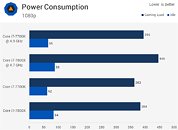
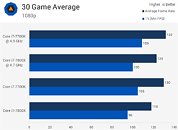 Now, to be fair, most of us were probably expecting that: consumer application optimization for high core-count processors (if we can actually call a six-core a high core-count processor in a soon to be Threadripper-infused world, but I digress) is sorely lacking. However, what really paints Intel's i7-7800X in a bad light is that its performance continues to be lacking even when it has a frequency advantage over the 7700K. As you can see in the performance metrics, a Core 17-7800X overclocked to 4.7 GHz (with a 500 MHz advantage over stock clocks of the 7700K and 200 MHz over its Boost clock) still performs slower than it. The stock 7700K has 5% higher minimum and maximum framerates than the 7800X, despite being clocked lower, having a ridiculously lower amount of L2 cache, and having about the same total L3 cache (which actually results in an about 30% lower available L3 cache per core.) And these lower frame rates are delivered with a 41% higher idle power consumption, and 23% higher gaming power consumption. Check the source link for some detailed benchmarks. As for all this, it seems that while Intel likes to take digs on AMD for their "glued-together" desktop dies repurposed for servers, Intel's 7800X, which has its cache hierarchy and core interconnect re-architected for servers, may be little more than a repurposed server CPU for the desktop crowds...
Source:
Techspot
Out-of-the-box results are somewhat in line with what we would expect: the Core i7-7700K does bring about a base clock increased by 700 MHz compared to the i7-7800X (4.2 GHz vs 3.5 GHz), and has a higher boost clock to boot (4.5 GHz vs 4 GHz.) And as we've seen over and over again, including with Intel rival AMD's Ryzen offerings, frequency usually trumps core count when it comes to performance when applications are exposed more than four cores. And this leads to Walton's results: the Core i7 7700K is still king in pure FPS terms, coming in with a much more attractive proposition than the 7800X in both minimum and maximum FPS, as well as power consumption.


136 Comments on Benchmarks Find Intel Core i7-7700K Better Than i7-7800X for Gaming
So, you have 7800x that might trade blows with thr R7 series in productivity AND gaming. Not the best scenario for Intel considering the R7 mothetboard/cpu platform is about half the price.
BTW, BF4 runs just fine on my Lenovo laptop, which only has a i7-6500U. A dual core processor.
And we have 6 core cpu since 980x, AMD phenom x6 and in that time people would tell you the same crap "future proof". When an i7 7700k isn´t enough for gaming, your 6-8 core Ryzen 3,9ghz won´t be enough aswell and you will need to change platform anyway, simple.
So many people still game on a Pentium G4560 or i3s and is more than enough for 60fps gaming on 90% of the titles and will be for some time.
Now with that being said Ryzen is an amazing product for the price and lets you do way more stuff than just gaming, oposed to intel mainstream offer. Wether or not you need that productivity tasks, is a different story. I dont, I want 200 frames, that´s all. I dont use many programs while Im gaming, not even social media, wich I have on my phone if I need to use it (even music, I play from phone spotify to my bluetooth sound system, ez pz).
All this wagon about 6 and 8 core is BS, and started only because AMD released competitive chips with that core amount. Truth is, I need 245fps on Quake Champions, AMD can´t deliver that due to lower clocks. I dont care about the productivity.
on the other hand i am very satified with my 7900X@4,7 as it is only 1fps in one test worse than 7740@5,2
www.3dmark.com/compare/spy/2002008/spy/2087570
This is the greatest bit of fail I've seen from intel in a while , their Mesh within this core topology is not a win , their ringbus worked better ,they should have stuck with it upto 8/16 cores and left mesh for Hedt.
So unsurprisingly intel hasn't actually got much up its sleave after all , they'll be shouting up Keller for a new job soon at this rate.
Intel should not have released SKYLAKE-X all together especially when it lacks for the asking price.
It's only Achilles heel is the OC headroom, but that may just be down to the process at GF. We'll just have to wait & watch if Intel's hubris gets them a second time, after a long long time.
People forget that it's AMD who's brought octa core to mainstream with phenomenal pricing, their mainstream (& lower end) is still not launched yet, afterall the 7700k is an APU.
The Pascal Titan is bottlenecked by the best Ryzen model whereas the 7800x is up there with the best.
By saying it ran "fine" I meant I have no issues playing at med to high settings at 1920x1080 with acceptable frame rates.
You see I have another rig that you might refer to as "super sic" - just take a look at my System Specs. You see I'm not one of those uninformed "people" you refer to as saying something like this all the time. I am educated, and have a very good point of reference while gaming at 4k. Can you say the same? The rig listed in my System Specs is a gaming monster and is what I game on at home. And it is a true 4k gaming rig achieving well over 60FPS on any game I am currently playing (e.g. BF1 on Ultra settings at 4k, I am getting ~70FPS).
I rarely game on that Lenovo laptop anymore since I graduated, but for a while I did fairly regularly while away from home and I had no complaints at all. And I am quite picky about how smooth a game runs and about slide-show frame rates below 30.
But why in the world would anyone want to attach a laptop such as mine to a 4k display (which has no DisplayPort output BTW)? Simply ridiculous. No claim such as that was ever made, so why would you make such a statement?
SkylakeX is a replacement of Broadwell X not Kaby. So there are plenty of changes.
The L2/L3 was probably changed due to the server/workstation world according to anandtech since those are L2 heavy...according to them. I wouldnt know.
Go read anandtech reviews if you want to actually know something about the changes.
Right now your just spewing garbage and cluttering this thread with ignorance.
Additionally,
I find many of these review charts people post highly suspect given the lack of details and ussually I find some stupid difference that makes one process better than the other as if they purposefully did so to skew results.
I.E.
low MHz/high latency RAM
An overclock that doesn't adjust uncore or other parts that can affect results.
Pointless charts of stock speeds
Games specifically selected that they know suck for X CPU design.
On hardforum I constantly see these dumb charts toted around that have very little bit of scientific method put into them.