Wednesday, September 26th 2018

ASUS DDR4 "Double Capacity DIMM" Form-factor a Workaround to Low DRAM Chip Densities
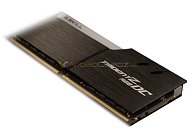
32-gigabyte DDR4 UDIMMs are a reality. Samsung recently announced the development of a 32 GB DDR4 dual-rank UDIMM, using higher density DRAM chips. Those chips, however, are unlikely to be available anytime soon, compounded by Samsung's reported scumbaggery in the making. In the midst of all this, motherboard major ASUS designed its own non-JEDEC UDIMM standard, called "Double Capacity DIMM" or DC DIMM, with the likes of G.Skill and Zadak designing the first models. The utility of these modules is to max out the CPU memory controller's limit despite having fewer memory slots on the motherboard. Possible use-cases include LGA1151 mini-ITX motherboards with just one slot per memory channel (2 slots in all), or certain LGA2066 boards with just four slots (one slot per channel).
There is no word on the memory chip configuration modules, but it's highly likely they are dual-rank. The first DDR4 DC modules could be 32 GB, letting you max out the memory controller limit of 8th gen and 9th gen Core processors with just two modules. ASUS is heavily marketing this standard with its upcoming motherboards based on Intel's Z390 Express chipset, so it remains to be seen if other ASUS motherboards (or other motherboards in general) support the standard. Ironically, the Zadak-made module shown in ASUS marketing materials use DRAM chips made by Samsung.

Source:
VideoCardz
There is no word on the memory chip configuration modules, but it's highly likely they are dual-rank. The first DDR4 DC modules could be 32 GB, letting you max out the memory controller limit of 8th gen and 9th gen Core processors with just two modules. ASUS is heavily marketing this standard with its upcoming motherboards based on Intel's Z390 Express chipset, so it remains to be seen if other ASUS motherboards (or other motherboards in general) support the standard. Ironically, the Zadak-made module shown in ASUS marketing materials use DRAM chips made by Samsung.


38 Comments on ASUS DDR4 "Double Capacity DIMM" Form-factor a Workaround to Low DRAM Chip Densities
I honestly have to question why does news have to be reported this way, is it Fox & Friends (or CNN for the other side) festive season?
Seems like you ruffled a few feathers First Strike
But yeah... it's similar with general use databases. Fast memory is always the problem, not processing power. The main task a CPU does in databases is comparing numbers as fast as possible (and with as little lag as possible).
8TB database used by 50 people is perfectly fine on 8 cores and I bet it wouldn't be bad on 4 as well (if the architecture is fast enough). But the storage is always an issue.
LHC at CERN generates massive amounts of data in all experiments combined. Processing was never an issue (all of the data is processed in some way, after all :-)), but saving was.
As a result, they save just a fraction of information gathered (the part that is most likely to contain interesting results) - currently about 50 PB / year.
Of course data is saved to tape and they could just buy more of it. But the problem is in caching between the recording and saving in a datacenter.
And even though they upgraded the storage system 3 years ago (so to - then - cutting edge SSDs, presumably), not much has changed.To be brutally honest, finding ways to improve RAM capacity is as far from "solutions looking for a problem" as you'll find in TPU news section. :-)
I mean: this piece was published next to "you can't synchronize case fans with your 2080Ti" and "but don't worry because you can use this LN2 system instead"
Now, while I do agree with those sentiments, I also agree, at least as far as that it shouldn't be in the original post of a news topic without an "editorial" tag, because here, rather than simply reporting the facts, btarunr has injected his personal views into a news post. I feel such a comment would be justified (even by news staff/site mods/admins what have you) in a separate post in the thread, or in the original writeup in post #1 with an "editorial" tag... or at the very least, in a separate paragraph(s) that come after the facts in a way that clearly says to the reader something like "those were the facts, here begins my view on the subject" (that isn't to say those words should literally be there, but the distinction should be obvious).
Hint: perhaps criticism delivered in this manner would be better received than flat out making insulting comments, like you "doubts about the mental conditions" :eek: of the author, or flaming him for "clickbait ... Fox & Friends", etc. Such comments aren't likely to be taken positively, rather they are more likely to inspire retaliation that leads to a shitfest (and deleted posts).
Lately, he also got into a habit of hiding/deleting posts that point this out. :-P
Being a writer is a different story. I'm not expecting high ethics or journalism training - it's just a hobbyist website after all, with no "serious", professional media behind it. Still, I believe we should expect more.
Then there's the actual character of TPU. Few years ago it was a news site (and a rather good one). Is it still true today? Hasn't it moved into more opinion-based writing?
You know... there is a demand for such content as well. You are allowed to criticize things you don't like. :-)
It's no secret some of TPU writers support a particular chip manufacturer and bash the competition. And I'm not talking about posting the legendary "Advertorial" but the articles we see every day.
When I look at these articles as news, they are often hard to swallow.
But if I treated them as opinion-forming, they would be perfectly acceptable. And I would totally understand: the particular company is clearly catering to PC-tinkerers after all.
I do miss the old TPU in general...
The articles were better. There was way less financial (particularly: stock) babble, less one-sided press releases and less opinions in general. And the tests were better - focused on gaming and OC (strong topics for TPU staff) and less "productivity" nonsense, which just looks kind of forced and silly.
you colossal dumbass.See how that just got nasty? No reason for that. Now, there's plenty of demand for content that isn't strictly news. Remember @R-T-B's "confessions of a miner"? Some people liked it, a lot of people really blasted him for it (even though they were clearly marked editorial!). I think, in this sense, most people would probably like news posts better if they worked the way I described back in post 34. Or maybe not, but I offered my view, in a polite, constructive way, without bashing. I think that's the crux of the issue.I haven't really noticed this, except maybe one particular example (something to do with an interview, Intel's "old arch peppered with security issues" was mentioned). It was only a short while ago, but if I were to go back and re-examine the news post, and my own comments, I might feel differently today. Though you and I have had various Intel vs AMD discussions in the past, so I'm sure you know where I stand on that particular subject... but that's not really for this thread. :)I still haven't figured this one out. I've publicly (and privately) mentioned that I have certain issues with overly political topics on the site (especially in the news section), which seems to be a rather recent thing. I don't know if politics and tech have just recently become intertwined (at least as much as it has been as of late), or if I'm just more aware of it now, or what... but something definitely feels different to me compared to "old TPU". Aside from that, I think the articles have pretty much stayed the same. There's always been tons of pretty well cut and dry news posts, like "company X announces product Y", "company X is developing something", "a thing happened at a place that produces X components" "dude sets 8.993 gigglehertz record using this hardware", etc. And there's always been "financial babble". Sometimes I try to read something like "Intel releases quarterly results", and my eyes glaze over and the gears in my head begin to experience extremely rapid oxidation while producing awful squeaking and grinding noises, complete with smoke billowing from my ears... but yeah, we've had plenty of those types of articles in the past.As far as reviews go, they've all been pretty much the same to me, or even improving over the years. There are now more fields of data, or more accurate data, in video card reviews than there has been in earlier years. For example, once upon a time we never saw card power consumption, we only got whole system power consumption, which would give us an idea of what power the card was drawing, but it wasn't as clear as the data we see today, which is exclusive to the card. Such reviews are very gaming focused as well. Sure you get stuff like 3DMARK results, but there's a whole slew of games that get tested, and OC does happen. It's just a lot... less exciting, I guess, with GPU Boost involved.
As for "productivity nonsense", I believe you and I have had that discussion before, as well. The way I see it, to put it bluntly, performance metrics easily get divided between applications that benefit from very high per core performance (yeah, on this site, that's usually gaming, though I do not deny the existence of "productive" programs that don't scale well with huge amounts of cores) and applications that easily scale well with today's processors with heaps of cores. This generally gets lumped into the "productivity" category, as most games still benefit the most from high per core performance as opposed to having loads of cores (though it appears some games are finally taking advantage of many cores), and gaming generally isn't seen as "productive".