Monday, June 17th 2019

Intel "Ice Lake" IPC Best-Case a Massive 40% Uplift Over "Skylake," 18% on Average
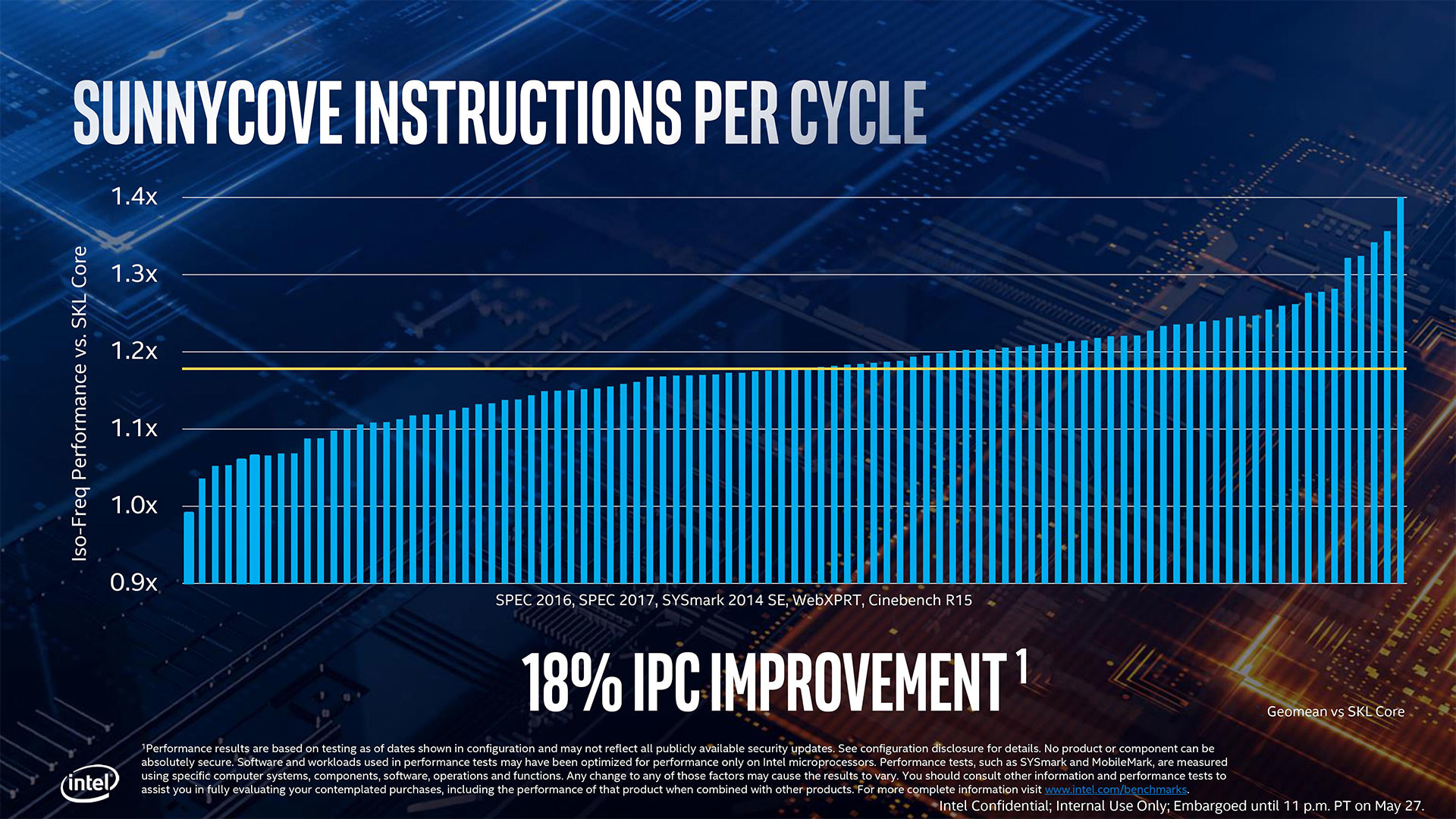
Intel late-May made its first major disclosure of the per-core CPU performance gains achieved with its "Ice Lake" processor that packs "Sunny Cove" CPU cores. Averaged across a spectrum of benchmarks, Intel claims a best-case scenario IPC (instructions per clock) uplift of a massive 40 percent over "Skylake," and a mean uplift of 18 percent. The worst-case scenario sees its performance negligibly below that of "Skylake." Intel's IPC figures are derived entirely across synthetic benchmarks, which include SPEC 2016, SPEC 2017, SYSMark 2014 SE, WebXprt, and CineBench R15. The comparison to "Skylake" is relevant because Intel has been using essentially the same CPU core in the succeeding three generations that include "Kaby Lake" and "Coffee Lake."
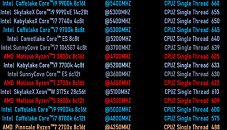
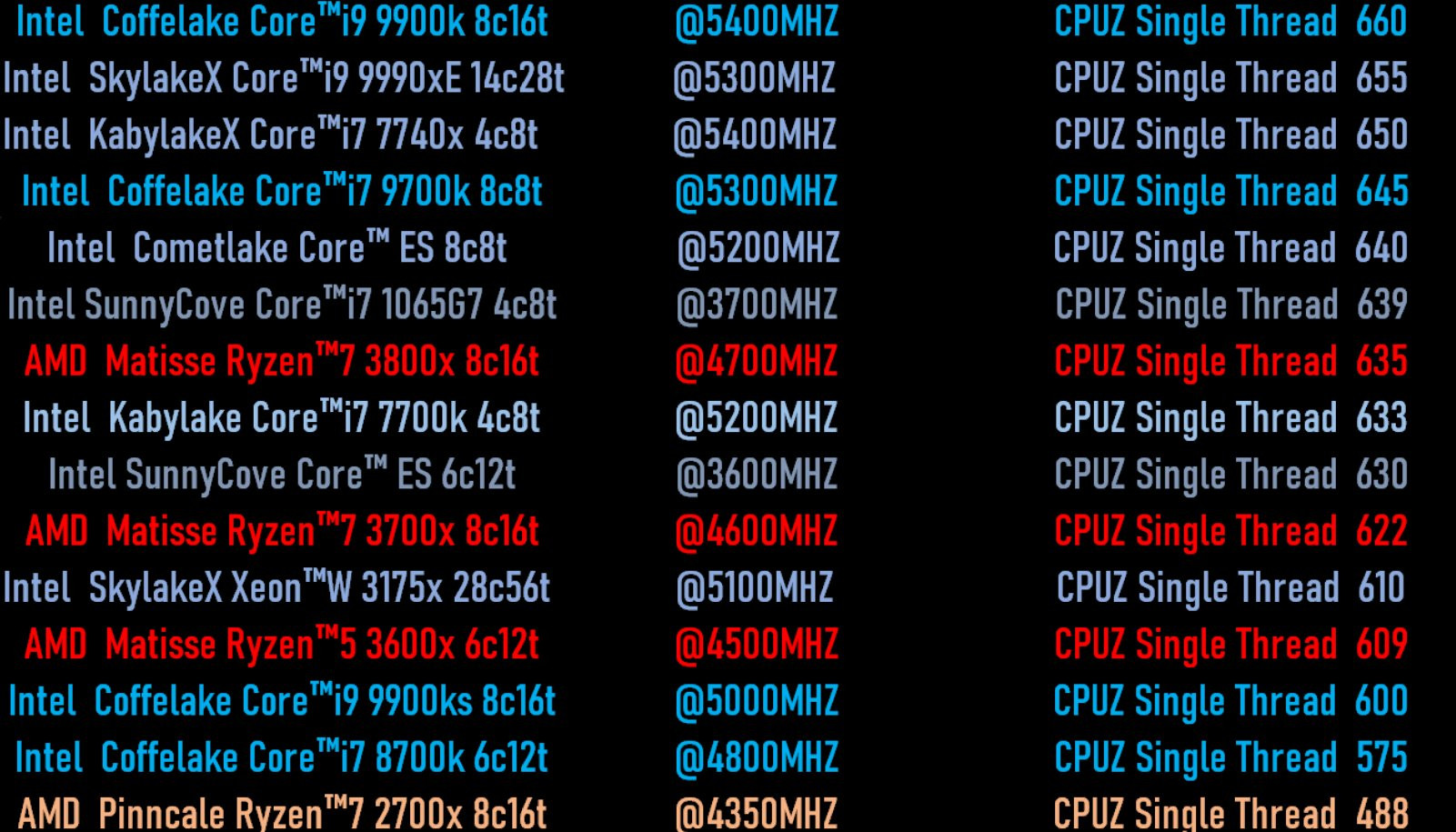
A Chinese tech-forum member with access to an "Ice Lake" 6-core/12-thread sample put the chip through the CPU-Z internal benchmark (test module version 17.01). At a clock-speed of 3.60 GHz, the "Ice Lake" chip allegedly achieved a single-core score of 635 points. To put this number into perspective, a Ryzen 7 3800X "Matisse" supposedly needs to run at 4.70 GHz to match this score, and a Core i7-7700K "Kaby Lake" needs to run at 5.20 GHz. Desktop "Ice Lake" processors are unlikely to launch in 2019. The first "Ice Lake" processors are 4-core/8-thread chips designed for ultraportable notebook platforms, which come out in Q4-2019, and desktop "Ice Lake" parts are expected only in 2020.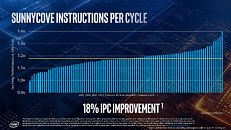
Source:
WCCFTech
A Chinese tech-forum member with access to an "Ice Lake" 6-core/12-thread sample put the chip through the CPU-Z internal benchmark (test module version 17.01). At a clock-speed of 3.60 GHz, the "Ice Lake" chip allegedly achieved a single-core score of 635 points. To put this number into perspective, a Ryzen 7 3800X "Matisse" supposedly needs to run at 4.70 GHz to match this score, and a Core i7-7700K "Kaby Lake" needs to run at 5.20 GHz. Desktop "Ice Lake" processors are unlikely to launch in 2019. The first "Ice Lake" processors are 4-core/8-thread chips designed for ultraportable notebook platforms, which come out in Q4-2019, and desktop "Ice Lake" parts are expected only in 2020.
153 Comments on Intel "Ice Lake" IPC Best-Case a Massive 40% Uplift Over "Skylake," 18% on Average
And then we have the benchmarks that yeah, they show amazing numbers but how do those numbers translate into real-world performance? It's great if you're the benchmark king but at the end of the day what really matters is how much work you can get done in a certain time frame. We've even seen it with SSDs, sure the sustained throughput numbers look great but do they necessarily translate to faster loading software? Nope, 4K random reads are still semi the same over the last few years.
Sunny Cove will increase many of its resources by 50-100%, including >100% in integer multiplication and division, so we should expect substantial gains in some benchmarks.
Hardware acceleration have nothing to do with knowing the answer beforehand. Hardware acceleration is about implementing pars or whole algorithms in hardware, which is much faster than software running on generic computational hardware. Examples of this includes compression, encryption and video codecs, which CPUs have special instructions for. Another type of "acceleration" is SIMD operations like SSE and AVX. In general, software have to be rewritten and recompiled to use new instructions. Exceptions exist, as the CPU's front-end have a very limited ability to optimize when converting x86 to microoperations, but this is only the case for instructions coming in specific patterns. Like e.g., the CPU can unroll small loops and eliminate instructions, if the loops are tight enough.
en.wikichip.org/wiki/intel/microarchitectures/sunny_cove
Most caches, buffers and queues get sizable increases, additional store pipe(s) and some additional capabilities in main execution pipes (not only AVX-512).
10nm is not ready does not mean Intel themselves are unable to get some working CPUs produced. They can and are known to have working 10nm CPUs for 2 years or maybe even more. 10nm is just not ready for mass production, meaning actual products on shelves.
Edit:
Intel says laptops with 10nm mobile CPUs will be on shelves by the end of year so they must have gotten something working. This is supposedly happening on the improved 10+nm process.
There is no guarantee that IPC increase in % will be there for all use cases. In fact, it definitely will not be, as illustrated by Intel's slide.
These are commonly called pipes, I suppose technically they are parallel execution units in a superscalar CPU.Architecture is not the problem, manufacturing it is. Despite them announcing laptops on shelves by the end of year Intel is assumed to be still struggling with 10nm. There is a lot unknown about what they are capable of and when but it is pretty clear Ice Lake/Sunny Cove (and subsequent architectures) will not be a player in the desktop space before end of 2020 or 2021 at earliest.
Intel will go for mobile first because 10nm should boost power efficiency and lacking high end of frequencies will not matter there anyway. Then they will go for Xeons for similar reasons. After they get these in order we can hope for something new on desktop.
Besides, Intel showing that 10nm will net lower frequencies is admitting a negative aspect of their newer process isn't it?
When it comes to frequencies Zen/Zen+ is a rather low bar in comparison. Intel did/does close to 5GHz boost clocks on their 14++nm while TSMC/GF 14/12nm rarely gets over 4.3GHz. I would say this is much more a foundry question than architecture one. While architecture plays a part the manufacturing process seems to be a much bigger factor in maximum clocks. TSMC and their 7nm seems to also be a bit better than Intel's 10nm in frequencies among other things.
The other side of this is that we really do not know much about the frequency behaviour of Zen2 yet. Not that we do know much about Intel and Ice Lake either. 1065 G7 seems to be the fastest rumored 10nm CPU and rumors say it has a boost clock of 3.9GHz. Whiskey Lake on 14nm++ has 4.6 or 4.8GHz.
We don't know what the frequencies will be but assuming Zen shrink to 7nm and boosts clocks and yet intel gets 10nm (half of what AMD did) and the clocks are settled at 3.9Ghz. Maybe that is why they start from mobile processors? Later on they will try to up the clocks a bit for desktops. I mean I think that's the case.
It isn't always the node process that drives the frequency. I can only hope the clocks will get better with maturity of the 10nm process.
Will Intel solve their 10nm process issues? Probably, but not before AMD takes a good portion of their market share and rightfully so.
I'd bet if they were going to lower prices exponentially, Intel would come up with a lame idea of premium processors (basically same but the premium is there) to justify the high price.
I see Intel having a lot of room for lowered prices, if they want that to happen.
- Current Intel's CPUs die sizes are 125mm^2 for 4-core (7700K), 150mm^2 for 6-core (8700K) and 175mm^2 for 8-core (9900K).
- Zen/Zen+ 8-core dies are a little above 200mm^2.
- Zen2 cores chiplet is 75mm^2 but IO Die is 120mm^2.
Plus you have the CCX combinations which basically defective chips can be used as well for lower quality products or/and less cores.
Zen2 has at least 2 dies. For reasonably close comparison, lets look at 8-core Zen2 like 3800X. Without considering any extra aspects, just the die area - 120+75 is still 10% bigger than 9900K. One of these dies is pretty much the same size as 4-core Intel CPU. The second die is indeed small and awesome. However, from all the forums and threads (including people who should have direct knowledge of the industry) 7nm production cost is estimated to be about 60% higher than 12/14nm and defect rate to be about twice as much as a mature process like 12/14nm. Plus some of the packaging challenges AMD shared on their slides.
I would not expect AMD's 8-core CPU production cost to be smaller than Intel's, I would lean towards the opposite.
Edit:
The problem with monolithic chips comes seriously into play with much larger chip sizes. Skylake-X 10-core (LCC) is 322mm^2, 18-core (HCC) is 484mm^2, 28-core XCC is 698mm^2. This is the sector where AMD already benefits from the ~200mm^2 Zen dies and will benefit further from 7nm Zen2 chiplets.
Defective chips are used for other SKUs by all manufacturers. Intel uses Coffee Lake Refresh dies in 9900K (9900), 9700K (9700) and 9600K. In a bit weird way not in anything lower than these. Depending on how you want to take this, it could also indicate that yields are not a problem.
AMD has the manufacturing advantage of not having to put everything on one piece of silicon thus the complexity of those dies are far lower than Intel. Splitting the processor into pieces and parts, like one die for the actual processor and another die for the I/O is ingenious. They've now cut the complexity of manufacturing the actual processor dies by nearly 50%, that's a huge chunk.
You, @londiste, sound like an Intel fanboy with your posts here. You can't seem to imagine a world where Intel isn't at the top of the heap, the cream of the crop, etc.
Intel have not promised any desktop 10nm products for Q2 2020. An "Ice Lake-X" might be coming, but I would guess that would be later. Intel have driver support for a desktop "495 series" Ice Lake chipset though, we don't know what this is for.
Whatever Samsung is going to help out with, will be coming later.No, I'm just stating the facts, I never said they will lower the prices that much. i9-9900K will be cheaper to make than 8-core Zen 2 for now.
Intel will lower their prices (or not) depending on how well they are selling.TSMC 7nm is expected to become about twice as expensive per chip size vs. 14nm, but that's when 7nm approaches optimal yields. Currently an 8-core Zen 2 would cost more to make than an i9-9900K, and that's even with factoring in the benefits of the small chiplets.