Monday, June 17th 2019

Intel "Ice Lake" IPC Best-Case a Massive 40% Uplift Over "Skylake," 18% on Average
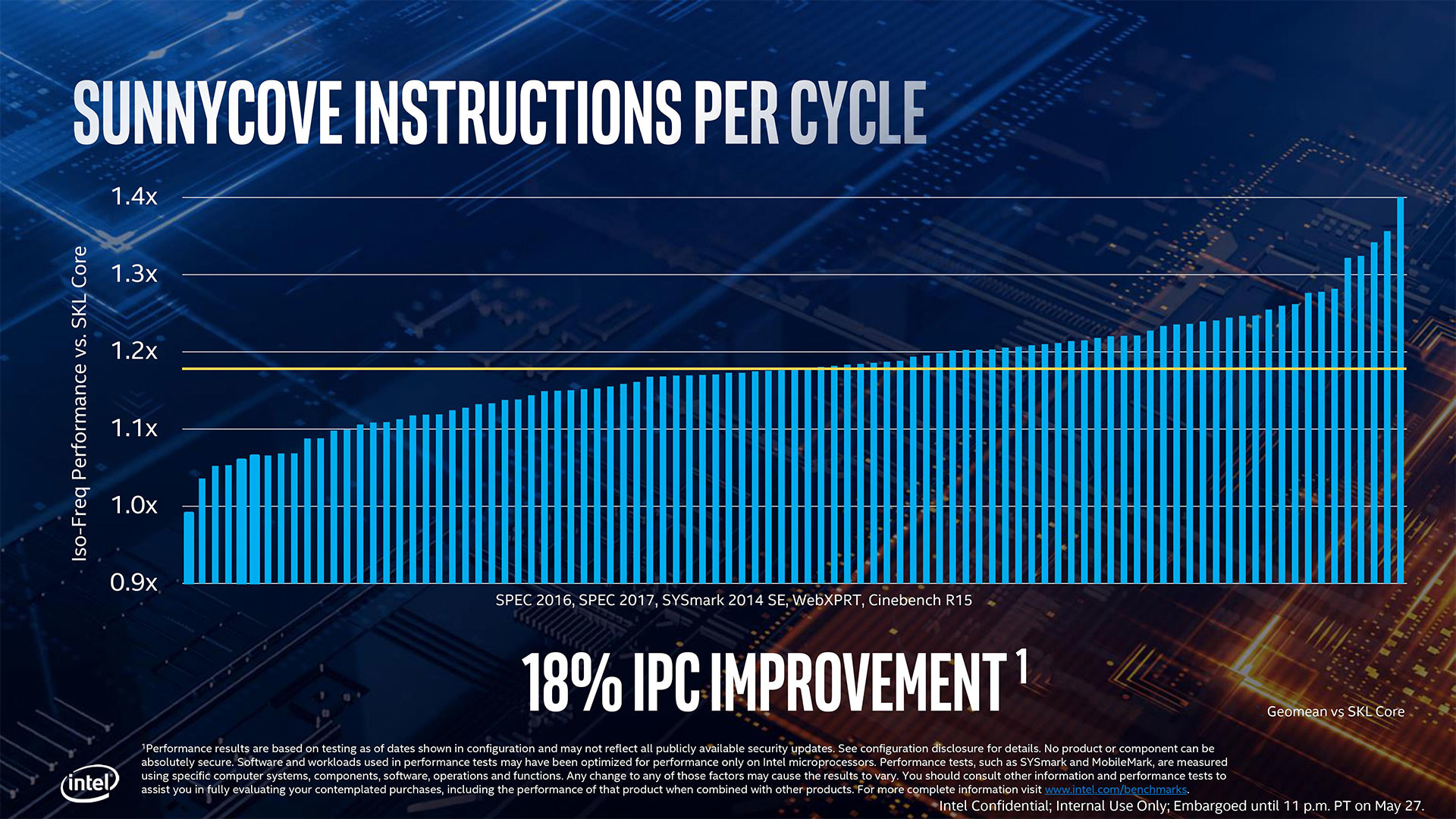
Intel late-May made its first major disclosure of the per-core CPU performance gains achieved with its "Ice Lake" processor that packs "Sunny Cove" CPU cores. Averaged across a spectrum of benchmarks, Intel claims a best-case scenario IPC (instructions per clock) uplift of a massive 40 percent over "Skylake," and a mean uplift of 18 percent. The worst-case scenario sees its performance negligibly below that of "Skylake." Intel's IPC figures are derived entirely across synthetic benchmarks, which include SPEC 2016, SPEC 2017, SYSMark 2014 SE, WebXprt, and CineBench R15. The comparison to "Skylake" is relevant because Intel has been using essentially the same CPU core in the succeeding three generations that include "Kaby Lake" and "Coffee Lake."
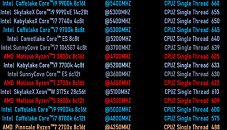
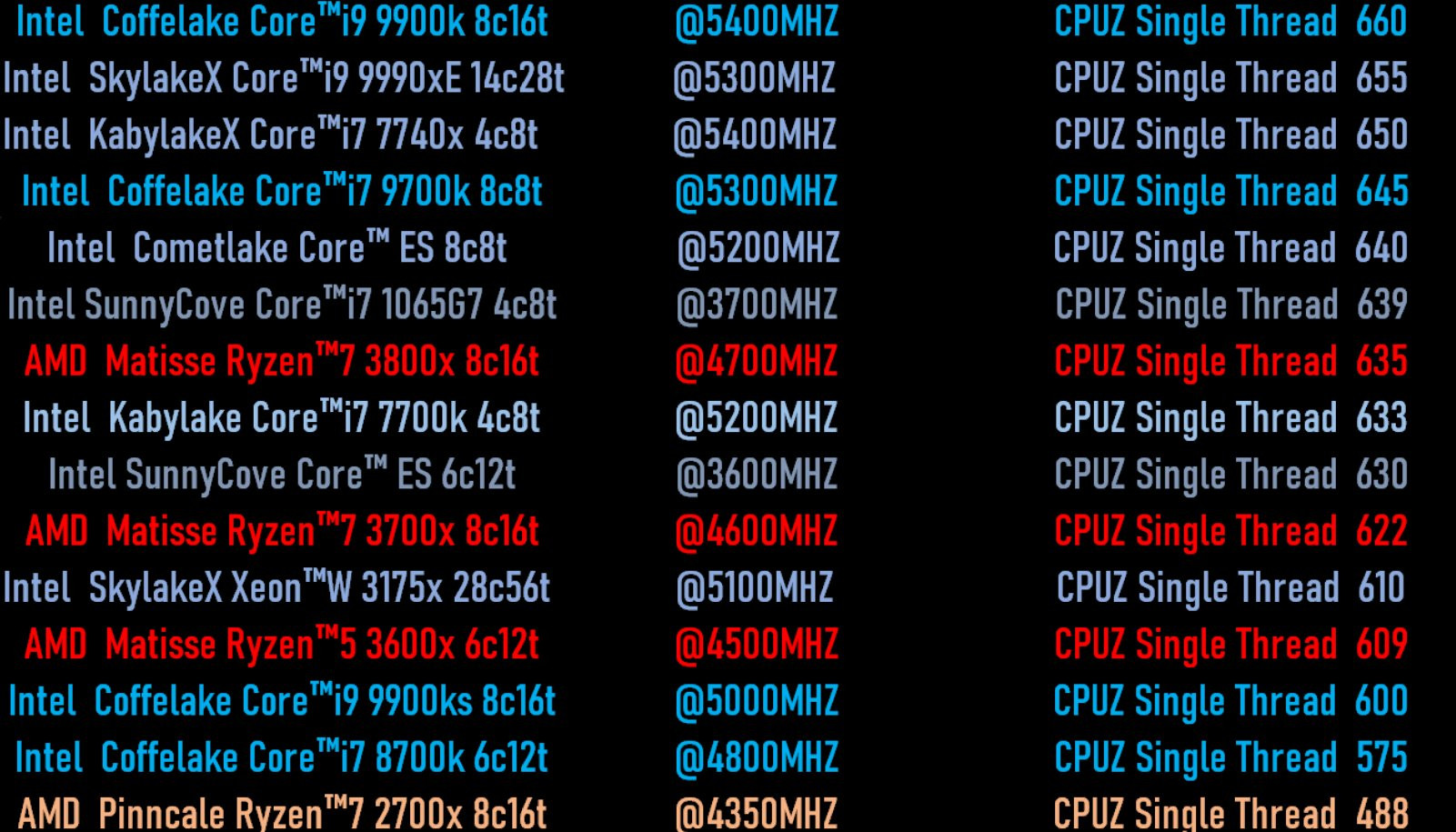
A Chinese tech-forum member with access to an "Ice Lake" 6-core/12-thread sample put the chip through the CPU-Z internal benchmark (test module version 17.01). At a clock-speed of 3.60 GHz, the "Ice Lake" chip allegedly achieved a single-core score of 635 points. To put this number into perspective, a Ryzen 7 3800X "Matisse" supposedly needs to run at 4.70 GHz to match this score, and a Core i7-7700K "Kaby Lake" needs to run at 5.20 GHz. Desktop "Ice Lake" processors are unlikely to launch in 2019. The first "Ice Lake" processors are 4-core/8-thread chips designed for ultraportable notebook platforms, which come out in Q4-2019, and desktop "Ice Lake" parts are expected only in 2020.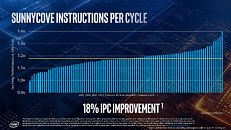
Source:
WCCFTech
A Chinese tech-forum member with access to an "Ice Lake" 6-core/12-thread sample put the chip through the CPU-Z internal benchmark (test module version 17.01). At a clock-speed of 3.60 GHz, the "Ice Lake" chip allegedly achieved a single-core score of 635 points. To put this number into perspective, a Ryzen 7 3800X "Matisse" supposedly needs to run at 4.70 GHz to match this score, and a Core i7-7700K "Kaby Lake" needs to run at 5.20 GHz. Desktop "Ice Lake" processors are unlikely to launch in 2019. The first "Ice Lake" processors are 4-core/8-thread chips designed for ultraportable notebook platforms, which come out in Q4-2019, and desktop "Ice Lake" parts are expected only in 2020.
153 Comments on Intel "Ice Lake" IPC Best-Case a Massive 40% Uplift Over "Skylake," 18% on Average
i9-9900K is a relatively small chip produced on a very mature node, Intel have a massive profit on this one. As I've said, Intel could have cut the price, but they don't until they have to.
Coffe Lake 8-core is ~174 mm² (incl. graphics), considering the much larger Skylake-X/SP dies (which also have more layers) starts at $589, it's a fairly safe assumption that these dies are cheap to manufacture. They are also small compared to the desktop GPU on the market.Until 2015, Intel had substantial progress. Since then they have just pushed clocks, due to their problem with node shrinks.It's called competition, and it's something we've lacked since the glory days of Athlon 64.
Without competition, there is less motivation to cut costs. But there is still the motivation to sell new products, which is the reason why Intel have slowly lowered costs without competition, like i7-5820K with a good 6-core for $389.Perhaps, but the demand for Intel CPUs have actually been high. Any decline in the PC market have been consumed by the enterprise market. Intel would have required more production capacity to do this, so far they've been maxed out on 14nm. So why would they, from their standpoint, lower the prices until they have to when their desktop CPUs are selling well?
I think Intel have been too focused on the enterprise market, but hopefully the competition from AMD can make them take it more seriously again.
The laptop market is sort of selling by itself, and is usually not performance driven, as the average laptop wears out physically long before its usefulness.
Now if Intel hadn't been sitting back with cruise control on perhaps the PC industry wouldn't have seen such a huge decline. If you ask me the likes of Dell, HP, and other OEMs should have put more pressure on Intel to actually get their asses in gear to make something great to move more PCs.
However, there is a simple answer to Intel's apparent lack of progress - Intel failing to develop a working 10nm process. That was planned to 2016, I think. We know Intel's 6-core and 8-core CPUs are clearly too much for 14nm given the intended TDP constraints. They were waiting for 10nm to materialize and it did not... and so far still hasn't.
Industry as a whole has had a lot more to worry about. Lack of progress is a factor but not the only one. Mobile is/was a big thing. Remember a few years ago when doom was predicted for PC and tablets, mobiles etc replacing them? That really was a thing in several fronts - hardware, RAM/Flash prices, software and a lot of supporting services and things made bets on mobile.
Why did adding just two more cores on top of the already six cores of the 8700K shoot the price up so badly? The only thought that comes to mind is that too many 9900K chips are coming off the line with defects in them. So if you want one, be prepared to pay dearly for it.
AMD lineup:
8-core $299 (Ryzen 7 2700)
6-core $199 (Ryzen 5 2600)
4-core $100 (Ryzen 5 2200G)
2-core $55 (Athlon 200GE)
Note that Ryzen 7 3700X will be 329, raising the 8-core bar slightly.
Intel lineup:
8-core $323 (Core i7 9700)
6-core $182 (Core i5 9400)
4-core $122 (Core i3 9100)
2-core $42 (Celeron G4900)
Less of a difference than I expected.You are basing this squarely on price. That is a bad indicator. Pricing is much more marketing than technical thing.
i7 7700K never really sold for $305. Its retail price was pretty much $350-360, even more so with i7 6700K still being sold and occupying the slot at $300-ish. i7 8700K effectively formalized that price.
i9 9900K is the top processor of the class you can get which inevitably comes with a price premium. Ryzen 9 3950X is bound to take that spot now with $250 (50%) higher price over Ryzen 9 3900X for 4 extra cores.
AMD is changing that. I wonder what the new Intel's processor lineup will look like. I'd bet it will have less products.
2c/4t, 4c/4c, 4c/8t is a fairly logical lineup. With the addition of a 6-core in 8000-series, they were kind of stuck in terms of lineup (4c/8t is faster than 6c/6t in several situations, relegating what is effectively i7-7700K to i5 in less than a year would look bad etc). 4c/4t, 6c/6t, 6c/12t is the best they could come up with.
Now, with the addition to 8-core in 9000 series Intel did have a perfect opportunity to match AMD-s offerings in terms of threads. They did not. We do know that all 4, 6 and 8-core do have HyperThreading in hardware but it is disabled in everything except 9900/9900K. With MDS and mitigation effectively being "disable HT", I really do suspect it is not a coincidence.
I am not saying that it is definitively so but it looks like a valid theory, no?
Give you a hint. More products more money. More features more money :)
6c/6t is plenty for years for the average user. 8c/8t...better and fine for enthusiast...8c/16t mainstream flagship. Why complicate things? :)