Friday, March 11th 2022

AMD Readies Even More Ryzen 5000 Series Desktop SKUs for April
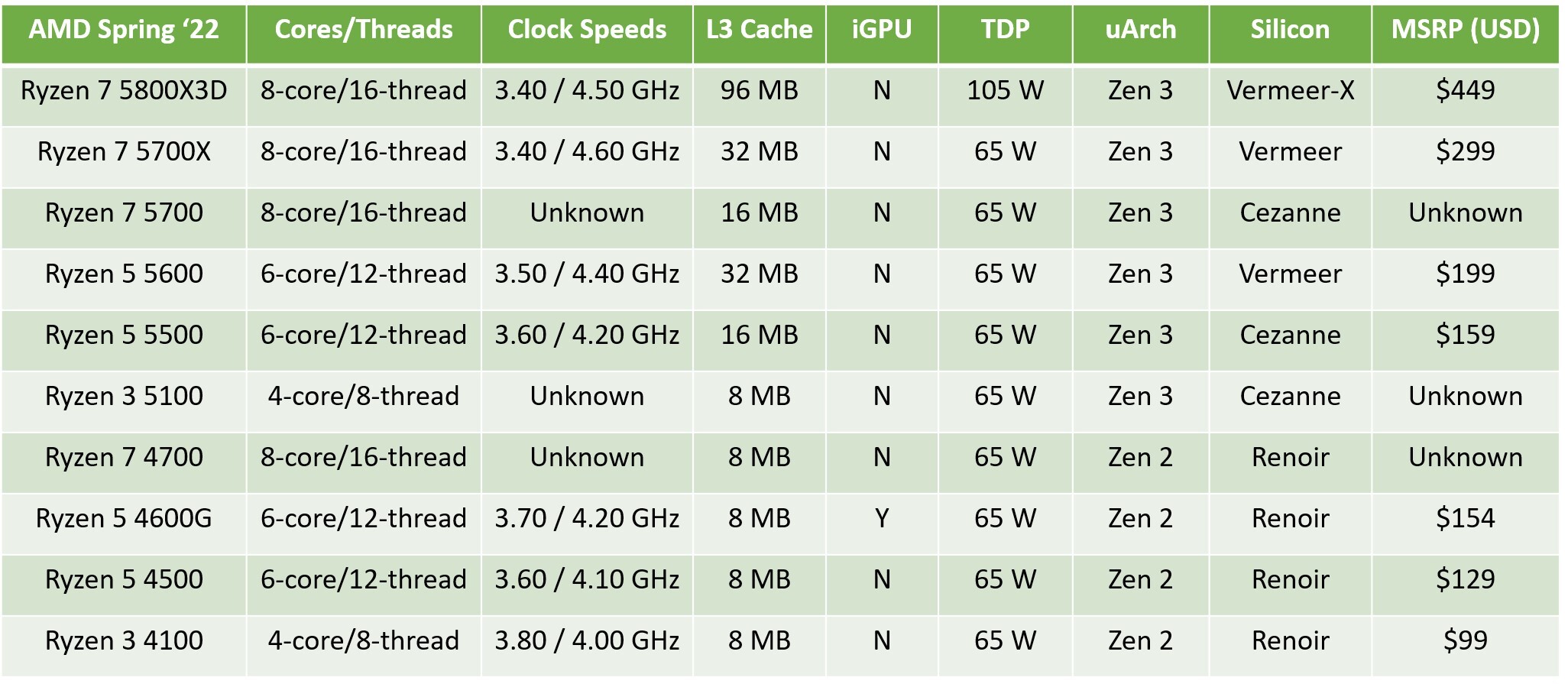
Earlier this week, we learned about AMD making several additions to its Ryzen 5000 Socket AM4 desktop processor lineup, to better compete against the bulk of the 12th Gen Intel Core "Alder Lake" processors. It turns out that there are three more additions to the lineup that we missed, because they're slated for a slightly later availability from the other chips (later by weeks).
The first of these three is the Ryzen 7 5700 (non-X). This chip is uniquely different from the Ryzen 7 5700X and the Ryzen 7 5600G. It is an 8-core/16-thread processor that's based on the 7 nm "Cezanne" silicon, with its iGPU disabled. This means you still get eight "Zen 3" CPU cores, but no iGPU, just 16 MB of L3 cache, and the PCI-Express interface of the chip is limited Gen 3. The Ryzen 3 5100 is the spiritual successor to the very interesting Ryzen 3 3100. It is a 4-core/8-thread processor based on the same "Cezanne" silicon with "Zen 3" cores, but with only 8 MB of L3 cache, and the iGPU remaining disabled. The third chip on the anvil is the Ryzen 7 4700, an interesting 8-core/16-thread offering based on the older "Renoir" silicon with "Zen 2" CPU cores.
Sources:
Wccftech, VideoCardz
The first of these three is the Ryzen 7 5700 (non-X). This chip is uniquely different from the Ryzen 7 5700X and the Ryzen 7 5600G. It is an 8-core/16-thread processor that's based on the 7 nm "Cezanne" silicon, with its iGPU disabled. This means you still get eight "Zen 3" CPU cores, but no iGPU, just 16 MB of L3 cache, and the PCI-Express interface of the chip is limited Gen 3. The Ryzen 3 5100 is the spiritual successor to the very interesting Ryzen 3 3100. It is a 4-core/8-thread processor based on the same "Cezanne" silicon with "Zen 3" cores, but with only 8 MB of L3 cache, and the iGPU remaining disabled. The third chip on the anvil is the Ryzen 7 4700, an interesting 8-core/16-thread offering based on the older "Renoir" silicon with "Zen 2" CPU cores.
53 Comments on AMD Readies Even More Ryzen 5000 Series Desktop SKUs for April
Their impact is also noticeable on older desktop hardware we sometimes dabble with after we're done with it at work. We usually update them with cheap SSDs if needed, use the still working Win7/8 -> 10 free upgrade from MS (since they still have OEM licenses) and ship them to schools instead of trashing them. We disable mitigations on older ones because they need all the help they can get. Context switch time is also heavily affected on some models which impacts every multithreaded load, which modern web most definitely is.
All in all, I disagree - you definitely can feel certain mitigations on certain hardware IRL.There's plenty of benchmarks on Phoronix targeting different segments for each heavily publicized vulnerability. You're right, the older mitigations have no impact on ADL, but how many more is it going to get before the generation is out of support?. BHI also affects 10th and 11th gens on desktop + a few more. What will be the impact on them? We'll have to wait for benchmarks.
Well, depends on your definiton of "up there" tho
AMD dropped (will be dropping, more exactly) the ball on this one. Let it rest.
this thing will be pretty good against a 12100F for 95€ with16x PCiE 4 or 5 (depending on motherboard).
This Ryzen 3 4100 for 100$ is the same garbage for fanboys of AMD like the great 6500 XT :roll:
But yeah if u have ure pink glasses up on ure face AMD is great :laugh:
I hope all you engineers and sages are applying for jobs at AMD, so they never make any more flawed predictions.
Take the arguing to PMs.
Thank You
* Zen 4 was a DDR5 design from day one
* It took the launch of ADL to demonstrate how dire the DDR5 situation is
* Zen 4 engineering samples showed up about the same time as ADL launched, which implies that the Zen 4 design is completed (except for obvious errata) and available to partners to start buildjng their products around
In other words, for AMD to decide to change the Zen 4 memory controller, or shoehorn a DDR4 version in there, would be a massive - perhaps impossible - change. Even if it is possible, for the company to make that change so (relatively) late in the day would require huge amounts of rework, which would have corresponding knock-on effects for their board partners. AMD had a poor reputation with partners after the Bulldozer days, they've somewhat rebuilt it with the Zen series but it's definitely not in the same place as the relationships those partners have with Intel, so pissing off said partners with last-minute changes would be problematic for AMD.
These "new" chips, which are just current and old-generation die harvests with different coats of paint, are very obviously a way for AMD to buy time by staving off ADL for a few more months at least. Whether that's to add DDR4 to Zen 4 (unlikely IMO) or just an attempt to allow the DDR5 situation to improve, it is definitely a somewhat desperate move that is unlikely to endear the company to consumers who have (justifiably) been ticked off about how long AMD has milked Zen 3 prices. And of course it's AMD's prerogative to do that, because they are a company and companies exist to make money, it's just that enthusiasts tend to have long memories.
Imho, they should have had a DDR4 controller as a backup the moment they put Zen4 on the drawing board. Of course nobody could have predicted DDR5 shortages. But everybody knew DDR5 would be more expensive and barely faster at first. If Zen4 launch drew close and DDR5 looked rosy, they could have silently scrapped DDR4 support.
could just do an am4 zen4 release w/ a ddr4 iod/imc, heck maybe even just recycle the current zen2/zen3 one?
Since it's unlikely AMD will release SKUs with a lifespan of less than 1 year, it's more likely Zen4 will come as a handful of high-end, expensive SKUs, while these one just announced/leaked will be sold alongside Zen4. Just like they did with Zen3+.