Thursday, May 26th 2022
M.2 PCIe 5.0 SSDs Set to Increase to 25 mm in Width, Might Not Fit Older Motherboards
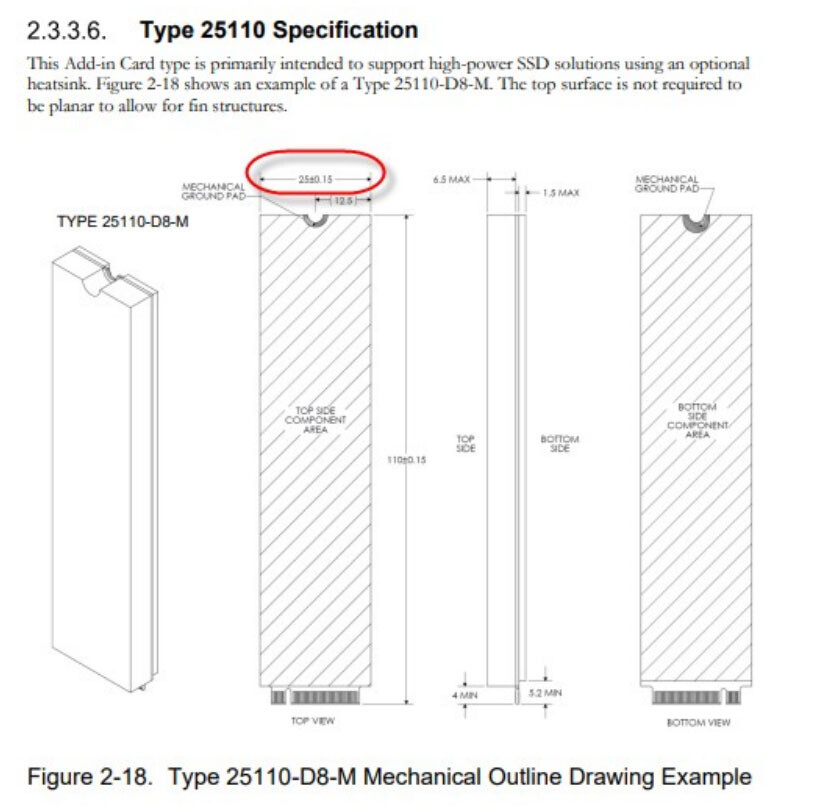
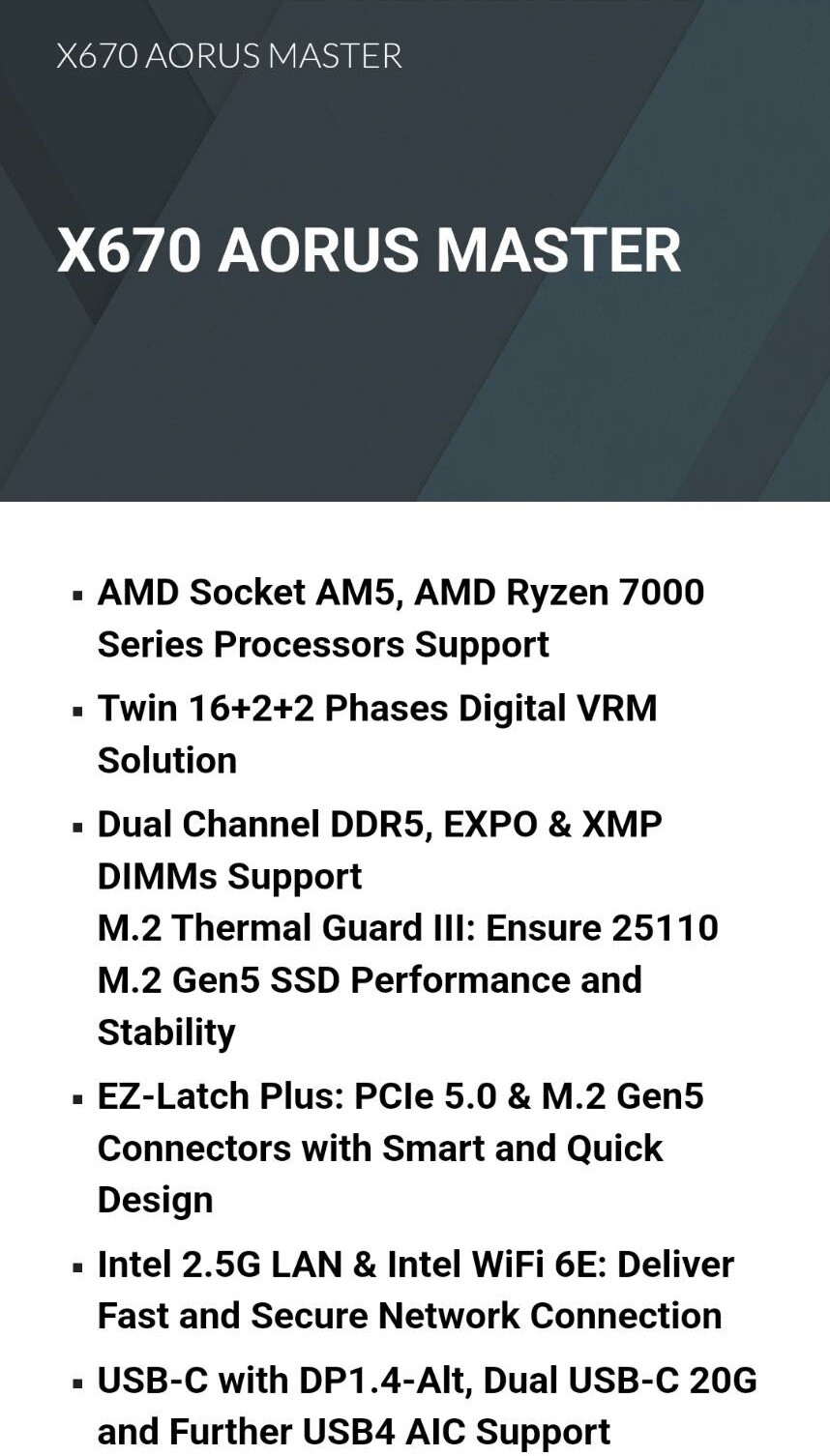
NVMe SSDs based on the M.2 form factor come in several different lengths today, ranging from 30 to 110 mm, although the 30 mm drives are rare and the 110 mm drives have so far been reserved for the server space. However, they've all had one thing in common, the 22 mm width, as otherwise there might be issues in terms of fitting the drives, especially in notebooks. However, it appears that the PCI-SIG snuck in a wider, 25 mm option for M.2 SDDs at the end of 2020, but seemingly forgot to mention it to anyone. The only reason we even noticed, was because Gigabyte listed its upcoming X670 and X670E motherboards as having support for 25110 SSD's, where you'd expect to see support for 2280 or 22110 drives.
An extra 3 mm in width might not sound like much, but many M.2 drives seem to be somewhat space constrained, mainly with regards to the passive components and the power regulation. It also seems like this is in preparation for PCIe 5.0 NVMe drives, where the host controller is expected to run hotter, even though it might not be as bad as initially expected. Regardless, it seems like motherboard makers are now making space for this slightly wider M.2 form factor, as well as implementing suitable cooling solutions to match. Whether we'll see drives using this slightly wider form factor or not, is still up in the air and one reason why the SSD manufacturers might choose not to go wider, is because new drives might not fit in older motherboards and laptops, if the clearance is too small.

Source:
via @hms1193
An extra 3 mm in width might not sound like much, but many M.2 drives seem to be somewhat space constrained, mainly with regards to the passive components and the power regulation. It also seems like this is in preparation for PCIe 5.0 NVMe drives, where the host controller is expected to run hotter, even though it might not be as bad as initially expected. Regardless, it seems like motherboard makers are now making space for this slightly wider M.2 form factor, as well as implementing suitable cooling solutions to match. Whether we'll see drives using this slightly wider form factor or not, is still up in the air and one reason why the SSD manufacturers might choose not to go wider, is because new drives might not fit in older motherboards and laptops, if the clearance is too small.
49 Comments on M.2 PCIe 5.0 SSDs Set to Increase to 25 mm in Width, Might Not Fit Older Motherboards
I think the real problem here is, how many motherboard makers are going to be thinking ahead for this not even "draft-standard?" there will b e tons of pcie5-capable mobos already shipped before they have the final standard!
This makes that impossible now!
They should just stop playing footsie, and go Type-C compatibility-breakage and change the entire slot tp sodimm-syle,
www.techpowerup.com/256084/pci-sig-achieves-32-gt-s-with-new-pci-express-5-0-specification
www.tomshardware.com/news/pci-sig-releases-final-pcie-5-spec,39521.html
hexus.net/tech/news/industry/131186-pcie-50-specification-completed/In the beginning yes, they'll be a lot more expensive, but they'll soon fall to close or even price parity (just like pcie4.0 are already close or at parity with gen3) and you get better and more modern nand/controller and are still able to take advantage of higher IOPS, endurance, lower lattency, etc.
PCIe 5 has already been shipping on motherboard m.2 slots for months, but if it takes a long time for mobo makers to respond t these changers, it will mean several incompatible drives (in the future) (not to mention cutting-out all existing mobos; a real concern because older drive have a tendency of disappearing)
As long as they're breaking things with USB-C-level change , why not just change the connector to SODIMM?
IDK, but it seems like E-ATX, ATX might close to their saturation point of how and what fits on a motherboard. M.2 slots are already spread willy nilly on them.
DTX is taken.
ETX would be confusing with E-ATX.
FTX? But that's an FTP extension...
GTX? Nope.
HTX? Taken by some extension to HyperTransport.
ITX, taken.
JTX should work.
YTX? dont ask Y?
IDK maybe even go with a number convention.
While I'd rather the shift to U.2 just happen at this point the that's completely impossible so a plausible solution would be adopting the new E1.S enterprise standard. The problem with that though is how they would connect to motherboards as they couldn't sit flat the way current M.2 does. I think it would be possible to do, but much like your suggestion of dedicated place (which would work well) it just isn't going to happen because there's no benefit to manufacturers.
Personally I just hope that I'll be able to use adapters to keep my SSD off the motherboard. Right now I'm using a U.2 to M.2 2.5 adapter connected to U.2 on my motherboard. There are M.2 to U.2 cables available, so I'd look into something like that for something without native U.2 motherboard support.
E1.S requires a compatible chassis, so I guess that's a no go, at least unless we bring back an external drive bay that could take some kind of slot for a few drives. It would obviously still require something like a U.2 cable per drive to connect them to the motherboard.
These were quite popular for a very short while. Seems like there aren't any that goes over PCIe 3.0 speeds at the moment though, so not sure if U.2 can support speeds beyond that either. U.3 seems to be for higher speed interfaces.
U.2 definitely supports PCIe 4.0 speeds (P5800X is the first that jumps to mind), but I don't know if any of that style adapter does as I'd imagine the market is tiny. There are PCIe 4.0 M.2 to U.2 2.5 adapters, but I haven't looked into options for connecting a motherboard M.2 to U.2 with PCIe 4.0 as I don't have an applicable setup yet. No clue what enterprise PCIe 5.0 drives will look like though since from what I understand the push is for E1.S to replace all of the current standards so who knows if U.2 will continue forward.
Kind of dumb idea to change the established standard without changing the name. Even USB consortium when it was still sane changed USB1 to USB2 just because of wiring even if plug remained the same. It'll be a mess.
A size difference would help kurb the reviews of the stupid, hell a different socket entirely would be good if it didn't mess up backwards compatibility rip.
And yes they were all Intel fanboys with their brand new system which wasn't even PCIE4 last year lul.
I gain two advantages.
Its chip wont get as hot as its spec'd to higher performance, so at same performance as 970 EVO its cooler.
I get the higher performance that still fits within 3.0 bandwidth such as the higher sustained writes and random i/o.
So M.2 is already showing its flaws if they having to increase the width. The problem when you design something to be tiny and with no headroom for scaling up the products in future. Sales of 5.0 SSD's will get crippled if this is the case as only 5.0 board/laptop owners could use them natively on boards.
Is there even a need in the consumer space for 5.0 NVME? They already really fast with limited noticeable use cases even over SATA spec.U.2 is doing fine in the server space.
The solution is easy, but I dont think the industry likes it for whatever reason.
Either.
PCIE SSD's (gigabyte did one early on I think, so this seemed to be the original idea).
U.2
Increased width but with b/c built in in so the additional part has gaps so can still fit in a smaller width slot. I dont like this, as noticing a trend now on new boards where everything is been compromised to cram in more M.2 slots as if they think everyone wants 4+ M.2 drives. There is already a thread on here questioning why all upcoming AMD board designs only have 2/3 PCIE slots.
PCIE storage adaptors with M.2 slots on them. With burification as well this is the logical way forward combine it with my b/c width idea on the slots if they 5.0 slots. Each higher end board could come with one card included to work in second 8x/16x slot, and boards start only coming with 1 or 2 onboard M.2 slots again. This would also make lower end boards cheaper.
Consider not selling 5.0 SSDs on consumer market and as such dont compromise consumer boards for them, the need seems to be mostly epeen hype related. This would also improve the above idea so e.g. a 8 lane PCIE 5.0 slot could host either 4 PCIE 4.0 SSDs or 8 3.0 SSDs.This is so obvious its like staring me right in the face, yet the industry doesnt seem to want it. PCIE is i/o expansion which is what NVME is, but the consumer industry is almost treating it now as just a GPU interface.
Also literally no one on this planet cares about laptops, if it wasnt bad enough 3080 laptops are slower gpus than a 3070 desktop there's even more issues with different tdp on them too now making 2x 3070 or 3080 laptops performing totally different.
You don't need anything more than a pcie3 speed m.2 on a laptop so everything about sizing and laptops is a mute point.
Can you expand/explain your not true comment please.
M.2 doesn't take its name from the card width, as there are several different widths and lengths. I was called NGFF or Next Generation Form Factor initially, but I guess that was considered too long. As you can see, there are 16.5, 22 and 30 mm wide M.2 form factors, although only the 22 mm wide were adopted for storage. Then there are solder down modules as well, mainly for WiFi and Bluetooth modules.
And in case you missed it, there are four different keys for the slots, A/E for WiFi/Bluetooth and other "low-speed" add-in cards and B/M for SSDs. On top of that, there's support for SATA AHCI drives, PCIe AHCI drives and PCIe NVMe drives. I have a feeling this slight increase in width isn't going to matter too much at the end of the day, at least not as long as 2280 drives are the standard in consumer applications.