Thursday, August 4th 2022

Potential Ryzen 7000-series CPU Specs and Pricing Leak, Ryzen 9 7950X Expected to hit 5.7 GHz
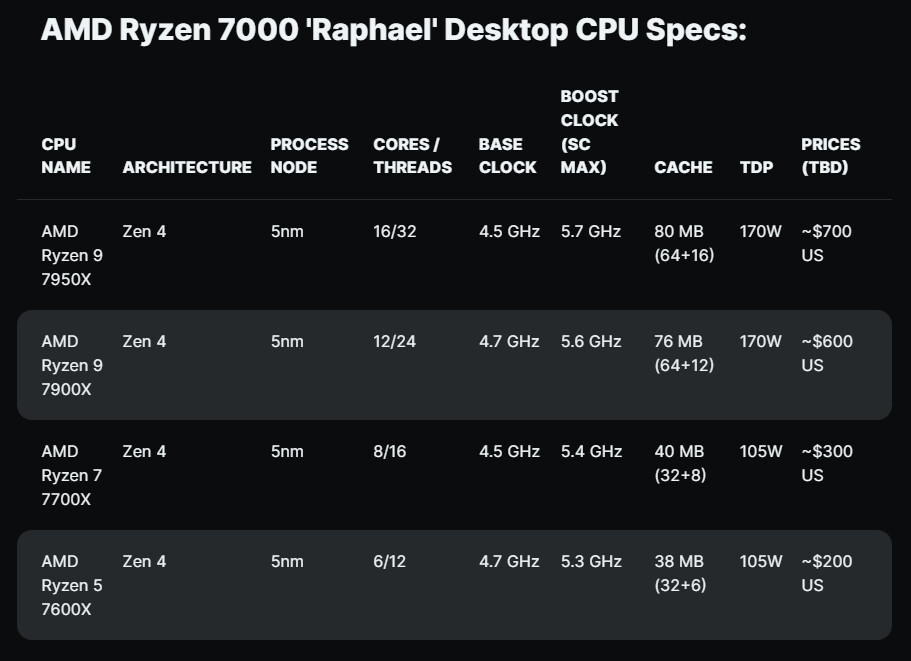
It's pretty clear that we're getting very close to the launch of AMD's AM5 platform and the Ryzen 7000-series CPUs, with spec details and even pricing brackets tipping up online. Wccftech has posted what the publication believes will be the lineup we can expect to launch in just over a month's time, if rumours are to be believed. The base model is said to be the Ryzen 5 7600X, which the site claims will have a base clock of 4.7 GHz and a boost clock of 5.3 GHz. There's no change in processor core or thread count compared to the current Ryzen 5 5600X, but the L2 cache appears to have doubled, for a total of 38 MB of cache. This is followed by the Ryzen 7 7700X, which starts out a tad slower with a base clock of 4.5 GHz, but it has a slightly higher boost clock of 5.4 GHz. Likewise here, the core and thread count remains unchanged, while the L2 cache also gets a bump here for a total of 40 MB cache. Both these models are said to have a 105 W TDP.
The Ryzen 9 7900X is said to have a 4.7 GHz base clock and a 5.6 GHz boost clock, so a 200 MHz jump up from the Ryzen 7 7700X. This CPU has a total of 76 MB of cache. Finally the Ryzen 9 7950X is said to have the same base clock of 4.5 GHz as the Ryzen 7 7700X, but it has the highest boost clock of all the expected models at 5.7 GHz, while having a total of 80 MB cache. These two SKUs are both said to have a 170 W TDP. Price wise, from top to bottom, we might be looking at somewhere around US$700, US$600, US$300 and US$200, so it seems like AMD has adjusted its pricing downwards by around $100 on the low-end, with the Ryzen 7 part fitting the same price bracket as the Ryzen 7 5700X. The Ryzen 9 7900X seems to have had its price adjusted upwards slightly, while the Ryzen 9 7950X seems to be expected to be priced lower than its predecessors. Take these things with the right helping of scepticism for now, as things can still change before the launch.
Source:
Wccftech
The Ryzen 9 7900X is said to have a 4.7 GHz base clock and a 5.6 GHz boost clock, so a 200 MHz jump up from the Ryzen 7 7700X. This CPU has a total of 76 MB of cache. Finally the Ryzen 9 7950X is said to have the same base clock of 4.5 GHz as the Ryzen 7 7700X, but it has the highest boost clock of all the expected models at 5.7 GHz, while having a total of 80 MB cache. These two SKUs are both said to have a 170 W TDP. Price wise, from top to bottom, we might be looking at somewhere around US$700, US$600, US$300 and US$200, so it seems like AMD has adjusted its pricing downwards by around $100 on the low-end, with the Ryzen 7 part fitting the same price bracket as the Ryzen 7 5700X. The Ryzen 9 7900X seems to have had its price adjusted upwards slightly, while the Ryzen 9 7950X seems to be expected to be priced lower than its predecessors. Take these things with the right helping of scepticism for now, as things can still change before the launch.
277 Comments on Potential Ryzen 7000-series CPU Specs and Pricing Leak, Ryzen 9 7950X Expected to hit 5.7 GHz
Even if we account for that and take 3900XT which is 12/24 compared to 12900k which is 16/24, even then it's 8% more efficient at stock for stock, and about 20% less efficient when the 12900k is power limited to 125w. Mind you this is last gen.
Since Zen 3 is about 15 - 20% faster than Zen 2, if we take that into account we would get (extrapolated numbers) that 5900x is 30% more efficient at stock for stock, and about the same efficiency when the 12900k is power limited to 125w. In order to be sure, Club386 should include a 5900x in those tests as well. That would give a better picture.
But I doubt that would change the current state, which is that Zen 3 is on average 50% more efficient and about the same or worse efficiency in the worst case (heavily biased towards intel by running it in optimised mode).
Of course the 5950x is a little bit more efficient at heavy MT workloads at same wattage, but alderlake is WAY WAY more efficient in lighter loads and ST workloads. From igor'slab review testing Autocad
Once again, you can put the score in relation to the power consumption in order to map the efficiency. The Core i9-12900KF is even 71 percentage points more efficient than the Ryzen 9 5950X. I’d rather not even write anything about the Core i5-12600K.
www.igorslab.de/en/intel-macht-ernst-core-i9-12900kf-core-i7-12700k-und-core-i5-12600-im-workstation-einsatz-und-eine-niederlage-fuer-amd-2/9/
So choose your poison, if you want heavy MT then the 5950x is 10% more efficient at same wattage, if you run lighter less threaded workloads (autocad / photoshop / premiere etc.) then the 12900k can be up to 70% ( o_O o_O ) more efficient. Options for everyone, isn't that nice? :)
But back to the core issue here, and what has been discussed for the past few posts: your extrapolations, your attitude to them, and your inflexibility and inability to adjust and maintain nuance in your arguments. I went into this a bit in the previous post, and above as well, but it still seems to not be sinking in.
In short: it's quite possible - or, likely even - that a theoretical 16 GC P core CPU would be more efficient than a 5950X at some range of power levels. That's the nature of a wide design - if not pushed to high in terms of clocks, they're extremely efficient. Just look at Apple's M1 - it's so wide that it matches both of these cores at just 3/5ths the clock and a fraction of the power. But it's also frickin' huge. As is ADL, though not on quite the same scale. You can of course choose to ignore die space efficiency in your arguments for performance efficiency (though that's a cost, just like power is a cost), but it's a major disadvantage in this regard - but one that also brings with it the possibility of going wide-and-slow.
The problem is that ADL has rather unpredictable and complex power behaviour. It boosts extremely high, and can, as we've seen, consume 55-60W in instruction dense workloads for a single core - but also sits much lower even at stock in lighter workloads, at ~25-30W in SPEC ST, for example. That of course also means that MT clock scaling will vary wildly when strictly power limited - in instruction dense/heavy workloads, 16 such cores in ~115W (assuming 15W uncore power), would clock much, much lower than what that single core can do, even if that single core goes far, far beyond its efficiency sweet spot.
Further complicating this is the inherent efficiency disadvantage of Zen3 due to through-package IF, which means its uncore consumes ~10-15W more than Intel's. That's nearly a core at full load worth of difference, so definitely significant. And it means that we get scenarios such as this (which is made up, and obviously not accurate to anything at all, but at least in the ballpark)
ST, instruction dense: ADL is a bit faster (~20%?), but consumes ~70% more package power, losing clearly in efficiency.
ST, not instruction dense: ADL is a bit faster, consumes a bit more core power, but notably less uncore power, thus leading in efficiency - anything from a slight to clear lead depending on the workload.
Low threaded (2-4), not instruction dense: same as above.
Low threaded, instruction dense: ADL falls way behind in efficiency unless power limited - but probably performs well when power limited. A complex range of efficiencies across vendors and chips.
nT, instruction dense: Likely an AMD advantage, as the higher uncore power makes less of an impact, while AMD's low per-core power means high clocks even at sustained heavy all-core loads.
nT, not instruction dense: Likely Intel advantage, assuming they maintain high clocks.
While this was all made up, what is the takeaway from seeing results such as these across various benchmarks and test suites? That just as with all other hardware, current boost behaviour, power limits, and other automated self-regulation processes makes testing - and reading results! - a lot more complicated, and conclusions are decreasingly simple and straightforward. And it especially makes theoretical, on-paper extrapolations more complicated, verging on impossible. The number of variables is increasing, and accounting for them is increasingly difficult.
We all know that ADL is fast, and performs well even at lower power limits - chips like the 12300 and 12100 demonstrate that very well. But there are still unanswered questions: What clocks would such a theoretical 16c chip be able to maintain across various workloads? How would uncore power change with the move to either a dual ring bus or mesh fabric? How would either of these affect performance through core-to-core latencies? How would cache configurations affect this - and how much cache would said chip have? If it doubled the cache of the 12900K, then that would again balloon the die area needed - and, once again, cost - while if L3 was kept lower, that would in turn hurt per-core performance.
On top of this, there are configuration differences and binning differences between existing CPUs that you are using to extrapolate your data, where you have consistently been highly selective - complaining of people bringing up the 12400 due to your impression that it's a terrible, inefficient bin, yet at the same time insisting on the 5800X - which is also the least efficient bin of desktop Zen3, by quite some distance - as the point of departure for comparing the two.
So: there are lots of unknowns here, and your extrapolations are far too simplistic, at times carry clear and obvious bias, and you are presenting them in a bombastic, nuance-free way that prompts counterarguments rather than constructive discussion. That doesn't mean that everything you have said is wrong - but it makes it impossible to have a constructive discussion. What could have been an interesting back-and-forth thought experiment instead degrades into an unconstructive shouting match because your way of presenting things forces everyone else into an involuntarily defensive stance trying desperately to add back some of the nuance your statements lack.
Which in turn, means that when you say hare-brained stuff like "ADL is more efficient everywhere" ... you're not only flat-out wrong, as we know there are scenarios - such as heavy/instruction dense ST tasks, as well as MT tasks at stock power - where Zen3 is indisputably drastically more efficient - but you're wrong in an unconstructive way that fosters dissent and conflict. Even if not intended that way, that way of talking is troll language. If you want to have a rewarding and productive discussion, you need to present your arguments reasonably and with nuance. And with sources. Without that, all you're achieving is asking for pushback, and turning everything into unnecessary conflict.I had to respond to this one last thing: as I've said about 652 million times in this thread: When testing at the same power limit means drastically different changes from stock power for each product being compared, then yes, that is indeed biased. It doesn't render the data useless, or the findings untrue, but it is an unequal comparison, as the products being tested all have stock configurations, and deviations from those thus represent changes from the inherent behaviour of the product. You can argue that the stock config of high end ADL is stupid, but that's another issue entirely - it doesn't make it any less biased to compare heavily underclocked ADL to stock-powered Zen3.
Of course, cost and area are likely equally if not more crucial considerations here as well - a 16 P core CPU would come well into HEDT territory, might not be physically feasible on the LGA1700 package (it would fit, but would it get enough power where it needed it, etc?), and would be crazy expensive while likely having quite poor yields. And it's not like 8+8 ADL is a small die, after all, so they're already pushing things. Given that Intel has - reaosnably - seen that consumer HEDT is dead and has no sustainable basis for existence - I think they made the entirely correct choice with their hybrid design, allowing for great nT performance and many more cores in a smaller area - but at the cost of complexity and a period of growing pains. IMO, that's a far more sensible approach than "let's just jam as many cores as we can into this thing, screw it." Which, IMO, is a similar reasoning as to why AMD hasn't been moving towards >8 core CCDs - we're already in "more cores than most people will ever make use of" territory with 16 (though there's an argument to be made for 8+16 being somewhat reasonable as E cores lack SMT), and per-core performance is still by far the most important thing.
There's also the consideration of a 16 P core configuration essentially placing itself by default as a quasi-HEDT offering, as its only real selling point would be "this doesn't have E cores, but 32 full power threads". With HEDT being (long) dead, that doesn't sound like an attractive selling point.But .... that statement is equally true at literally every possible setting, which means it's not an argument for or against anything whatsoever. The point is that stock settings are more important than non-stock settings. It shows you how the product works, as configured by the manufacturer, who has positioned it extremely deliberately after tens of thousands of hours of testing, binning and tuning, to find the optimal competitive balance. It shows how that has resulted in a specific configuration of a specific silicon implementation of an architecture, and it speaks to the reasoning put into this tuning. It speaks to what is and isn't possible, and the concerns and considerations taken into account when setting specs.Why should we use a handful of enthusiasts with specialist knowledge and unusual use cases as the standard for what's important? As we discussed in the other thread, you have a vastly overblown belief in how many people know how to, care enough to, and want to tune their CPUs (and GPUs). And, crucially: your argument here boils down to "I believe that what I like should be the standard." There is nothing in this approach that weighs sufficiently heavily to counteract the simple fact that stock settings are stock settings, with all that entails. And any arbitrarily chosen power level set by you or a reviewer will never be anything but arbitrary, unless a wide range of power levels are tested for an actual overview of the overall efficiency of the architecture as implemented. Essentially every CPU ever made runs at stock, and only at stock. Thus, stock operations are by far the most important measure, the basic measure that should always be taken first, and towards which comparisons are directed. Tuned operations are also interesting to look at, but it's a niche scenario and can thus by default not be treated as the standard.
You can always argue that Intel ought to have configured the 12900K differently at stock - many of us have done so - but this falls in line with your overall pattern of generosity towards them, handily skipping obvious criticisms. After all, it could easily be argued that Intel should have configured these CPUs to run at peak efficiency for everyday users, while leaving tons of OC headroom for enthusiasts who know how to tune them - by your reasoning, that shouldn't be a problem whatsoever, right? But instead, it's clear from the tuning of these chips that Intel felt strong pressure to win in terms of performance, and thus tuned these chips to ludicrous levels of power in order to decisively do so. Which grants valuable and interesting insight into Intel's reactions to AMD's perf/W ant MT dominance over the past few years, and shows just how seriously they've taken that threat. Which means that for the vast majority of people, these chips run less efficiently than they should, at higher power than what's necessary or even remotely efficient, all because Intel desperately needed a benchmarking win.
I mean, there are lots of useful things we can glean from the specific configuration of the 12900K, in terms of Intel's reasoning:
- 8 cores (or 10 like the 10900K) would be woefully uncompetitive against a 16c in MT tasks
- 16 cores would be too big (and hot, though they clearly ignored that part), unless they did something clever
- ADL can be quite efficient, but for a conclusive ST win it needs power
- ADL's high power ceiling renders boost tuning ... complicated, and performance is thus the same
- Intel needed to be seen as "striking back" against AMD after years of barely scraping by and clearly being unprepared for a resurgent competitor
- Intel is (finally!) starting to make some use of their vastly diverse portfolio of products in innovative ways
- There are clearly different parts of Intel competing, some clearly focusing on "higher number better" PR thinking, others on smart, complex designs, and likely a ton of compromise positions
- There can be vast chasms between "what wins benchmarks" and "what is the best operating parameters for this product", and the bencmark-oriented people won out with ADLI think you need to look up what "prosumer" means :P Sapphire Rapids is a HPC/server CPU, not a prosumer one, and I would be very surprised if they pushed out another "enthusiast HEDT" product after the PR faceplant of the """5GHz""" Xeon W-3175X, which had the tech world laughing at them for months afterwards.This is true for nT workloads at least - for lower threaded workloads it would be more complex, as discussed above. It would also be able to make a lot better use of those 240W in terms of performance, at least in nT workloads. The interesting question to me would be, when weighing power, performance, and die area/cost (and, of course, how to weigh these is not a simple question at all), if it would be a more attractive proposition than a 5950X at 100W less power.
In the end I don't even think it might be more efficient than 12900k since it would have to have dual ring bus which would draw more power than single ring bus on top of additional cores.
Then finding a good binned such CPU to have both ring buses in tact as well as all the 16 cores, would be feat in it self. That processor would cost easily 50 - 100% more than 12900k in retail.
Would its performance be 100% more? Most likely not.Pretty much this.
Also on that note, it being already 35% bigger than 2 CCDs of the 5950x; You have repeatedly said that 1 AL core should be compared to 1 Zen 3 core even fully knowing that 1 AL core is like twice the size of Zen 3 core. This is obvious since AL is a wide cpu design. So CPU core surface area, its architecture, its freq/voltage curves, etc. are all parts of the CPU design.
Saying let's take one AL core at THIS specific wattage and compare it in THAT specific workload is kind of unfair comparison.
How about we compare 1 design to another design at the same/similar price points? I.e. what the reviews usually are doing? It has been done and usually Zen 3 cores are more efficient.
Now due to AL's design it can be more efficient in certain workloads than Zen 3, we all agree on that.
Having said that, AL is not more efficient than Zen 3 at everything at any wattage.This is one of the things we went over in course of Computer architectures when I was doing my BS in computer science (which was about 10 years ago).
Bonus info, this class was taught by a former Intel engineer who was working on the Haswell (before we even knew it was a thing, as architectures are made years in advance of the actual product hitting the shelves) CPU as a signal integrity engineer since he has a PHD in that area. This was one of my favourite classes, and in it we discussed that you have to balance different things in the CPU in regards of wideness of the cpu, it's die area, caches (L1, L2 L3), registers, yields, etc.
It's an art, and there's no right or wrong answer here. Just different implementations of the different architectures which will yield obviously different performance numbers.
I still keep in touch with this guy. He was recently working for Ampere before they unveiled their first ARM processor, afterwards he left Ampere for Microsoft. He also still teaches CPU architectures in Portland university part-time all these years.
The reason why Intel (or even AMD for that matter) configure their CPUs the way they do is exactly because of reviewers. Intel wants you to think that the 12900k is faster than the 5950x in MT, which is not. But the average user looking at a review will just glance over the very popular CBR23 benchmark and conclude otherwise. For the same reasons zen 3 was powerlimited way lower, cause AMD had no competition in heavy MT workloads back in 2020.
Comparing stock and just stock for efficiency would be fine if people understood what they are looking at. They don't. They can't even fathom the fact that the 12900ks for example is a better binned 12900k can be a lot more efficient. They see powerdraw at 900w and that's all that matters to them.
And frankly, if what I'm suggesting (testing at similar power limits) wasn't very very important, TPU wouldn't have done it in the first place, right? I mean im pretty sure the time it took them to benchmark the CPU at so many different power levels would have been insane, and kudos to them for doing so.
EG1. You are right about the prosumer market, I thought SR would have been HEDT, for some reason I was thinking sierra forest would be the xeon part
Which then leaves us with yet another axis of variability, which in turn also doesn't scale linearly across workloads, as most workloads aren't nT.Fascinating! And yeah, there are far, far, far too many variables in play to pretend that there's any such thing as a "right answer" to any of this. That's what makes it so interesting!And here we're back to the ... well, I think this highlights a part of the problem with this discusison: your reading of what others write is simple, superficial, and bordering on bad faith in its assumptions. How on earth am I "thinking that ignorance is better?" Have I said that anything is better anywhere? No. I'm talking about useful information, relevant knowledge. And knowing how a chip operates at the parameters at which it will be operating in >99% of use cases is more relevant knowledge than how it can operate in hand-tuned scenarios.No, but then I have never argued for anything even remotely resembling what you're saying here either. Literally nothing you're saying here resembles what I've been saying at all. And if you think so: please, pretty please, try to actually read what I've been saying. Look at the words, and think about what they mean, without projecting some nefarious agenda into them. The solution to that CPU efficiency issue? Highlighting gaming power draw testing, and not using simplistic power testing for more than it's worth. (The problem with this is of course that gaming CPU power draw testing is really friggin' difficult due to driver variability and overhead, platform differences, actual gaming performance differences (which is largely GPU bound) and more, making a like-for-like comparison near impossible.)
Also, I will continue rejecting the stupid and oversimplified false equivalency you keep making between tuning a CPU and applying a fan profile. Yes, both are done in BIOS, but that's about where the similarities end. The risk involved and the level of complexity are so staggeringly different that the two are simply not comparable. Also, fan profiles are reliably adjustable in software (though that software typically sucks, but that's another problem), unlike CPU power limits.Again, oversimplified. It was configured that way because of the complex mix of competitive realities, architectural and implementational physical characteristics of the chip, marketing, strategy, and more. "Because of reviewers" is a reductive and stupidly oversimplified summation of that.Uh ... Zen3 was power limited way lower because it literally doesn't scale higher. At all. There is no meaningful performance improvement to be had by pushing Zen3 higher. So, Zen3 wasn't power limited way lower because of no competition, but because if they set it to 240W, performance would likely be worse due to leakage currents and thermal issues, rather than better.... and they would understand what they were looking at if you instead showed them arbitrarily power limited non-stock configurations? Yeah, your logic is wildly inconsistent here.But ... nobody here is saying that this isn't important, or useful, or a great thing. It absolutely is! But it's an interesting and useful thing specifically for us enthusiasts, as it informs both our opinions and practices. It is explicitly not useful for anyone outside of this very small niche hobby (and perhaps a few other very niche groups, like SI system tuners and the like), because for even a well informed general audience, all it would do would be sow confusion. "Why doesn't my PC act like this? Your benchmark said X, but mine is A?" Etc. Presenting complex information like this is a complex communicative and pedagogical act, and not one suited for something aimed at giving a relatively representative overview, like a product review. It's a follow-up-article thing, for people who are prone to reading follow-up articles. And that's perfectly fine.Ah, Sierra Forest is that E core only Xeon project, right? Yeah, no, SR is HPC/Server, AFAIK its biggest PR push is one of those exascale supercomputers. ... Aurora? I think? Intel HEDT is dead, and is showing no signs of returning. The closest thing they've got is Xeon-W - just like how AMD has killed TR, replacing it with TR Pro and EPYC (which are the same, just with marginally different tuning).
But my point is, a consumer will spend even more money than he already has to buy a worse product cause the review didn't bother testing at same noise levels. Which is pretty equivalent to testing at same power levels in my opinion when it comes to CPUs. Imagine random BOB replacing his 12900k for a 5900x cause the first is very inefficient, drawing 240w while the latter only sips power at 125w. Wouldn't that be completely stupid since he can limit his 12900k to 125w and actually outperform the 5900x?And yet that's exactly what Intel did. Actually, the 12900k scales even worse than the 5950x from 125 to 240w, yet here we are.I'm just too tired to reading the same nonsense over and over again from people that don't understand what graphs show you. Oh look - X GPU at 300w is more efficient than Y GPU configured at 900w. Hooray, like who cares? Again, unless you don't know you can change the power limits - quite easily imo (I know you disagree with that part), I don't see the point.
The debate went back and forth on each side and no one in the end cared except for the couple of people wanting to pad their egos.
If you buy according to TDP you would not get 12900K and saying you can limit yest sure but you still use performance. It does not matter how much but you do which is not what you have paid for.
So please, stop this nonsense with limiting power to satisfy the TDP argument. When you limit power you limit performance and it is not what you have paid for. It does not matter how much you limit the CPU it is not being advertised as that and the price is not reflecting your opinion and power limit factors and how much efficient it is at 35w limit. do you know why? Because if I were to buy a CPU for $800 (or what is the price now?) and limit it to 35W or 50w (it really doesnt matter at this point) I would rather buy a dedicated CPU with that power range 35w-50w. Heck, for $800 i can buy the whole PC. You see how your arguments melt quickly with your flawed logic.No. You get for what you pay not all the way around. You pay first and then you decide what you want this CPU to perform like? Full speed or half speed. This TDP or that TDP? That is bullshit.
This power limitations, tweaking is for enthusiasts not for everyone. This is a ridiculous argument. You can try things and see where it lands with power limits and decrease in performance but with other perks you may find valuable. Why would he buy 12900K if the 240w tdp is the most concern for him? He should have gone with 5900x from the start or 12600 non-k or if he needs more cores 12900T.Intel did this to squeeze whatever left performance was there. Even if the cost of power consumption was high they went with it. Even though they did, still didnt top all the charts with AMD top processor.
That was their choice and you pay for that choice as well and a lot. Limiting it to brag about how efficient it is? Buy a 12900T which does not go above 110w in power consumption if i remember correctly but boost stays below 5GHz and it is cheaper.
You're just... continuing to lie. About everything.
No one can prove you wrong or even discuss what you're saying because you're just throwing things out chaotically - It's like you're so worried about being wrong that you're just throwing out anything and everything you can, acting like people getting bored and ignoring you is the same as you winning this argument you've made up.
Honestly, I've had enough - especially since the previous infractions you decided never happened were about you trolling AMD reviews and news posts on this exact topic.
Have a week off, think some things through. Come back with an improved attitude or it'll be a longer holiday next time... and don't try making alternate accounts. It'll be pretty obvious who you are, when no one else makes the wild claims you do.
You are paying for performance obviously and then limit the performance to match your TDP but you still pay for performance. It does not make sense for me especially when you told the lame example about a dude buying 12900K and switching to 5950x due to hi TDP of the latter one. That was the stupidest example ever. Anyway read again cause you simply twist everything around or your comprehension of what's been said and what people are pointing out is very skewed.I thought Aussies have everything 'upside down' but this dude there, he's got upside down, reflected of a water surface ran through a prism and mirror imaged. Can't follow his chain of thought literally and I don't think it is a language barrier.
Stop the insulting remarks.
Don't drag out a back & forth argument for 3 or more pages, it ruins the threads.
PCWorld did a more thorough examination under more realistic scenarios than running Cinebench. So has Igor's Lab.
"The problem with painting the entire 12th-gen chip with the broad brush of an all-core or single-core load is reality isn’t like that. For the next results, we captured both systems running Puget System’s PugetBench Premiere Pro benchmark. Most assume Adobe Premiere Pro will hammer all of the CPU all of the time, but it’s really a mix of different CPU and different GPU tasks at work. It’s actually a little surprising, but instead of Ryzen 9 easily winning from its better all-core power efficiency, it’s pretty much dead even. In performance, the Core i9 actually outscores the Ryzen 9 by 40 percent when the integrated graphics (IGP) are enabled and by 6 percent when it’s off. For this test, we show power consumption when the IGP is off. Considering that Premiere is probably one of the more intensive applications a regular nerd will use, it tells us that those who insist the 12th-gen Core i9-12900K will be a “power hog” are vastly overstating the situation."
So with that, actual measured power draw over time, Purple is AMD the dark red is Intel 12900K.
Gaming - 12900K wins on power efficiency, and is faster :
Adobe Lightroom and Photoshop, again the 12900K is more power efficient than the 5950X (purple is AMD, red Intel):
So what you are talking about is some kind of odd "proof" based on singular use cases, like Cinebench.
So indeed, if your use case is to run renders all day long, 5950X is the chip for you.
Real question, is that what you do with your PC?
If not, why do you care about Cinebench?
Yeah... because it's using hardware encoding/decoding of the IGP? That's a pretty good example of misinterpreting the results.
That 6% win, is the CPU performance difference.
As to what gamers do with their PC's?
They game. On anything but a 5950x.
Where you'll find that everyone talking about AMD being more efficient at gaming still holds up
Doesn't matter if its power consumption over time measured in never-ending tasks
Or tasks that benefit from finishing the job faster
It's strange the ways people reach to describe this stuff - no gamer needs or wants a 5950x or a 12900K/F.
The gaming performance difference between them is tiny.
When you're looking at options that perform within 6% (Per your claim)
or 1.5-10% (TPU's claims)
At low resolutions when not GPU limited, intel have a performance advantage.
That's when their power consumption goes up.
Anything that prevents the CPU from reaching those high turbo states and the high power consumption, also prevents that performance advantage. They happen together, or not at all.
The argument that "My 12th gen intel isn't bad with power consumption because it's GPU limited" is just so... strange.
Because you can get that exact same performance from a CPU that wont suddenly triple in power usage any time the CPU actually has work to do.
Anything beyond a 12600K, is simply not power efficient by any metric - single threaded, multi threaded, or total consumption for a task like rendering.
You can get a 5600x or a 12600K and unless you're running at 1080p 360Hz with a 3090Ti, the higher end CPU's from AMD and Intel literally just throw away power for no gains.
Running GPU limited or with a frame cap reduces that, but if you *rely* on that you might as well underclock the CPU because you're relying on low enough load do automatically do it for you.
It's buying a 3090Ti, gaming at 720p 30Hz with Vsync on and claiming it's the most power efficient GPU of all time.
If you don't care about cinebench, rendering or multithreaded workloads why would you buy anything greater than a 6 core CPU?
Not to mention, the CPU is being utilized in 60% or something around. (Death Stranding for instance or Cyberpunk)