Thursday, August 4th 2022

Potential Ryzen 7000-series CPU Specs and Pricing Leak, Ryzen 9 7950X Expected to hit 5.7 GHz
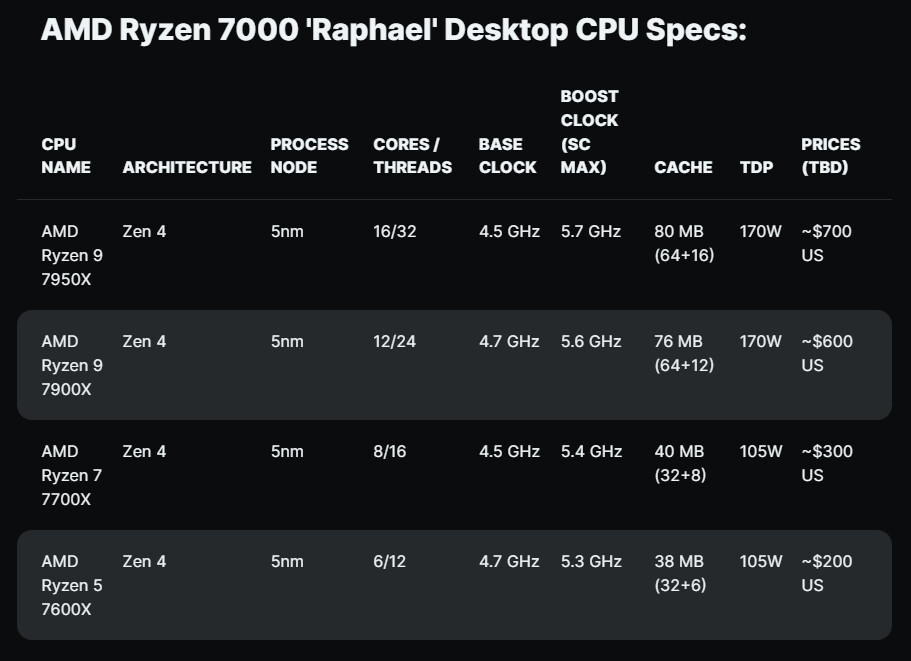
It's pretty clear that we're getting very close to the launch of AMD's AM5 platform and the Ryzen 7000-series CPUs, with spec details and even pricing brackets tipping up online. Wccftech has posted what the publication believes will be the lineup we can expect to launch in just over a month's time, if rumours are to be believed. The base model is said to be the Ryzen 5 7600X, which the site claims will have a base clock of 4.7 GHz and a boost clock of 5.3 GHz. There's no change in processor core or thread count compared to the current Ryzen 5 5600X, but the L2 cache appears to have doubled, for a total of 38 MB of cache. This is followed by the Ryzen 7 7700X, which starts out a tad slower with a base clock of 4.5 GHz, but it has a slightly higher boost clock of 5.4 GHz. Likewise here, the core and thread count remains unchanged, while the L2 cache also gets a bump here for a total of 40 MB cache. Both these models are said to have a 105 W TDP.
The Ryzen 9 7900X is said to have a 4.7 GHz base clock and a 5.6 GHz boost clock, so a 200 MHz jump up from the Ryzen 7 7700X. This CPU has a total of 76 MB of cache. Finally the Ryzen 9 7950X is said to have the same base clock of 4.5 GHz as the Ryzen 7 7700X, but it has the highest boost clock of all the expected models at 5.7 GHz, while having a total of 80 MB cache. These two SKUs are both said to have a 170 W TDP. Price wise, from top to bottom, we might be looking at somewhere around US$700, US$600, US$300 and US$200, so it seems like AMD has adjusted its pricing downwards by around $100 on the low-end, with the Ryzen 7 part fitting the same price bracket as the Ryzen 7 5700X. The Ryzen 9 7900X seems to have had its price adjusted upwards slightly, while the Ryzen 9 7950X seems to be expected to be priced lower than its predecessors. Take these things with the right helping of scepticism for now, as things can still change before the launch.
Source:
Wccftech
The Ryzen 9 7900X is said to have a 4.7 GHz base clock and a 5.6 GHz boost clock, so a 200 MHz jump up from the Ryzen 7 7700X. This CPU has a total of 76 MB of cache. Finally the Ryzen 9 7950X is said to have the same base clock of 4.5 GHz as the Ryzen 7 7700X, but it has the highest boost clock of all the expected models at 5.7 GHz, while having a total of 80 MB cache. These two SKUs are both said to have a 170 W TDP. Price wise, from top to bottom, we might be looking at somewhere around US$700, US$600, US$300 and US$200, so it seems like AMD has adjusted its pricing downwards by around $100 on the low-end, with the Ryzen 7 part fitting the same price bracket as the Ryzen 7 5700X. The Ryzen 9 7900X seems to have had its price adjusted upwards slightly, while the Ryzen 9 7950X seems to be expected to be priced lower than its predecessors. Take these things with the right helping of scepticism for now, as things can still change before the launch.
277 Comments on Potential Ryzen 7000-series CPU Specs and Pricing Leak, Ryzen 9 7950X Expected to hit 5.7 GHz
Most of the time you're getting 5% more FPS for 0-10% less power on the 12900K.
Example :
I don't even know what this thread is about anymore.....
BTW nice cherry pick here is mine. Your 12900K is running at 4.9Ghz which is conservative and does not boost to 5.2Ghz. It is limited. Let it boost to 5.2 and the 132W will become 190W or so.
Also every review that test's gaming efficiency has the alderlake far far (and I mean FAR, like up to 70% far) ahead of Zen 3 except the 3d.From your video there are games that the 5950x consumes 55% more power for similar performance (ms fs for example).
Ages ago some people had pentium4 running @ ~8.0GHz on liquid nitrogen cooling (10 or more generations of intel CPUs back).
This seems to indicate that 6.0 and even over will indeed be possible for the first time (without extreme cooling).
Also because of the massive size of the chip its easy to cool 240w. I have my 12900k on a u12a and its doing just fine. The 13900k will be even easier to coolThe motherboards with active cooling are the ones that need it the least
I remember my z690 ace having active cooling while its vrms were rated for 1800 amps .
I mean are you trying to argue a weaker entry level board should be trying to OC to 6GHz with fan attached and rubbish VRM design like I don't get it!!? The board itself will probably be coupled with weaker bios options as well and fewer PCB layers. Good luck with that compared to the person using a higher end MB. Call me nuts, but I think the person with the better MB will have a easier time at it.
You make good point on the size of the chip and cooling in terms of that versus concentrated heat. AMD needs to find a means to utilize the X3D cache to better disperse heat concentration further though 5800X3D is actually really good on efficiency. I think the picture frame approach is the best way possibly along with a slower larger TSV L4 cache underneath. They've got two options for that inside out or outside in and they could also invert it between connected chiplets for varied cache and chiplet designs. I can see that being a real ACE in tandem with big LITTLE approach.
They could 3D Stack inside 8 CPU cores in a smaller amount inside or outside a chiplet in larger amount for L3 cache though slower larger L4 underneath all of it that they mount to like pictures on a wall would make a lot of sense. I have my doubts that will happen with Zen 4 and stacked cache still be relatively new, but for Zen 5 maybe they've got time enough to consider the pro's and con's of it.
If they utilize a smaller L3 stacked cache latency will be better for the L3 and less voltage getting in the way frequency scaling for the L3. A larger L3 is good for capacity though so it too could be good depending on usage. Perhaps we may see something akin to it with Zen 5. It might not be quite in the form of a picture/frame arrangement, but eventually I see it serving as good interconnect ring/mesh cache bezel between chiplets and pretty flexible one.
Thats even more true for amd, how many amps can you cool on those tiny chiplets?
www.newegg.ca/p/N82E16813162038?item=N82E16813162038&source=region&nm_mc=knc-googleadwordsca-pc&cm_mmc=knc-googleadwordsca-pc-_-pla-_-motherboards+-+intel-_-N82E16813162038&id1=12406874354&id2=116029104657&id3=&id4=&id5=pla-1455288991910&id6=&id7=9000811&id8=&id9=g&id10=c&id11=&id12=CjwKCAjw3qGYBhBSEiwAcnTRLtdhcdB6xRSA1S4SJYIg8ndKK1cEP93wF5NVgd0bGe-WSOqVctCzdxoCqsgQAvD_BwE&id13=&id14=Y&id15=&id16=500405868642&id17=&id18=&id19=&id20=&id21=pla&id22=102503995&id23=online&id24=N82E16813162038&id25=CA&id26=1455288991910&id27=Y&id28=&id29=&id30=13256051496240068861&id31=en&id32=&id33=&id34=&gclid=CjwKCAjw3qGYBhBSEiwAcnTRLtdhcdB6xRSA1S4SJYIg8ndKK1cEP93wF5NVgd0bGe-WSOqVctCzdxoCqsgQAvD_BwE
The z690 pro a from msi can handle 300w just fine without any active cooling, and it's one of the cheapest z690 mobos.
I dont know why you are stuck at 500w, if you are making your cpu pull 500w your problem isnt the vrms. Its cooling that chip which is impossible
Furthermore this is a thread about the performance of AMD's next Gen so please take your thoughts to the Intel 13th Gen thread. In regards to the thread
I feel that the 7000 series chips will be faster than 5000 how much I don't know. What I can say with confidence though is if my 5950X ran at 5.7 GHZ on even a single core I would be very happy. We are in a really interesting time and both Companies HAVE to try hard to get our dollars so they will both have compelling products. AMD has to maintain the 15-20% increase in performance.
You dont need to be an engineer to figure out the 13900k will be easier to cool. Its a given