Wednesday, March 19th 2025

NVIDIA Adjusts GeForce RTX 50 Series Pricing in Europe; Slight Reduction Result of Favourable Exchange Rate
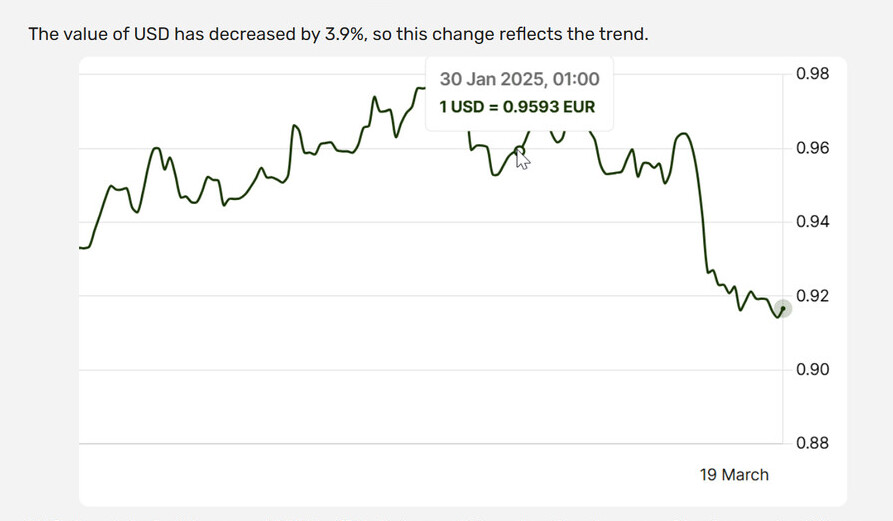
Graphics card price watchers have highlighted refreshing downward motion in Europe, apparently affecting three out of the four GeForce RTX 50 series graphics cards. VideoCardz received a couple of email tip-offs from its pan-European audience, prompting the publication of a short investigative piece. NVIDIA's slight adjustment of official pricing for GeForce RTX 5090, RTX 5080, and RTX 5070 models is the result of a strengthened Euro. The US dollar's value has dropped by roughly 3.9 %; according to recent detective work, focusing on German trends. Team Green's "generous" reductions have arrived roughly two weeks after a stabilization of the USD-EUR exchange rate.
Curiously, the GeForce RTX 5070 Ti is an outlier here—NVIDIA did not reduce its German guide price (€879 + VAT) for this upper-mid-range offer. A Founders Edition does not exist at this GPU level, so Team Green has tasked its board partners with the creation of so-called "MSRP conformant" alternatives. One of VideoCardz's tipsters has observed various GeForce RTX 50 series models simply "rotting on shelves," due to potential buyers balking at unreasonable retailer-implemented price hikes. NVIDIA's minor changes (4.3 to 4.6 %) are unlikely to make a noticeable impact across the Euro zone.


NVIDIA GeForce RTX 50 series pricing (for Germany)—launch price to current price
Source:
VideoCardz
Curiously, the GeForce RTX 5070 Ti is an outlier here—NVIDIA did not reduce its German guide price (€879 + VAT) for this upper-mid-range offer. A Founders Edition does not exist at this GPU level, so Team Green has tasked its board partners with the creation of so-called "MSRP conformant" alternatives. One of VideoCardz's tipsters has observed various GeForce RTX 50 series models simply "rotting on shelves," due to potential buyers balking at unreasonable retailer-implemented price hikes. NVIDIA's minor changes (4.3 to 4.6 %) are unlikely to make a noticeable impact across the Euro zone.


- RTX 5090: €2329 —> €2229 (-4.3%)
- RTX 5080: €1169 —> €1119 (-4.3%)
- RTX 5070 Ti: €879 —> €879 (0%)
- RTX 5070: €649 —> €619 (-4.6%)
37 Comments on NVIDIA Adjusts GeForce RTX 50 Series Pricing in Europe; Slight Reduction Result of Favourable Exchange Rate
5080 starts from 1500 eur but usually 1800
5070 ti starts from 1250 eur but usually 1500
5070 seems to be ~870 eur
Effectively Nvidia is keeping the price here the same as all they are doing is adjusting for fluctuations in currency value. Failing to lower the price to account for the weakened dollar would in fact be another price increase as Nvidia would be making more money when the local currency is converted into dollars.
If this is your definition of consumer friendly, then there isn't an anti-consumer international company in the world according to your logic. This is entirely a normal course of business when selling in multiple countries.
not surprising given the current economy where everything's price has increased
RTX 5080: €1169 —> €1119 (-4.3%)
RTX 5070 Ti: €879 —> €879 (0%)
RTX 5070: €649 —> €619 (-4.6%)
Source: VideoCardz"
This turn out to be fake news or click bait.
Correct prices should be:
RTX 5070 starting from 678,98€,
RTX 5070Ti starting from 999,95€,
RTX 5080 starting from 1419€,
RTX 5090 starting from 3249€.
German prices from geizhals.de.
Edit: yeah, I said almost, still silly prices
Have we ever read about a price change because of euro strengthening? I have never ever read a press release saying that X company is lowering prices because of euro gaining over dollar. If I had, that's probably ages ago.
At the same time this is probably the first time AMD is having a success in the GPU market in the last many years. And it is much better to say that "Ι am lowering prices because of euro/dollar exchange rate" than saying "I am lowering prices because I suddenly face competition".
Zotac 539£ partially covered heatsink exhaust from what I can see from angled pictures. Zotac did the same on Solid version covered exhaust of heatsink entirely on one side and is free of plastic shroud just on the side towards MBO:nutkick:. IMO I would stay away.
Hope you find that useful
If they give that inch, it is generally a foreboding signal into wider adjustments.
Notice once again how it is 'up to the partners to make designs conformant to the [$750] msrp'. It would be funny if it wasn't sad, as I have literally explained this is how they (partners) get screwed several times.
The first people to lose margin are the partners, only after they have been pushed to the brink on cutting margins (and if they still don't sell) will nVIDIA actually cut prices of the components sold to them.
And, as always, nVIDIA will constrain supply to keep ASP as high as possible, that way they make optimal margin on each unit. AIBs, then reliant on volume, get screwed.
Again, I have explained this several times, and now you are literally seeing nVIDIA flat-out openly explaining it as well (by telling AIBs to make skus conformant to MSRP), which is the first step in an actual price-cut.
nVIDIA literally uses partners as a human shield to protect their margins. In bottom-dollar situations the FE models act as literal competition, in which they make *all* the money on a sale.
That is not the case for the 5070 Ti, likely the key money-maker for AIBs (and hence why they will be forced to cut prices on their cash-cow), but it is for many other SKUs for different reasons.
It's kind of a brilliant system if you *really* think about it. Evil, but brilliant. nVIDIA knows how to look out for and protect themselves better than any company I have ever followed over the course of my entire life.
On top of that, they use their partners to gauge what the market will absorb in actual selling price; adjusting higher as necessary to take more when able and also someone to blame when not.
They are also very good at selling the tempting offers of SKUs like the 5070 Ti to partners, as they do reap margins when times are good, but when times are bad and prices must fall, partners will be the first to lose.
Both in margin, and in allocation for needed volume to make up that difference in margin. All-the-while, nVIDIA continues to make as much money as humanly possible.
nVIDIA is composed of perhaps the best marketing people on the entire planet. That is to the benefit of nVIDIA, correct, and absolutely nobody else. It is in-fact a detriment to most, and many do not realize it.
In many ways. I try to explain some of those instances and scenarios. I admire them from a marketing POV, but as a customer and somebody that cares for the well-being of the ecosystem, I am extremely critical.
As many *should* be, and some already are, but perhaps many are beginning to realize these things for the first time. Many are too far entrenched in being sold the marketing to see the forest for the trees.
I attempt to fix that. I'm not always successful, but somebody has got to try or they they will keep pushing further in every direction to screw everyone they can for their own well-being, as they have for decades.
Sure, the Geforce buyers can spend thousands to play games with extra shinyness, but ray tracing still isn't there in terms of performance or affordability for a majority of buyers. And instead of increasing performance Nvidia wants to sell software gimmicks and fake frames.
Granted without FSR4 or DLSS3, but that's the point of progress. Now you have those features and they are cheaper (and up-scaling quality better), but not the raster/ram for 4k.
With nVIDIA they have moved the needle zero since RTX4 outside selling the small compute/bw differences from 4080->5080 to eventually outdate the former; AMD rebalanced for the actual specs/markets.
Without features that would be outdated in good playability over time come new generations that move the goalpost; while raster stays stationary; as RT likely will now as well given we now have a standard.
It's ~50TF for 1080p60 (or 1440p up-scaled) on RDNA4/nvidia.
Now we can pretty much safely say things like the PS6 will have that spec + whatever extra grunt/ram it takes to upscale to 4k60. Which, 5080, btw, doesn't. That is another area it is purposely cut-off from acheiving.
On purpose. Eventually all these little things will add up and you realize this is what nVIDIA does. They do it on purpose. They don't have to but they do. To kill longevity and force upgrades.
What you see as technological advantages truly are in-fact genius marketing gimmicks. They are use of smaller area of the die (for less ops; 4/8-bit) to do operations generally required of FP32 units.
Which is why products like the 5080 exist, which are not 4k GPUs (or even great 1440p RT GPUs) but still cost $1000. To sell those gimmicks (such as 1080p->1440p/4k up-scaling w/ FG) instead of actual performance.
This saves die space, and allows them to sell a cheaper/smaller chip crutching on those features. Follow? It is in-fact genius. You must understand WHY they do it, not only that what you see as benefits occur.
The 4090 is a very good GPU. It is/was overpriced, but it is in-fact a very good GPU. It has and will last a long time, although nVIDIA has already started to keep it under 60fps in 4k or 1440pRT up-scaling scenarios; they won't completely go that route until they can sell a cheaper replacement. This will continue as further features and/or implementations of DLSS/FG become incorporated into more games.
Please understand most do not buy a 90, they buy the crap that is obsoleted or not-qute-good-enough for the spec they advertise, and actually are good-enough for the GPU spec one tier down from AMD.
5080 is only one DLSS update (or spec hike from replacement GPUs) away from not being able to stay in the 48hz VRR range of most monitors in 1440pRT.
Remember that I said that when it stutters after those occur. BECAUSE THAT IS WHAT NVIDIA DOES. They plan it. Because they are very smart, and people are very short-sighted.
I am going to laugh come UDNA and Rubin. You will realize 4090 is not quite as high-end as you believe. It is/was a very good chip for it's time, and a decent spec, but AMD will absolutely compete.
Again, you can pretty much understand the stack to be capable of 6144sp * 1/2/3 at high clocks or 1/2/3/4 at low clocks across a multiple of 128-bit bus. 4090 would be less than a 2x setup at 3nm clocks.
nVIDIA will probably sell a 192-bit chip with 9216sp (to replace 5080 for good-enough 1440pRT barely, but not great 4k/up-scaling) bc that's nVIDIA.
AMD will probably cut down a 256-bit chip (6*1792?) and completely destroy it for less money, because that is AMD. They will make what 5080 *should* have been, and probably sell it for current 9070 xt prices.
My *guess* is that AMD will do 1/2/3 at ~$400/800/1200. I *could* be wrong, but it's feasible. At that point you will not be wrong that you had a very good (if extremely expensive) GPU for four years.
And I will say a ~9070 XT is ~$400, capable of native 1080p RT (or 1440p up-scaling), a GPU better than 4090 keeping 1440pRT (and 4k-upscaling) for less than a '80' level gpu, and a much faster GPU much cheaper than 4090 ever was that keeps 4k60RT (unlike $3000 5090); other skus (perhaps cut-down) for certain scenario/use-cases (like 1080p->4k), or a less-than-full bottom-end SKU that can OC for 1080p.
Perhaps at that point you will flaunt path tracing at 1440p if not only 4k resolution for much more money. I will not care. I will tell people to buy the GPU that can do the thing for their sitch.
I will be happy those GPUs do not cost $1000, $2000, and $3000 as nVIDIA chose to often place them respectfully (and those earlier nvidia gpus perhaps not quite good-enough for those specs long-term).
And I will not be wrong that many more people will buy those and be happy for a long-time, in much higher availability and much lower price.
Importance of each our own prerogative, but general experience for as many people as possible/value/longevity mine.
And perspective.Largely correct, although obviously there is something to be said for pushing for higher rate of ops and implementation of those features (although I would argue not in exchange for other capabilties, as they do).
I would say RT is here with the 9070 xt (for native 1080p/1440p users that up-scale with FSR4)! Might not keep 60fps forever, especially if FSR4 improves (to make 1080p->4k better like DLSS4), but still good.
Certainly in VRR range given it is literally designed to keep 60fps in the 1080p/1440 up-scaled scenario right now. Hence, it's probably a safe bet (unlike almost any nVIDIA GPU for any standard spec).
Granted, that *is* still expensive to a lot of people, and I fully respect that. Hence read what I wrote about UDNA. I think that will fall to ~$400, which I think will bring it to *pretty much* everyone.
Perhaps even cut-down SKUs that can overclock to that playable level (as AMD/ATi has been known to do). Maybe the stack is cheaper (350/700), I don't know, but certainly more accessible/consistent regardless.
Always remember nVIDIA purposely withheld that capability with 5070 to keep that out of the range of many general consumers. As well as limiting buffer to 12GB as another obsolescence/upsell technique.
This is why what they do is scummy, and AMD is literally carrying the flag for standardization and balance of those features to each tier as quickly as possible; and I expect that to continue.
If nVIDIA continues to do what they do with Rubin (and perhaps PT), or perhaps has to create an affordable generation (through dense process/lower clocks/Micron ram), I don't know. They could try either.
If the former, it will be their general path repeated. If it is the later, it will be because of competition from AMD (especially if AMD redesign cache for greater bw for consistant RT/PT clocks/ability).
With some slight concessions, 9070 is okay too I suppose (although I wouldn't recommend it bc it could have problems over time...not worth it to save $50). 5070 is a POS bc it has 9070 problems plus less ram.
What Hec said is correct. You are in-fact ridiculously very incorrect. nVIDIA does in-fact leverage these things for high prices in exchange for actual better hardware performance, where-as AMD does not.
AMD buyers are not poor, as implied, just different goals. Most people cannot justify whatever price they would have to pay for a 4090 for 1440pRT. Or even $1200 for a 4080 for 1080p->1440p. They can $600.
AMD obviously sees features as part of the evolution of similar markets over eras. This is just the latest ~$500-600 1440p gpu they always make, now with 1080pRT and 1440p up-scaling for the 1440p market.
From nVIDIA which has cost $1000 for a couple years, and arguably still does. To put it another way, nVIDIA has not sold a <$1600 (MSRP) 4k raster GPU for a very long time; AMD did it with 7900xtx for half.
Like I say, some people really swallow that nVIDIA marketing hard. I mean real, real, real, fucking hard. Like what-you-said-is-a-flat-out-lie hard. If you believe it, you're the problem.
It's your money, but it kind of absurd. It makes much more sense (for most people) to upgrade as needed and save a shit load of money *and* have better perf in their pertinent resolution at any given moment.
Especially given what nVIDIA does (make sure cards can no longer hit a spec later in their life AND they cost more).
While AMD hits a resolution spec, stay consistent, and are affordable for each resolution target; features added when applicable to each of those markets (for a consistently lower price). It's truly that simple.
Now they have done it for 1440p (with good 1080pRT up-scaling). nVIDIA has not. Again, both purposely.
The next step is a 4090, which AMD chose not to make (and compete with a not POS 5080 nvidia also didn't make). In my estimation, likely because it would cost $1200 and they didn't think many would buy it.
Because they already bought a 4090. Or maybe they feared nVIDIA would beat them out with a 12288sp 5080 (which is probably true) at a similar price and didn't want to risk it.
They both will fight that good fight next gen for less money. I, and many other people, will likely buy one then (or maybe even a used 4090 when they are inevitably cheap and price drop through the floor).
If you can or could afford/justify a 4090 currently, awesome. I can't argue against it if you did; I'm stuck bc I want 1440pRT->4k and can't. Nothing for me atm, but that doesn't mean a 9070 xt isn't great for most.
Including RT. On 1440p. Which is most of the market. For $600 from AMD. From nVIDIA still costs (imo) $1000...theortically. If they weren't actually $1600 in reality. Which is insane.
And nVIDIA's stuff way too expensive without any guarentee of longevity in areas they claim leadership in those features. It's a racket, pure and simple. One I feel is coming to an end, and this is just the start.
9070 XT's success and the 5000 series relative failure (and impending price cuts) are not only proof of this, but almost-certainly a bellwether. Let's see who's right!