Monday, August 4th 2025

AMD Readies 16-Core Ryzen 9000X3D CPU with 192 MB L3 Cache and 200 W TDP
AMD is reportedly gearing up to expand its Ryzen 9000 "Granite Ridge" lineup with two all-new Zen 5 CPUs that push the limits of power draw and cache capacity. Leaker chi11eddog, who has cultivated ties with motherboard vendors, claims that AMD will introduce an 8-core/16-thread model rated at 120 W TDP, featuring a substantial 96 MB of L3 cache. This mirrors the cache density of the existing Ryzen 7 9800X3D, but could represent a distinct SKU. More striking is the rumored 16-core/32-thread part, a 200 W processor boasting 192 MB of L3 cache, surpassing the Ryzen 9 9950X3D's 128 MB. According to the leak, this chip features a dual-CCD design, with each chiplet pairing 32 MB of on-die cache with 64 MB of stacked 3D V-Cache, marking the first time AMD may ship a desktop CPU with 3D V-Cache on both dies.
If these claims prove accurate, AMD may finally have solved the economic puzzle of dual-X3D production. Until now, the company's top-end 16-core models have paired a single 3D V-Cache chiplet with a standard CCD. The new dual-stacked design removes that compromise and promises consistently high cache bandwidth across multithreaded workloads. If launched, these chips would reinforce AMD's gaming performance crown and finally bring true dual-X3D dies to the mainstream desktop arena.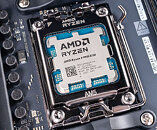

Sources:
chi11eddog on X, via VideoCardz
If these claims prove accurate, AMD may finally have solved the economic puzzle of dual-X3D production. Until now, the company's top-end 16-core models have paired a single 3D V-Cache chiplet with a standard CCD. The new dual-stacked design removes that compromise and promises consistently high cache bandwidth across multithreaded workloads. If launched, these chips would reinforce AMD's gaming performance crown and finally bring true dual-X3D dies to the mainstream desktop arena.


355 Comments on AMD Readies 16-Core Ryzen 9000X3D CPU with 192 MB L3 Cache and 200 W TDP
If you have 16 cores, 8 with x3d and your game runs 6-7 schedule-asking threads, will it keep them on the x3d ccd reasonably well (without resorting to manual intervention)?
If yes, then you are unlikely to see any performance improvement in current games from dual-x3d ccds.
Either way though, I do wish these new CPUs, or the next socket, would come with a PCI lane increase.
With dual X3D CCDs, you’re no longer bound by that scheduler workaround. You still want thread locality, but now the OS has the flexibility to scale across all 16 cores without sacrificing cache performance.
Most games today may not fully need that—but titles like MSFS, Cities II, Star Citizen, Cyberpunk (RT), and UE5 games already scale beyond 16 threads in meaningful ways. This isn’t just about current titles—it’s about removing a legacy constraint that’s beginning to matter.
IMHO, this is a proving ground for Zen 6 to go full dual-stack with improved I/O die.
I would be a lot more interested if it wasn't a thousand bucks lol :D
Though, at least you'll get the generational improvements. I'm looking forward to how the IOD for it will behave.
BTW, two CCDs with high latencies will bring exactly nothing to the gaming performance, even if the TDP is 500W.
Actually, I have asked uncle google and he told me:
linustechtips.com/topic/1614063-does-a-2-ccd-makes-a-difference-in-gaming-with-background-tasks/
Generated by AI:
Source: Google.