Monday, August 4th 2025

AMD Readies 16-Core Ryzen 9000X3D CPU with 192 MB L3 Cache and 200 W TDP
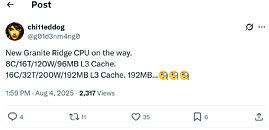
AMD is reportedly gearing up to expand its Ryzen 9000 "Granite Ridge" lineup with two all-new Zen 5 CPUs that push the limits of power draw and cache capacity. Leaker chi11eddog, who has cultivated ties with motherboard vendors, claims that AMD will introduce an 8-core/16-thread model rated at 120 W TDP, featuring a substantial 96 MB of L3 cache. This mirrors the cache density of the existing Ryzen 7 9800X3D, but could represent a distinct SKU. More striking is the rumored 16-core/32-thread part, a 200 W processor boasting 192 MB of L3 cache, surpassing the Ryzen 9 9950X3D's 128 MB. According to the leak, this chip features a dual-CCD design, with each chiplet pairing 32 MB of on-die cache with 64 MB of stacked 3D V-Cache, marking the first time AMD may ship a desktop CPU with 3D V-Cache on both dies.
If these claims prove accurate, AMD may finally have solved the economic puzzle of dual-X3D production. Until now, the company's top-end 16-core models have paired a single 3D V-Cache chiplet with a standard CCD. The new dual-stacked design removes that compromise and promises consistently high cache bandwidth across multithreaded workloads. If launched, these chips would reinforce AMD's gaming performance crown and finally bring true dual-X3D dies to the mainstream desktop arena.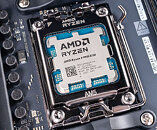
Sources:
chi11eddog on X, via VideoCardz
If these claims prove accurate, AMD may finally have solved the economic puzzle of dual-X3D production. Until now, the company's top-end 16-core models have paired a single 3D V-Cache chiplet with a standard CCD. The new dual-stacked design removes that compromise and promises consistently high cache bandwidth across multithreaded workloads. If launched, these chips would reinforce AMD's gaming performance crown and finally bring true dual-X3D dies to the mainstream desktop arena.


355 Comments on AMD Readies 16-Core Ryzen 9000X3D CPU with 192 MB L3 Cache and 200 W TDP
The only way it’s viable is if it was a test run for zen 6, and thats still pushing it without improvements to the I/O die and IF. With higher core count CCD chips around the corner, there’s likely nothing tangible to gain.
More performance forcing it into a 6 core chip.
I wonder what the benefit would be compared to a single X3D cache, but it would likely have some performance benefit as I doubt AMD would release a dual X3D with no benefit over a single X3D.AMD's management is doing fine, their GPU drivers have been more stable than the RTX 5000 series.
Have you tried a dual CCD CPU? The claims of the latency and stuttering are way overblown.Linus tech tips and Google AI? Really?
To clarify: the 7900X3D has two 6-core CCDs, with only one (CCD0) featuring 3D V-Cache. When you lock a game like Cyberpunk to CCD0, you're using 6 cores / 12 threads with full V-Cache—which gives the best performance in cache-sensitive titles due to reduced latency and better cache locality.
Even when both CCDs are active, the 7900X3D still outperforms the 7900X, because game threads still benefit from the V-Cache die. But it doesn't outperform CCD0-only performance, because threads may spill into the non-cached CCD, introducing latency.
The real issue isn’t core count—it’s cache symmetry. A future dual 3D V-Cache CPU (like a 9950X3D) would let you scale across all threads without sacrificing cache locality or relying on thread parking tricks.
Am I taking crazy pills, or is this really that hard to understand?
This is why I’ve previously stated instead of, or alongside I guess, AMD should invest more time in a hardware scheduler if they plan to keep the heterogeneous design down the road. It’s largely all moot with Zen 6 and core increases per CCD just around the corner. Your or anyones money is much better spent on Zen 6 than some abomination/test run product.It was an unrelated response to the 12 Core X3D parts being DOA, so yes you may be taking crazy pills.
I'm most probably not gonna buy one anyway, it's just a pipe dream. :ohwell:
May want to lay off the crazy pills and look what that was actually in response to…
It doesn’t matter, artificially locked it’s faster than both the 7900 and 7900X3D. So, when replying to “AMD wouldn’t release a DOA product” and “12 core CPUs are fine (AMD Zen parts)”, that’s a perfectly applicable example of the opposite. Additionally the 7800X3D and 9800X3D have always out performed the dual CCD hybrids.
Is it that hard to understand? Even AMD discounted the 12 core X3D parts to below the 8 core X3D parts, by more than $100 at certain points. The response has nothing to do with whether or not an ENTIRELY different design of this rumored chip.
Sure you can get a 16 core part but you will pay for it. Also, I am not a die hard gamer, so a lot of the arguments mean nothing to me.
My biggest problem is the 4070Ti not the 9900X.
The limitations of previous dual-CCD X3D chips weren’t just about raw performance — they were due to asymmetric cache layouts. That’s what forced the scheduler workarounds and parked cores. This rumored dual V-Cache design removes that constraint entirely. That’s not a minor tweak — it’s a structural change.
Whether it outperforms the 9800X3D will depend on the workload. But writing it off as DOA based on older designs misses the point — this isn’t the same architecture.
You can disagree, but dismissing it with personal jabs doesn’t make your argument stronger. Try to separate the tech discussion from the attitude.
It might be just a niche product like intels ks models. Low number available and a high price. But who knows, if they come out. AMD Might have solve the possible performance problems that might could happen in the mean time with driver optimisation. Much like intel had problems with there p and E cores could not work together properly on different tasks, in the early stage of 12 gen chips
A 24c/48t heterogeneous 10950X3D with a proper hardware scheduler would beat the pants off whatever this rumored chip is. Won’t have to sacrifice frequency when using the non vcache ccd as well.
This rumored chip will not be the silver bullet fanatics want it to be.
FFS :rolleyes:
I'm a little sympathetic to logistical issues getting in the way of a product's release, but AMD has done this time and time again with X3D chips. Even if you can't push out many of them, a 9965X3D would have been good company when the 9950X3D saw its day.
I do disagree, and you’re perfectly welcome to. Current evidence proves otherwise, as does clock limitations, temperature limitations, package limitations, thread assignment limitations, and so on. Without any real evidence, and this more likely being a proof of concept for implementation in Zen 6 if real, it’s only accomplishment will be burning a hole in someones wallet while being a largely limited/restricted release.
If you’ve got cash to burn and are after multi-thread performance there are already better options.