Monday, August 4th 2025

AMD Readies 16-Core Ryzen 9000X3D CPU with 192 MB L3 Cache and 200 W TDP
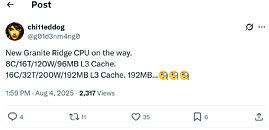
AMD is reportedly gearing up to expand its Ryzen 9000 "Granite Ridge" lineup with two all-new Zen 5 CPUs that push the limits of power draw and cache capacity. Leaker chi11eddog, who has cultivated ties with motherboard vendors, claims that AMD will introduce an 8-core/16-thread model rated at 120 W TDP, featuring a substantial 96 MB of L3 cache. This mirrors the cache density of the existing Ryzen 7 9800X3D, but could represent a distinct SKU. More striking is the rumored 16-core/32-thread part, a 200 W processor boasting 192 MB of L3 cache, surpassing the Ryzen 9 9950X3D's 128 MB. According to the leak, this chip features a dual-CCD design, with each chiplet pairing 32 MB of on-die cache with 64 MB of stacked 3D V-Cache, marking the first time AMD may ship a desktop CPU with 3D V-Cache on both dies.
If these claims prove accurate, AMD may finally have solved the economic puzzle of dual-X3D production. Until now, the company's top-end 16-core models have paired a single 3D V-Cache chiplet with a standard CCD. The new dual-stacked design removes that compromise and promises consistently high cache bandwidth across multithreaded workloads. If launched, these chips would reinforce AMD's gaming performance crown and finally bring true dual-X3D dies to the mainstream desktop arena.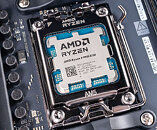
Sources:
chi11eddog on X, via VideoCardz
If these claims prove accurate, AMD may finally have solved the economic puzzle of dual-X3D production. Until now, the company's top-end 16-core models have paired a single 3D V-Cache chiplet with a standard CCD. The new dual-stacked design removes that compromise and promises consistently high cache bandwidth across multithreaded workloads. If launched, these chips would reinforce AMD's gaming performance crown and finally bring true dual-X3D dies to the mainstream desktop arena.


355 Comments on AMD Readies 16-Core Ryzen 9000X3D CPU with 192 MB L3 Cache and 200 W TDP
With a dual CCD config you're paying nearly double for the same performance, that's by definition not worth it
Maybe after everything AMD got tired of hearing the same thing from consumers and decided to launch it for the heck of it.I have the 4585PX coming in a week and from what I hear, they're slightly better binned atleast from the early batches but otherwise exactly the same as a 9950X3D.
www.neowin.net/news/report-microsoft-quietly-disables-vital-windows-feature-crippling-many-amd-ryzen-cpus/
Well, the biggest feature for this CPU is that no Microsoft Xbox Game Bar bug or feature removal could nerf this CPU unlike what happened to the 7950X3D or 9950X3D when Microsoft removed its ability to direct games to the X3D cache CCD in Windows 10 according to a report by PCGH and then reported on by NeoWin. Those CPUs have 2 CCDs, with only one of them having the cache. Losing that feature in the Xbox Game Bar severely nerfs the CPUs with 2 CCDs in which only one of them has a V-Cache.
Can someone please check to see if this bug or feature removal affects the Windows 11 version of the Xbox Game Bar?
EDIT: Fix spelling error.Neither AMD nor TSMC knew how to put the cache on the bottom for a long while. Putting the cache on the top was the only method for a while, but did have its advantages like having web server CPUs where serving frequently-used content could benefit from having a stacked multi-layer cache on top of the CPU so that the most frequently served web pages and files could fit within the X3D stack of caches. For workstation workloads, cache on top being a heat insulator was a severe nerf.
For gaming and workstation CPUs, the cache should go on the bottom. TSMC and AMD took a long time to jointly develop this technology, though. Until that was developed, cache on top was the only method.
I don't really know why it's so large but I guess there is a lot of deep buffers, not to mention that PCI-E and USB are both large structures. And pin pads and drive circuits are always bulky, so more pins is more silicon.
I wonder what they've done to overcome this, if anything.
The "ideal" scenario would be stacked V-cache in both CCDs plus an extra L4 on the IOD, but the cost of doing so would make pricing go through the roof.
Latency might not be a big deal here, it's more like bandwidth would be a problem (infinity Fabric would be shared for another purpose).
Yep, if it were in IOD, it might still end being faster than regular RAM, but maybe negligibly faster compared to cache attached directly to a CCD.
IMHO, AMD did what yielded best results and those results were still better way than performance drop caused by latency issues between two CCDs.
Anyway, CCDs and chiplets in general are amazing thing, as they dramatically reduce production costs (they offer very easy scalability).
AMD just needs to solve the interconnection (latency) issues, infinity fabric and memory controller must get considerably faster, too.
The 2x3D rumors are probably attempts to bring something to market that the market really wants. And if they succeed, they'll make even more money off the desktop.
But again, they're not as stupid as Intel's Ultra, where a little latency on a poorly placed memory controller - kill the their gaming crown.
Adding an L4 on top of the X3D on one chiplet seems like the way to go. The scheduler issues are blown way out of proportion tbh, it's a lot better than when the 7950X3D first launched.