Friday, August 8th 2025
Silicon Motion Details its First Consumer PCIe 6.0 NVMe SSD Controller
Silicon Motion revealed the first details of its first consumer PCIe 6.0 NVMe SSD controller at the Future of Memory and Storage (FMS) conference this week, alongside a new DRAM-less PCIe 5.0 controller that appears to rival the SM2508 in terms of performance. The new PCIe 6.0 controller is currently only known under the code name Neptune, but Silicon Motion is promising 25 GB/s or better sequential read speeds and up to 3.5 million IOPS. However, this hinges on the use of 4800 MT/s NAND flash in an eight channel configuration. Neptune is expected to launch sometime in 2028, which means you have plenty of time to save up.
As for its new DRAM-less PCIe 5.0 controller, it goes under the SM2524XT model name and features 14 GB/s or better sequential read speeds and 2.5 million IOPS, which is identical to Silicon Motions flagship SM2508 controller. However, this does require faster 4800 MT/s NAND, so it's not likely we'll see that type of performance from the first generation of drives based on the SM2524XT, as it has a 4-channel NAND interface vs. an eight channel interface on the SM2508. The SM2524XT is expected to launch some time next year. A new common feature for both of the new controllers—that they share with the SM2504XT—is support for Separate Command Architecture (SCA) which allows for commands and address transmission paths to be handled in parallel instead of having to deal with them sequentially, which should reduce latency and increase available bandwidth to the NAND.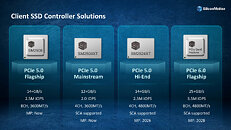
Source:
via Tom's Hardware
As for its new DRAM-less PCIe 5.0 controller, it goes under the SM2524XT model name and features 14 GB/s or better sequential read speeds and 2.5 million IOPS, which is identical to Silicon Motions flagship SM2508 controller. However, this does require faster 4800 MT/s NAND, so it's not likely we'll see that type of performance from the first generation of drives based on the SM2524XT, as it has a 4-channel NAND interface vs. an eight channel interface on the SM2508. The SM2524XT is expected to launch some time next year. A new common feature for both of the new controllers—that they share with the SM2504XT—is support for Separate Command Architecture (SCA) which allows for commands and address transmission paths to be handled in parallel instead of having to deal with them sequentially, which should reduce latency and increase available bandwidth to the NAND.

17 Comments on Silicon Motion Details its First Consumer PCIe 6.0 NVMe SSD Controller
That would presumably be Zen 7 on AM6 (2100 pins) and Razer Lake on LGA1954 (same as Nova Lake).
Ever since Phison E18 we've seen skyrocketing power draw for drives doing nothing.At last those first PCIe v4 controllers knew how to idle...
Now they're all sucking power for doing nothing like the worst Intel NetBurst CPUs.
Silicon Motion will most likely be late as you say, but if they'll be later than usual, I guess we'll see.
Hopefully something changes that improves how NVMe drives work, or there will be little to no incentive to go past PCIe 4.0 drives.
At what queue depths? Some PCIe 5.0 drives reach their advertised “speeds” at such high queue depths it’s clearly completely non reachable by most in consumer sector.
Can't answer your question though, as the chip is three years out...
I am still on a Gen3 drive for my gaming rig and server.
But yeah we are a point where faster NVME wouldn't help the rest of the system. There will always be waiting time.
Basically if your SSD can transfer 100GB/s, will still be limited by your RAM speed (6.4GB/s), so for now, those PCI-E 5.0 and 6.0 drives are totally useless for the average user.
Or the RAM speed is actually 51.2GB/s (6400x8) ?? - PC5-51200(DDR5-6400)
Confused...
6400 MT/sec x 8 bytes (64 bits) = 51,200 MB/sec
51,200 / 1000 = 51.2 GB/sec
51.2 × 2 (dual channel) = 102.4 GB/sec
In real world it will be lower, but if you Google image search for AIDA64 DDR5, you can get a decent idea of what's achievable.
By the time we have pcie gen6 SSDs on boards, the "sweet spot" ddr speeds won't be an issue for 100 GB/s.
Again though, im much more excited to see 2.5m to 3.5m IOPs, which would be a huge boost from ~600k IOPs of my current ssds.