Sunday, August 24th 2025

SK hynix Begins Mass Production of 321-Layer QLC NAND Flash
SK hynix Inc. announced today that it has completed development of its 321-layer 2 Tb QLC NAND flash product and has begun mass production. This achievement marks the world's first implementation of more than 300 layers using QLC technology, setting a new benchmark in NAND density. The company plans to release the product in the first half of next year following completion of global customer validation.
To maximize the cost competitiveness of its new product, SK hynix developed a 2 Tb device with double the capacity of existing solutions. To address potential performance degradation in large-capacity NAND, the company increased the number of planes, independent operation units within a chip, from 4 to 6. This enables greater parallel processing and significantly enhances simultaneous read performance.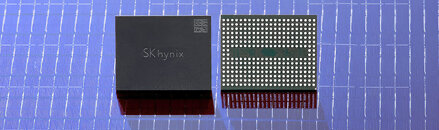 As a result, the 321-layer QLC NAND delivers both higher capacity and improved performance compared to previous QLC products. Data transfer speed has doubled, write performance has improved by up to 56%, and read performance has improved by 18%. In addition, write power efficiency has increased by more than 23%, strengthening competitiveness in AI data centers where low power consumption is critical.
The company plans to apply its 321-layer NAND first to PC SSDs, before expanding to enterprise SSDs (eSSD) for data centers and UFS for smartphones. Leveraging its proprietary 32DP3 technology, which enables the simultaneous stacking of 32 NAND dies in a single package, SK hynix aims to enter the ultra-high-capacity eSSD market for AI servers by achieving twice the integration density.
"With the start of mass production, we have significantly strengthened our high-capacity product portfolio and secured cost competitiveness," said Jeong Woopyo, Head of NAND Development at SK hynix. "We will make a major leap forward as a full-stack AI memory provider, in line with the explosive growth in AI demand and high-performance requirements in the data center market."
To maximize the cost competitiveness of its new product, SK hynix developed a 2 Tb device with double the capacity of existing solutions. To address potential performance degradation in large-capacity NAND, the company increased the number of planes, independent operation units within a chip, from 4 to 6. This enables greater parallel processing and significantly enhances simultaneous read performance.

The company plans to apply its 321-layer NAND first to PC SSDs, before expanding to enterprise SSDs (eSSD) for data centers and UFS for smartphones. Leveraging its proprietary 32DP3 technology, which enables the simultaneous stacking of 32 NAND dies in a single package, SK hynix aims to enter the ultra-high-capacity eSSD market for AI servers by achieving twice the integration density.
"With the start of mass production, we have significantly strengthened our high-capacity product portfolio and secured cost competitiveness," said Jeong Woopyo, Head of NAND Development at SK hynix. "We will make a major leap forward as a full-stack AI memory provider, in line with the explosive growth in AI demand and high-performance requirements in the data center market."
33 Comments on SK hynix Begins Mass Production of 321-Layer QLC NAND Flash
For a moment it feels like QLC creates a problem that no one asked for xd
Why do I have the feeling they don't mean cheaper 8 TB and finally larger capacity internal drives for PC, but rather the same small up to 4 TB drives with better margins for them, and some brand new huge "lifestyle" external drives with stupidly high prices?
And the rest will go to "ultra-high-capacity eSSD market for AI servers by achieving twice the integration density"?
And also, they announced "mass production" before.
news.skhynix.com/sk-hynix-starts-mass-production-of-world-first-321-high-nand/
At the moment, I agree with you, but we don't know what the future will bring.
Well, to each their own...
And yes, QLC is *that* bad.
you ain't improving shit if you don't make the effort of trying to figure out how to do it
QLC is that bad, ok, but what about 10 years from now when the tech finally matures and gets good ?
how do you think CPUs moved from single core to multicore ? the first attempts at making multi core PCs was to use multiple CPUs, it was wildly expensive and didn't work super well, and yet look where we are now, Intel making 52c/52t consumer CPUs, AMD making 16c/32t across two dies with a buttload of cache on top, they didn't pull that out of their ass from nowhere...
Now, this *may* improve in the future (everything is possible), but I, for certain, wouldn't count on it.
(Plus, please enlighten me what kind of normal user would even go through 5 TBW over the lifespan of an SSD, let alone the 80 of the absolute bottom barrel QLC 256GB SSDs. When you do nothing but use webapps, TBW does not matter one bit)
People even defend the uncommon sizes. Only WLAN and mobile cards should be in the 2230 format (I strongly believe it is that size with different notches)
-- Still reading again another 1TB or 2TB m2 2280 nvme review.
Instead, the backlash to QLC has lead to more improvements in TLC. Most premium drives still use TLC, because QLC is garbo. This did not happen with TLCs adoption, by this point in its life MLC has almost disappeared with one exception: the samsung pro drives.
The drives mentioned are 5+ years old, are you saying nothing has improved since then?
A lot of QLC drives are being used in the server space, especially for storage these days, so if they're as unreliable as you claim, how come large corporations are betting QLC drives?Uhm... A lot of WiFi cards are 1630 and most 4G/5G cards are 3030 or 3042...
3D NAND bringing back bigger more robust transistors made it comparable to planar MLC.
Now what do we have left to fix QLC again pushing that edge?
Increasing transistor size back even further taking per cell data capacity gain back in increased silicon area consumption?