Sunday, August 24th 2025

SK hynix Begins Mass Production of 321-Layer QLC NAND Flash
SK hynix Inc. announced today that it has completed development of its 321-layer 2 Tb QLC NAND flash product and has begun mass production. This achievement marks the world's first implementation of more than 300 layers using QLC technology, setting a new benchmark in NAND density. The company plans to release the product in the first half of next year following completion of global customer validation.
To maximize the cost competitiveness of its new product, SK hynix developed a 2 Tb device with double the capacity of existing solutions. To address potential performance degradation in large-capacity NAND, the company increased the number of planes, independent operation units within a chip, from 4 to 6. This enables greater parallel processing and significantly enhances simultaneous read performance.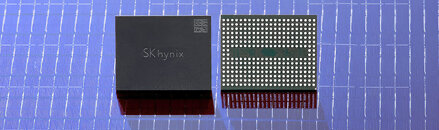 As a result, the 321-layer QLC NAND delivers both higher capacity and improved performance compared to previous QLC products. Data transfer speed has doubled, write performance has improved by up to 56%, and read performance has improved by 18%. In addition, write power efficiency has increased by more than 23%, strengthening competitiveness in AI data centers where low power consumption is critical.
The company plans to apply its 321-layer NAND first to PC SSDs, before expanding to enterprise SSDs (eSSD) for data centers and UFS for smartphones. Leveraging its proprietary 32DP3 technology, which enables the simultaneous stacking of 32 NAND dies in a single package, SK hynix aims to enter the ultra-high-capacity eSSD market for AI servers by achieving twice the integration density.
"With the start of mass production, we have significantly strengthened our high-capacity product portfolio and secured cost competitiveness," said Jeong Woopyo, Head of NAND Development at SK hynix. "We will make a major leap forward as a full-stack AI memory provider, in line with the explosive growth in AI demand and high-performance requirements in the data center market."
To maximize the cost competitiveness of its new product, SK hynix developed a 2 Tb device with double the capacity of existing solutions. To address potential performance degradation in large-capacity NAND, the company increased the number of planes, independent operation units within a chip, from 4 to 6. This enables greater parallel processing and significantly enhances simultaneous read performance.

The company plans to apply its 321-layer NAND first to PC SSDs, before expanding to enterprise SSDs (eSSD) for data centers and UFS for smartphones. Leveraging its proprietary 32DP3 technology, which enables the simultaneous stacking of 32 NAND dies in a single package, SK hynix aims to enter the ultra-high-capacity eSSD market for AI servers by achieving twice the integration density.
"With the start of mass production, we have significantly strengthened our high-capacity product portfolio and secured cost competitiveness," said Jeong Woopyo, Head of NAND Development at SK hynix. "We will make a major leap forward as a full-stack AI memory provider, in line with the explosive growth in AI demand and high-performance requirements in the data center market."
33 Comments on SK hynix Begins Mass Production of 321-Layer QLC NAND Flash
@TheinsanegamerN btw, Samsung Pro drives also use TLC since the 980 Series.
Enterprise QLC drives are very reliable but can't be used with as high load as TLC drives and also have lower performance, the cost is 30% lower. QLC-drives usually have 0.3 DWPD and TLC-drives 1-3 DWPD, so a 15TB QLC drive can handle 4.5TB data written every day for 5 years, that is more than enough for many applications.
The cost difference between QLC and TLC in a server with 24 15TB disks is over 30000€ so QLC are used when you don't need the extra performance and write endurance TLC provide.
As QLC drives starts to go up in sizes they also start replacing spinning disks, the price for QLC SSD is still higher but they are more dense so you save rack space and power, you get 12*30TB spinning disk in 2U while you get 24*128TB with SSD, 360TB vs 3PB.
Enterprice QLC drive often start with sizes from 15TB and up, I think the price doesn't scale well below that as NAND vs controller prices makes smaller drives less attractive when compared to TLC-drives. Right now the 30TB QLC drives have best €/TB prices and according to a few vendors I'v spoken to the 60TB drives will take that spot very soon.
In the consumer space, drives are much smaller, for a 1TB drive maybe the NAND prices between QLC and TLC are less than 15€, so to lower the pricepoint even more the vendors using the cheapest controllers and firmware and you end up with rather bad drives that costs ~30€ less than a decent drive with TLC. For the enterprise space, the vendors spend much more in development making good firmware the can handle the drawbacks of QLC.
So to sum up, QLC in enterprise is a viable option as vendors make good controllers and firmware and NAND prices scale well with large capacity.
In consumer space, QLC is used in the cheapest drives, built with the cheapest components and firmware making them rather bad.
www.storagereview.com/review/intel-ssd-670p-review-qlc
www.tomshardware.com/reviews/intel-ssd-670p-m-2-nvme-ssd-review
The lowest endurance one is rated at 185TBW with the highest one being 740TBW. And this is using older QLC tech. QLC drives are clearly able to be used for more than general purpose PCs.
This Enterprise QLC drive (192 layer) is rated for 32PBW PB not TB
hothardware.com/reviews/solidigm-ssd-d5-p5430-data-center-ssd-review
All these people crying about how bad QLC is are either buying the wrong drives or are ignorant to the current state of QLC drives.
QLC isn't meant to replace Optane/SLC-level write caches.
Example 1: Samsung 990 pro 4TB is the same price as Kingston NV3 4TB + 2TB model.
Example 2: WD black sn 770 2TB is the same price as a Kingston NV3 2TB + 500GB/1TB depending on sales.
Yes they are slow but you get more. You guys are pretty spoiled with deals to boost consumerism. Not defending QLC, just saying a lot of people's budgets don't always allow a lot of good drives at all times. I have a mix of both and for what it's worth for general usage and/or backups QLC isn't that bad if it's cheaper. Some markets have very limited choices. You can get 5Y warranty on some QLC and it makes it even more atractive.
TLC drives seem to be cheaper there so i agree that over there QLC makes little sense and is bad value. Hope things improve in pricing and tech. If not just get spindles? Weekly backups and doing screenshots of smart data are good practice for any type of drives.