Wednesday, September 3rd 2025

AMD "Zen 6" Processors to Use TSMC 2 nm Node for CCDs, 3 nm for IOD

AMD will transition its next-generation "Zen 6" desktop Ryzen and server EPYC processors to a split-node strategy, placing CPU core complex die (CCD) on TSMC N2P 2 nm node variant and building the I/O die (IOD) on the N3P 3 nm node. At TSMC, volume ramp for the 2 nm node is around the third quarter of 2026, opening the door for limited shipments as early as late Q3 or broader availability in Q4 2026. Under the split approach, the compute chiplet will house the Zen 6 cores and a substantially larger shared L3 pool, while the IOD will continue to host memory controllers, PCIe lanes, USB, and the integrated GPU. Earlier rumors suggest that each CCD could contain 12 Zen 6 cores with support for SMT, and a shared L3 cache that may increase to roughly 48 MB per CCD compared with prior generations. Typical consumer configurations would pair up to two CCDs with a single IOD, creating chips with up to 24 cores and 48 threads, while server variants could scale further depending on packaging.

Performance expectations center on achieving double-digit IPC gains, higher sustained clock speeds, and improved power efficiency, thanks to the advanced process nodes. The choice of N3P for IOD helps AMD cut some costs for non-core logic, while the N2P compute die aims to extract greater generational gains. However, as with any new TSMC node, it will carry a premium over the N3P, so using it only for the compute side is the most viable choice. Platform compatibility remains for one more generation, with Zen 6 expected to support the existing AM5 socket. Users can upgrade CPUs without a full platform replacement. If the ramp timing holds, Zen 6 will arrive into a crowded second half of 2026 desktop window. For datacenter applications, the EPYC "Venice" generation, based on Zen 6, will utilize sIOD (server I/O die), implementing PCIe Gen 6, which provides a generational doubling in bandwidth to GPUs, SSDs, and NICs. AMD is also claiming memory bandwidth of up to 1.6 TB/s for these CPUs, so we could see some of that trickling down into consumer configurations.
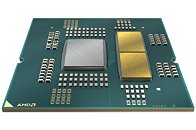
Source: Kepler_L2
Add your own comment

71 Comments on AMD "Zen 6" Processors to Use TSMC 2 nm Node for CCDs, 3 nm for IOD

#51
_roman_
THU318 GB/s is very limiting if you have a second GPU (only high-end boards have two x16 slots connected to the CPU), capture card and multiple NVMe drives.
Where is that an ordinary desktop usage?

When you need more than the link speed.

I think 8x pice 5.0 lane for gpu 1 and 8x pcie 5.0 lanes for gpu should be plenty of bandwidth. If not HEDT

You may look for multicore software and not blame it on the lack of 3D-Cache.

the stuff seems to be freely available as of now. Random picked 9000 cpu.
geizhals.at/amd-ryzen-threadripper-9960x-100-100001595wof-a3504021.html

A small niche, cpu with lots of cache with few cores with many pcie lanes.


92 / 88 pcie 5.0 lanes
www.amd.com/en/products/processors/ryzen-threadripper/9000-series/amd-ryzen-threadripper-9960x.html
Posted on Reply
#52
THU31
_roman_Where is that an ordinary desktop usage?

When you need more than the link speed.
I literally posted a gaming scenario, and you keep recommending Threadripper.

I have a second GPU for PhysX, a capture card and three NVMe drives. This is a gaming configuration, not productivity.

Motherboards with x8/x8 slots cost $500+. Do you really think that adding four extra lanes to the chipset link would raise motherboard prices by hundreds of dollars? How can you possibly be against adding more basic features (that the competition has already had for years), that makes no sense. It's like you want to artificially limit mainstream products so people have to pay three times as much for high-end ones just to get one feature. Are you defending 8 GB GPUs in 2025 too? I heard the majority of people don't need more than that, because they only play competitive games.
Posted on Reply
#53
Darkholm
Makaveliexcellent post i'm looking forward to 1:1 with DDR5 8000 on Zen 6 :)


This is a possibly we shall see 670E and 870E are the same chipset with just USB 4.0 added. So would be a kind of a dick move lol.
300 and 400 chipsets were also the same, but then again, we know what happened :D
Posted on Reply
#54
Oberon
ymdhisDoes that mean the memory controller will stop sucking? Big if true. Will this open up the potential for getting new motherboard chipsets as well?

Here's hoping they'll also use the new interconnects from strix halo, which use a lot less power.
AMD's memory controller is better than Intel's; you can more consistently hit 8000+ MT/s on AMD CPUs than on Intel (where it is still FAR from guaranteed), but the performance tradeoffs aren't worth it for the desktop chips.
Posted on Reply
#55
Geofrancis
THU31I have a second GPU for PhysX,
That uses almost no bandwidth and would probably work fine on a 1x 1.0 slot.
Posted on Reply
#56
TPUnique
QuicksMeh, 10% here to 20% there is boring...

If it's not 60%+ you probably won't even notice the difference. You throwing money away then.
It's a (relative) waste of money only if you already have a Zen 4 or Zen 5 with at least 8 cores.

But if you'll be in the market for a CPU at the time on Zen 6's release, it'd be dumb not to choose this arch over the previous ones... unless you're really cash strapped.
Posted on Reply
#57
Tek-Check
TPUniqueAnd jumping from Zen 5 to Zen 7 could net more than 20% gains, which is nothing to sneer at.
You meant that jumping from Zen5 to Zen6 could bring even 40% uplift in applications, because '10800X3D' will have 4 extra cores on a single CCD.

Both companies splurged on next gen CPUs, so I expect really good uplifts.
Posted on Reply
#58
THU31
GeofrancisThat uses almost no bandwidth and would probably work fine on a 1x 1.0 slot.
Any data to back this up? Is there actually a way I could test that myself?
Posted on Reply
#59
_roman_
THU31I have a second GPU for PhysX, a capture card and three NVMe drives. This is a gaming configuration, not productivity.
THU31Any data to back this up? Is there actually a way I could test that myself?
The specification for those 3 expansion card from the manufacturer should be quite clear.

The common knowledge lane sharing and bandwidth sharing still applies. As discussed with the chipsets and mainboards.

I do not classify three expansion cards as a desktop anymore. 1990 it was a desktop with three expansion cards.
you may think about using the network interface to offload the storage bandwith and getting a proper 4TiB or larger PCIE 5.0 4 lanes storage.

I'm grateful for your insights. I want to understand your point and argumentation. Just why.
THU31Are you defending 8 GB GPUs in 2025 too?
Nice try. Do not troll.
Read my posts. I was quite clear about 8GiB gpu in the past.
Posted on Reply
#60
TPUnique
Tek-CheckYou meant that jumping from Zen5 to Zen6 could bring even 40% uplift in applications, because '10800X3D' will have 4 extra cores on a single CCD.

Both companies splurged on next gen CPUs, so I expect really good uplifts.
For the software which can take advantage of it, certainly it'll be even more of a banger.

2027 will be an exciting year for CPUs and GPUs alike.
Unless PRC does end up invading ROC, in which case the difficulties experienced during the 'rona times will retrospectively appear as mere appetisers ☠
Posted on Reply
#61
trparky
_roman_I would differentiate between Motherboard issues and platform issues.
I should sell soon my am5 asus motherboard. Asus can not do it right with the asus prime x670-p motherboard

Not well DRAM will need certain times a CMOS reset. I did run for a while no expo, than expo. I would differentiate between decent Hynix-A Die EXPO Profile which has the supported AMD MT/s rating. Not sure if it is 5200MT/s or 5600 MT/s rating for the dram. Check the cpu product page before buying motherboard, cpu and dram when you do not want to deal with cmos reset.
Maybe, because I have no issues on my Gigabyte board.
Posted on Reply
#62
Geofrancis
THU31Any data to back this up? Is there actually a way I could test that myself?
It depends on the task, things like mining, video encoding or physx don't use a lot of memory so they don't need a lot of bandwidth compared to graphics and AI that are using massive datasets that need to be moved around.
Posted on Reply
#63
ronss
i believe zen 6 will be manufacutured at tmsc plant in phoenix where i live..cool.......getting a new microcenter too...they will not have to ship far for their cpus
Posted on Reply
#64
Tek-Check
ronssi believe zen 6 will be manufacutured at tmsc plant in phoenix where i live..cool.......getting a new microcenter too...they will not have to ship far for their cpus
Zen6 will not be manufactured in Phoenix because CCDs are on N2 node, which is only procured in Taiwan until at least 2028.
Posted on Reply
#65
trparky
And even if the CCDs were manufactured here in the United States, the CCDs go somewhere else to be packaged into the final product and then shipped back here.
Posted on Reply
#66
Geofrancis
Tek-CheckThat's not going to happen.
Probably not but using the IO die for a chipset wouldnt be without precedent, they must have a lot of IO dies with faulty memory controllers but the PCIE lanes are ok.
Posted on Reply
#67
randomdude9182
QuicksNo worries I am not in a hurry. Seems AMD is also not in a hurry to make money then. 2029 / 2030 is perfectly fine. I am not a sucker for 10% -15% cpu gains anyways.
Amd zen6 is already reaching 30+% on 3nm (on what I suspect isnt final performance uplift and a lower tier part, and will be better scaling on desktop due to n2x). I say this beacuse of ccd core count.

And I mean, the only time amd didnt have a 15% leap was zen5 for multiple reasons.
LittleBroAbout damn time AMD revamped IOD with brand new shiny memory controller.

My 9800X3D can't do 3200 MHz on stock settings, it's causing memory errors. 3100 MHz works fine.

AMD needs to get their shit together amd introduce IOD with some modern capabilities, reaching memory speeds of 10k MT/s and higher.
TPUniqueThey will make money hand over fist, with or without your meager contribution. And jumping from Zen 5 to Zen 7 could net more than 20% gains, which is nothing to sneer at.
It is going to be a massive increase. 20% in two generations would be straight up impossible, zen6 mobile es benchmarks are doing 30% higher numbers for what I suspect is a lower-mid tier part compared to a flagship.
Posted on Reply
#68
Jism
LittleBroAbout damn time AMD revamped IOD with brand new shiny memory controller.

My 9800X3D can't do 3200 MHz on stock settings, it's causing memory errors. 3100 MHz works fine.

AMD needs to get their shit together amd introduce IOD with some modern capabilities, reaching memory speeds of 10k MT/s and higher.
Lol. I bet you a 100$ your memory is not QVL compatible, and blaming it on AMD while the culprit is the combination of the motherboard and used memory. Even a ancient 2700x reaches 3600Mhz RAM.
Posted on Reply
#69
randomdude9182
JismLol. I bet you a 100$ your memory is not QVL compatible, and blaming it on AMD while the culprit is the combination of the motherboard and used memory. Even a ancient 2700x reaches 3600Mhz RAM.
Or its deffective and he thought it wasnt for some reason? The memoroy controller could have been damaged somehow. EIther that or what you said.
Posted on Reply
#70
LittleBro
JismLol. I bet you a 100$ your memory is not QVL compatible, and blaming it on AMD while the culprit is the combination of the motherboard and used memory. Even a ancient 2700x reaches 3600Mhz RAM.
I bought my RAM kit specifically because it's listed in QVL (my board is listed on G.Skill's QVL). Many 9800X3Ds can't go beyond 3100 MHz.

As fo 2700X, 3600 MHz is in fact 1800 MHz. As for mine 9800X3D, 3100 MHz is effectively 6200 MHz. No 2700X could run DDR5.
Posted on Reply
#71
randomdude9182
LittleBroI bought my RAM kit specifically because it's listed in QVL (my board is listed on G.Skill's QVL). Many 9800X3Ds can't go beyond 3100 MHz.

As fo 2700X, 3600 MHz is in fact 1800 MHz. As for mine 9800X3D, 3100 MHz is effectively 6200 MHz. No 2700X could run DDR5.
"As fo 2700X, 3600 MHz is in fact 1800 MHz"
By the way, use mt/s (megatransfers/s) its a much better unit. Yes, 6200mt/s ram is the usual high end, although some kits can do 6400 at lower timings. Don't randomly divide the numbers in half and expect everyone to get it, we thought your cpu/ram might be "highly defective" beacuse 3100mt/s is the normal ddr4 ram speed.
Posted on Reply
Add your own comment
Nov 19th, 2026 03:27 PST change timezone

New Forum Posts

Popular Reviews

TPU on YouTube

Controversial News Posts