Friday, November 7th 2025

GDDR7 Shortage Could Stop NVIDIA GeForce RTX 50-Series SUPER Rollout
NVIDIA's rumored GeForce RTX 50 series "Blackwell" SUPER graphics cards might face delays due to the ongoing DRAM shortage affecting the industry. These GPUs are expected to feature more dense GDDR7 memory modules with 3 GB per module. The current DRAM shortage could impact the planned release date and potentially lead to the cancellation of the entire rollout. According to Uniko's Hardware, there is speculation that the SUPER refresh cycle might be scrapped entirely, leaving only the standard NVIDIA GeForce RTX 50 series in production. This regular series uses earlier GDDR7 memory with 2 GB per module, which is likely more readily available as the new AI developments are consuming the higher-density modules first.
According to BenchLife.info, NVIDIA was reportedly planning a mid-lifecycle refresh for late Q1 to early Q2 2026, with a possible announcement at CES 2026. Earlier speculation suggested three new SKUs that would replace existing models: the RTX 5070 SUPER, RTX 5070 Ti SUPER, and RTX 5080 SUPER. The main improvement seemed to be in memory capacity, with all three cards expected to have 50% more memory than their non-SUPER counterparts. The RTX 5070 SUPER was said to offer 18 GB, while the RTX 5070 Ti SUPER and RTX 5080 SUPER would each provide 24 GB. However, the latest rumor leaves us with no clues about whether these GPUs will actually appear. The only thing we can anticipate is CES, where NVIDIA might reveal more information.
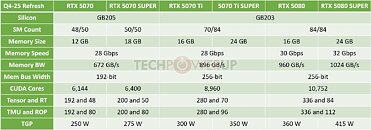 For 3 GB GDDR7 memory modules, NVIDIA is likely focusing on higher-end products like the RTX PRO "Blackwell" series and its AI server stack. Interestingly, NVIDIA's "Rubin CPX" GPU—a specialized accelerator from the upcoming "Rubin" family designed specifically for massive-context AI models—uses 128 GB of GDDR7 memory. It seems possible that NVIDIA is stockpiling GDDR7 memory for its high-margin server products, leaving the gaming market with the 2 GB GDDR7 modules for the time being. However, this information is currently based on rumors and should be taken with caution.
Sources:
Uniko's Hardware, via VideoCardz
According to BenchLife.info, NVIDIA was reportedly planning a mid-lifecycle refresh for late Q1 to early Q2 2026, with a possible announcement at CES 2026. Earlier speculation suggested three new SKUs that would replace existing models: the RTX 5070 SUPER, RTX 5070 Ti SUPER, and RTX 5080 SUPER. The main improvement seemed to be in memory capacity, with all three cards expected to have 50% more memory than their non-SUPER counterparts. The RTX 5070 SUPER was said to offer 18 GB, while the RTX 5070 Ti SUPER and RTX 5080 SUPER would each provide 24 GB. However, the latest rumor leaves us with no clues about whether these GPUs will actually appear. The only thing we can anticipate is CES, where NVIDIA might reveal more information.


48 Comments on GDDR7 Shortage Could Stop NVIDIA GeForce RTX 50-Series SUPER Rollout
They did this with 40 series too, and when the new cards dropped old cards were gone and you were left paying the price.
Whatever.
"Billions of dollars of investment in AI Could Stop NVIDIA GeForce RTX 50-Series SUPER Rollout"
There is very little incentive for Nvidia to bow down to the level gamers operate at nowadays.
BUT, you can bet your ass they 1000% will make up for any lossses/delayed profit mongering, by making the next series of cards even more expensive than originally planned :(
It's always the issue that the graphic card chip is too small and therefore the VRAM does not matter. :P