Sunday, November 30th 2025

AMD Lists Ryzen 7 9850X3D CPU with 5.6 GHz Boost Frequency
AMD has launched an official website placeholder for the Ryzen 7 9850X3D processor, which was leaked in October. As a part of the "Granite Ridge" Ryzen 9000 X3D series, AMD is reportedly developing two additional updates to the lineup. One is a flagship model, the Ryzen 9 9950X3D2, and the other is a refined eight-core, 16-thread X3D design. Today, AMD's website confirms the Ryzen 7 9850X3D, featuring 8 cores and 16 threads, 96 MB of L3 cache, and a boost clock up to 5.6 GHz, with a 120 W power envelope. This represents a 400 MHz increase over the Ryzen 7 9800X3D model, which has the same cache and core configuration. AMD is likely using higher-binned dies it has saved over the past few months to offer a better alternative to Intel's upcoming "Arrow Lake Refresh," scheduled for early 2026, and "Nova Lake," scheduled for late 2026.
However, details about the new flagship model, the Ryzen 9 9950X3D2, featuring 16 cores and 32 threads, remain uncertain. This chip reportedly includes 3D V-Cache on both chiplets, totaling approximately 192 MB of L3 cache. It is said to operate at a base frequency of 4.30 GHz, with a boost up to around 5.6 GHz, and has a TDP of about 200 W. The 9950X3D2, with its new naming convention, suggests a tradeoff of slightly lower peak boost speeds (-100 MHz) compared to the single-stack X3D Ryzen 9 9950X3D model, but offers significantly increased cache capacity. Today only the higher-clocked Ryzen 7 9850X3D is confirmed by AMD, so we might have to wait on the dual-chiplet X3D2 SKU a bit more.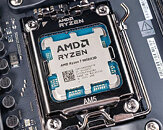
Sources:
AMD, via VIdeoCardz
However, details about the new flagship model, the Ryzen 9 9950X3D2, featuring 16 cores and 32 threads, remain uncertain. This chip reportedly includes 3D V-Cache on both chiplets, totaling approximately 192 MB of L3 cache. It is said to operate at a base frequency of 4.30 GHz, with a boost up to around 5.6 GHz, and has a TDP of about 200 W. The 9950X3D2, with its new naming convention, suggests a tradeoff of slightly lower peak boost speeds (-100 MHz) compared to the single-stack X3D Ryzen 9 9950X3D model, but offers significantly increased cache capacity. Today only the higher-clocked Ryzen 7 9850X3D is confirmed by AMD, so we might have to wait on the dual-chiplet X3D2 SKU a bit more.

148 Comments on AMD Lists Ryzen 7 9850X3D CPU with 5.6 GHz Boost Frequency
There are people that will choose a 9950X vs a 9950X3D because they do more work and don't really play games. And the money saved they can put towards ram or an SSD.
I just had a friend that did this because he mostly games on his console but needs the PC to render.
For CPUs what really matters is two things:
- is it fast enough to run your content
- is it fast enough to carry your GPU
You can't review that properly against the other CPUs in the playing field, too many variables. So the best way to approach CPU performance is by relative performance. That, combined with the knowledge of what minimum CPU you need to get by for your personal use case, allows you to make an informed choice. And to get the best look at relative performance, you make sure the CPU is the bottleneck.
I can understand the complaints of unrealistic benchmarks, and I definitely appreciate seeing real world gaming tests over GPU limited 720P tests or a bajillion FPS in a competitive game that no one but a handful of actually competitive e-sports players care about.
The tests are not unrealistic, they isolate the CPU, and if you have a fast GPU, or plans to buy one going forward, those tests are extremely accurate to gauge what's the best CPU to buy. If you have a slower GPU, the CPU results show you a realistic scenario too, because the GPU doesn't weigh in on the results. It makes the CPU testing pretty much 'content agnostic' and just shows raw performance. It doesn't get a lot more 'what you see is what you get' than that. Your request is an exercise in futility.
If all you want is 'enough to play game X' go ahead and read or watch a performance review on that specific game - which also do exist.
Beyond that, there are also various game scenarios where you want as much CPU as you can throw at it, even completely discounting what GPU you have - this applies to almost every sim building game, grand strategy, 4X, because the game logic will eventually just choke your framerate - and every 100 mhz helps to stay away from that as long as possible. Lots of cache helps too, and if the game is properly threaded, even core count can help. For that scenario, I really do want to see those 720p results and isolated CPU performance relative to the rest of the CPUs I could buy. Even on AM5, it doesn't matter, you can choke every CPU, no problem.
Say you are just a Joe, not knowing what is what these days. You buy the 9950 because you work and play games, maybe do some science stuff on the side.
But then 2 months later you see there is a 9950X3D. Does everything you wanted your 9950 to do, but it does it better for games and science.
So now you are pissed at AMD. Just make everything on the top end that would have an X to an X3D. Problem solved.
Edit:
I almost bought a 9800X3D this weekend, glad that I did not.. because I will get the faster one :)
Or you could just wait 5-6 months for a sale or new products, I'd be pissed having not waited for at least a sale on the non-X3D, but that's just me not being a "true enthusiast" being able to resist buying the new shiny right away.
Its been pretty good man, cant complain. Does everything I want except boost to 6GHz :)
Either way it goes: you lose
If both parts are available on the market at the same time you have to do your due diligence before opening your wallet.
If you didn't do proper research and have buyers remorse after that's really on the user.
If anything, I'm more miffed at AMD not releasing the dual 3D processor already. The 9950X3D is a compromise, I don't do compromises.
There are people out there who just look at what the store has, and buy the top stuff without batting an eye.
If the top product changes within a month or two, I would be pissed too.
But how often does that happen? I know people love X3D for obvious reasons, but to me the segmentation is annoying :)
Also, the regular Ryzen 9s still have one CCD being faster than the other, the 9950X has one fast CCD and one slower one, this causes issues in applications that expect all cores to be the same.
I'm hoping this will be fixed in Zen 6.
I wish we could get a 9600X3D already. X3D is great and all but its gate-kept to the high end. Even a last gen 7800X3D is more expensive than a 265K/9700x
Praying for Nova Lake bllc to challenge the X3D monopoly so there can be better prices on astronomically large L3 CPUs
And I cannot get more than 15 passes in Linpack, I have to drop clocks down to 5400 to do it. I can already do that with PBO so not much point.
I hope the dual X3D gives you the best that Zen 5 can offer in both clocks, power tolerance, and of course raw performance.
One last real hurrah before Zen 6 comes in for the slaughter lol..
If you're really anal about power usage, you can undervolt and underclock a 9800X3D and it will still be 5-10% faster than a 7800X3D while using the same amount of power.
To be fair, that still isn't amazing in comparison, and we can blame AMD for pushing the 9800X3D out of its optimal efficiency range, but the 9800X3D is an improvement over the 7800X3D even if it's only a fairly modest one.
And you should also consider that in most applications with a 9800X3D, you won't be CPU-limited, so the CPU normally won't be running at its maximum clocks and using 155W. There are some situations where it can, but only when you would actually benefit from the extra CPU performance.
And there is a way to test if a CPU is good enough for one's needs (at real resolutions and settings that people use).
I'm not questioning the testing methodology, I'm only questioning the usefulness of the results. As someone who has gone through a 7700X, 7800X3D, 7950X and 7950X3D, and saw absolutely no difference in gaming, please allow me to be skeptical.
People had these exact same complaints when reviewing ivy bridge VS piledriver back in the day. Guess what? Those CPUs that were ridiculously fast in those 720p tests that produced useless data? They were still capable of gaming a decade later, while their Piledriver counterparts were left on the struggle bus.The purpose of 720p testing is to find bottlenecks in CPU performance, not to show a realistic resolution to game on. Yet we always hear certain members of the peanut gallery complaining about how nobody games at 720p.
People really, REALLY struggle with this basic concept. Reminds me of the automotive industry where people whined and gnashed their teeth for years that German car makers were testing the 150-0 MPH break distance when nobody ever realistically drove at 150 MPH. Even when shown that the British cars, which were never designs to go over 70, handled significantly worse and slowed down far worse then their German counterparts, they still cried about how nobody drove 150.
*shrug* some people will just never be able to comprehend such advanced ideas.
Besides, I believe that one's temperatures should be under control in all conditions.I understand the purpose of 720p tests very well. But please, have a look around TPU, and tell me how many people you see running a 5080 or 5090 with a 9900K.