Wednesday, December 17th 2025

Windows Server 2025 Gets Native NVMe SSD Support After 12 Years

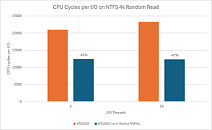
Microsoft has introduced native NVMe SSD support in its Windows Server 2025 build, now available as an opt-in feature for users. After 12 years of NVMe's existence and years of support in the Linux kernel and Linux-based operating systems, native support has been added to the Windows Server stack. Previously, Microsoft converted NVMe drive commands into SCSI commands, which resulted in processing latency and overhead, slowing down read/write speeds in typically high-performing storage configurations. With native NVMe support, the entire stack and I/O processing have been redesigned to achieve optimal SSD performance.

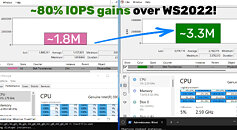
System administrators don't need data to recognize the significant performance improvements that native NVMe support will bring. Windows Server 2025's native NVMe support fundamentally transforms storage performance by enabling direct multi-queue access to modern hardware. It delivers up to 3.3 million IOPS on PCIe Gen 5 SSDs and exceeds 10 million IOPS on HBAs, while reducing latency through streamlined, lock-free I/O paths. This leap in efficiency is essential because traditional SCSI-based processing, originally designed for rotational disks with a single-queue model limited to 32 commands, cannot fully utilize flash storage.
In contrast, NVMe was specifically designed for solid-state media with native support for 64,000 queues, each handling 64,000 simultaneous commands. This allows Windows Server 2025 to eliminate legacy translation layers, improve CPU utilization, and unlock next-generation storage capabilities. Microsoft says that this is a storage revolution and "a new foundation for Windows Server storage, built for the future." Microsoft even has a dedicated email for feedback and questions nativenvme@microsoft.com, which will likely serve as a feedback and bug logger hub. For Windows 11, there is no information on when the OS will bring native NVMe support, but we can assume that it will trickle down in the coming months.
Sources: Microsoft, OC3D
Add your own comment

49 Comments on Windows Server 2025 Gets Native NVMe SSD Support After 12 Years

#1
TheGeekn°72
M$oft truly is the AMD of OS that has Nvidia positioning : somehow in every household and company but cannot for their own life manage to do things right the first time

I didn't even know it didn't have native NVMe support since it appeared on market, 12 years? are you kidding me? if that's an opt-in on WS25, does that mean W10/11 don't have it either? that it should come in a future update?

if the latter is true then I cannot wait to see the bump up in performance we've been sitting on this whole time because no one bothered to check if they had the hardware support for a decade+ old industry standard
Posted on Reply
#3
TheGeekn°72
AleksandarKMicrosoft even has a dedicated email for feedback and questions nativenvme@microsoft.com, which will likely serve as a feedback and bug logger hub.
thank you for including that, I sent them a thoughtful (debatable) email.
Posted on Reply
#4
Dr. Dro
I'm here pondering what are the implications of this on client versions of Windows. This means there is no native NVMe storage support on them either, I take it?
Posted on Reply
#5
TheinsanegamerN
AYFKM? Microsoft was running NVMe in SCSI mode this whole time?

Wait, is THIS why NVMe drives have never shown any real benefit to consumer applications?

How do you screw that up?
Posted on Reply
#6
Six_Times
I cant help but wonder IF this was implemented years ago it might have been enough to save Intel's own Optane, 3D XPoint memory technology? That was such a fantastic technology. Try to imagine the generational advancements that we would have today had it not been abandoned due to lack of proper (easy plug and play) support on the server side by Windows Server.

Intel was ahead of their time with XPpoint.
Posted on Reply
#7
TheinsanegamerN
Six_TimesI cant help but wonder IF this was implemented years ago it might have been enough to save Intel's own Optane, 3D XPoint memory technology? That was such a fantastic technology. Try to imagine the generational advancements that we would have today had it not been abandoned due to lack of proper (easy plug and play) support on the server side by Windows Server.

Intel was ahead of their time with XPpoint.
The biggest issue with Optane was that they couldn't get it to scale up. Of course nothing is stopping Intel from taking another crack at it, aside from their heavy cash bleed.
Posted on Reply
#8
Wirko
Dr. DroI'm here pondering what are the implications of this on client versions of Windows. This means there is no native NVMe storage support on them either, I take it?
Indeed, what about client Windows? I'm confused. TPU SSD reviews indicate that the system can use queue depths above 32. This is from the latest review:

Posted on Reply
#9
_JP_
Nice wording there to make it sound like it's not completely late to the market and we haven't seen the Microsoft SCSI driver handling everything since SATA, because anything after the AHCI was too complicated, while CPU overhead is commonplace. Not in linux or any other system, fortunately.
Posted on Reply
#10
Wirko
Six_TimesI cant help but wonder IF this was implemented years ago it might have been enough to save Intel's own Optane, 3D XPoint memory technology? That was such a fantastic technology. Try to imagine the generational advancements that we would have today had it not been abandoned due to lack of proper (easy plug and play) support on the server side by Windows Server.
Servers run on Linux unless there are specific reasons, like the need to run some Windows-exclusive server application such as Exchange. Or a domain controller.
Posted on Reply
#11
TheinsanegamerN
WirkoServers run on Linux unless there are specific reasons, like the need to run some Windows-exclusive server application such as Exchange. Or a domain controller.
*WEB servers. The majority of web servers run Linux. However, global server count is a lot bigger then just web hosts, depending on the source, the numbers flip to Window holding a majority.
Posted on Reply
#12
tpa-pr
Will this improvement be delivered via a standard feature update or is it going to require a full OS reinstall? I know we have a few clients with servers that could benefit from this.
Posted on Reply
#14
DaemonForce
TheinsanegamerN*WEB servers. The majority of web servers run Linux. However, global server count is a lot bigger then just web hosts, depending on the source, the numbers flip to Window holding a majority.
You guys are being dumb. I used to run Windows web servers on my early desktops and they're great for .NET web.
I was one of the last vb.NET coders on the planet when everyone else jumped ship for C#. It's good, just not for me.
Real autists setup some PHP/LAMP server for whatever ops but I set things to work a minute from the power button.
Posted on Reply
#15
Visible Noise
DaemonForceReal autists setup some PHP/LAMP server for whatever ops but I set things to work a minute from the power button.
AJAX, SOAP, and Java Beans :roll:
Posted on Reply
#16
N3utro
WirkoIndeed, what about client Windows? I'm confused. TPU SSD reviews indicate that the system can use queue depths above 32. This is from the latest review:
There are no large differences of performance when benchmarking nvme SSDs on windows 11 and on popular linux distributions so either it already has native nvme support, either the translation is better managed than on windows server 2022.

Windows server versions are more complex and business critical, which means they typically receive updates long after they have been successfully tested on retail versions.
Posted on Reply
#17
TheinsanegamerN
N3utroThere are no large differences of performance when benchmarking nvme SSDs on windows 11 and on popular linux distributions so either it already has native nvme support, either the translation is better managed than on windows server 2022.

Windows server versions are more complex and business critical, which means they typically receive updates long after they have been successfully tested on retail versions.
It doesnt have native NVMe support:
For Windows 11, there is no information on when the OS will bring native NVMe support, but we can assume that it will trickle down in the coming months.
Posted on Reply
#18
Unregistered
I always knew the performance on my HTPCs and Linux servers that I manage was significantly better but I just chalked that up solely to NTFS being a steaming pile of garbage(it is), but I was unaware that in the current year they still don't support NVME drives natively that is impressively incompetent.
TheinsanegamerNHow do you screw that up?
Satya Nadella says as much as 30% of Microsoft code is written by AI You screw it up by putting an unqualified CEO at the helm of the company and then him proceeding to fire all the talented coders and visionaries, only to replace them with drones from his home country since they cost so much less, but hey the share price went up and that's all these people care about. It's honestly depressing.
Posted on Edit | Reply
#19
DaemonForce
Guys, tough question but why do you care? You're not the ones in the enterprise space and even we don't care about it.
We start WinPE, load the driver, image Windows, bcdboot, reboot, done. Nobody cares about "native" oob support.
Posted on Reply
#20
LastDudeALive
For Windows 11, there is no information on when the OS will bring native NVMe support, but we can assume that it will trickle down in the coming months.
Excuse my french, but pardon the fuck? Windows 11 treats my NVME like an HDD? They had 8 years from the release of the initial NVME standards to incorporate it into Windows 11 before it launched, and we still don't have it 12 years later?
Posted on Reply
#21
Unregistered
DaemonForceGuys, tough question but why do you care? You're not the ones in the enterprise space and even we don't care about it.
We start WinPE, load the driver, image Windows, bcdboot, reboot, done. Nobody cares about "native" oob support.
did you even read the article? They are using an abstraction layer to make NVME work like a SCSI drive resulting in much higher latency.
Posted on Edit | Reply
#22
Sora
Six_TimesI cant help but wonder IF this was implemented years ago it might have been enough to save Intel's own Optane, 3D XPoint memory technology? That was such a fantastic technology. Try to imagine the generational advancements that we would have today had it not been abandoned due to lack of proper (easy plug and play) support on the server side by Windows Server.

Intel was ahead of their time with XPpoint.
Optane is better in OS performance than flash nand, if anything this could help nand finally outdo optane.
tpa-prWill this improvement be delivered via a standard feature update or is it going to require a full OS reinstall? I know we have a few clients with servers that could benefit from this.
This feature snuck into a canary build of 11 a while back but the feature id is unknown currently for those, and client users different id's to server so probably won't for awhile.
The drivers are already present for a good while though
Posted on Reply
#23
DaemonForce
Shadowizeddid you even read the article? They are using an abstraction layer to make NVME work like a SCSI drive resulting in much higher latency.
Did you? It's saving what looks like a fairly 1:1 ratio on CPU cycles. Don't have the CPU to run those drives? Great, 2025 is for you.
Otherwise go back to 2019 or 2022 where your CPU is gonna suffer more to squeeze out that precious IO at tighter latency.
I'm not asking about the article. I'm looking at these comments trying to figure out wtf is happening.
Posted on Reply
#24
_roman_
ShadowizedI always knew the performance on my HTPCs and Linux servers that I manage was significantly better but I just chalked that up solely to NTFS being a steaming pile of garbage(it is), but I was unaware that in the current year they still don't support NVME drives natively that is impressively incompetent.
caja, a file manager has a lot of delays when opening NTFS on a SATA II HDD from SAMSUNG wiht a few read errors.
BTFS with zstd 15 compression on that drive with caja is a lot more snapier

NTFS is outdated and old. File transfer also leads that BTRFS is better. the ntfs fuse module is very old and should be well optimised.

edit: I doubt many user can setup a drive correctly. That is a bit more compliated as it seems.

--

Linux, i talk about the kernel and not about the gnu userspace!, had everything put in the SCSI software corner. That is the reason why anything was shown as /dev/sdx for parallel ata and serial ata.

-- well microsoft ignored PCIE 3.0 and PCIE 4.0 devices and decided quite late with many PCIE 5.0 decives to finally implement a low level file io. The boot times for windows 11 pro are far much worse than for my efi-stub linux kernel with compression and encryption enabled and lvm2 in use.

Nothing which I did not saw already in 1996. Slow, slower, microsoft. the insane hardware requirements for nothing was obvious even in 1996. kde3 desktop on a pentium 1 wiht 120Mhz vs Windows does not run properly and can not play a single mp3.
Posted on Reply
#25
SetsunaFZero
_roman_Nothing which I did not saw already in 1996. Slow, slower, microsoft. the insane hardware requirements for nothing was obvious even in 1996. kde3 desktop on a pentium 1 wiht 120Mhz vs Windows does not run properly and can not play a single mp3.
Well i can tell you it's getting worse and worse every 2-4 years.
That's my Windows 11 Enterprise with all it's Enterprise BS running in the background, only Outlook and Teams are open. If i open up all my applications that i need i'm will be hitting 25GB of RAM and I'm just an IT Sys Engineer. 🙄
TheGeekn°72if that's an opt-in on WS25, does that mean W10/11 don't have it either? that it should come in a future update?
Probably only for W11 since W10 is EOL
Posted on Reply
Add your own comment
Nov 14th, 2026 00:40 CST change timezone

New Forum Posts

Popular Reviews

TPU on YouTube

Controversial News Posts