Friday, January 2nd 2026

YPlasma to Debut Noiseless Laptop Cooled with DBD Plasma Actuators at CES 2026
YPlasma, a pioneer in solid-state thermal management with operations in Newark, NJ and Spain, today announced its participation in CES Las Vegas 2026. Located at Eureka Park, Stand #60845, YPlasma will host the World Premiere of the first-ever application of Dielectric Barrier Discharge (DBD) plasma actuators for consumer electronics cooling—a revolutionary solution designed to replace mechanical fans and traditional ionic wind devices.
As electronics become thinner and AI-driven processing demands more power, traditional cooling methods are reaching their physical limits. YPlasma's solid-state technology addresses these challenges by using cold plasma to generate high-velocity "ionic wind" without a single moving part.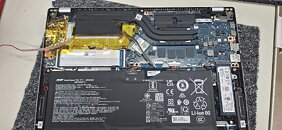
 A Breakthrough in Form Factor: The 200-Micron Cooling Film
For the first time, DBD technology has been miniaturized into a form factor that redefines hardware design. YPlasma's actuators are essentially thin films, measuring as little as 200 microns in thickness. This paper-thin profile allows them to be integrated directly onto heat sinks, chassis walls, or internal components, enabling ultra-thin laptop designs that were previously impossible to cool. Furthermore, these actuators are the first in the world capable of producing both cooling and heating within the same device, offering unprecedented thermal versatility.
Live Demonstration: See the Future of Thermal Management
Media, investors, and industry partners are invited to witness the technology in action and meet the leadership team during a dedicated live showcase:
If you're attending CES 2026, visit YPlasma at Stand #60845 in Eureka Park, Hall G at the Venetian Expo. You can find more details about our participation at the Official CES Exhibitor Directory: exhibitors.ces.tech
Why DBD is the Superior Choice for Laptop Cooling
While many have explored "corona discharge" for ionic cooling, YPlasma's DBD technology represents a fundamental leap forward in safety, reliability, and acoustics:
Beyond consumer electronics, YPlasma's DBD technology serves as a versatile platform for several critical industries:
Source:
YPlasma
As electronics become thinner and AI-driven processing demands more power, traditional cooling methods are reaching their physical limits. YPlasma's solid-state technology addresses these challenges by using cold plasma to generate high-velocity "ionic wind" without a single moving part.


For the first time, DBD technology has been miniaturized into a form factor that redefines hardware design. YPlasma's actuators are essentially thin films, measuring as little as 200 microns in thickness. This paper-thin profile allows them to be integrated directly onto heat sinks, chassis walls, or internal components, enabling ultra-thin laptop designs that were previously impossible to cool. Furthermore, these actuators are the first in the world capable of producing both cooling and heating within the same device, offering unprecedented thermal versatility.
Live Demonstration: See the Future of Thermal Management
Media, investors, and industry partners are invited to witness the technology in action and meet the leadership team during a dedicated live showcase:
- Event: Live Demo of Plasma-Cooled Laptop Prototype
- When: Wednesday, January 7th, 2026, at 4:00 PM
- Where: Stand #60845, Eureka Park (Venetian Expo, Hall G)
"Unveiling the first laptop cooled with our DBD plasma actuators marks a historic moment—not just for YPlasma, but for the entire electronics industry," said David García Pérez, CEO and Co-Founder of YPlasma. "We're excited to engage with global partners and demonstrate what our technology can achieve."
"The AI era requires a complete rethink of how we manage heat and air," García Pérez continued. "With our engineering teams in Madrid and Newark, we are bringing space-grade technology—packaged in a 200-micron film—to everything from your laptop to the next generation of aircraft."The YPlasma team attending CES will be led by David García Pérez (CEO & Co-Founder) and José Antonio González Paz (COO & Co-Founder), together with Miguel Ángel Cota (CTO).
If you're attending CES 2026, visit YPlasma at Stand #60845 in Eureka Park, Hall G at the Venetian Expo. You can find more details about our participation at the Official CES Exhibitor Directory: exhibitors.ces.tech
Why DBD is the Superior Choice for Laptop Cooling
While many have explored "corona discharge" for ionic cooling, YPlasma's DBD technology represents a fundamental leap forward in safety, reliability, and acoustics:
- Truly Noiseless Operation: Operating at an ultra-quiet 17dBA, YPlasma's system is virtually inaudible to the human ear, eliminating the "fan whine" common in high-performance laptops.
- Ozone-Free Safety: Unlike corona discharge devices, which can produce harmful ozone byproducts, YPlasma's DBD system uses a dielectric barrier to limit discharge, ensuring it is safe for consumer use in enclosed spaces.
- Reliability & Longevity: DBD eliminates "tip erosion," the primary failure point for corona needles. YPlasma's protected electrode design ensures the cooling system lasts the entire lifetime of the device.
Beyond consumer electronics, YPlasma's DBD technology serves as a versatile platform for several critical industries:
- Active Flow Control: Enhancing aerodynamics for road vehicles, aircraft, and wind turbines to improve fuel efficiency and reduce drag.
- Sanitization: Providing advanced disinfection solutions for agriculture and large-scale HVAC systems.
- Propulsion: Developing next-generation propulsion systems for UAVs and space exploration.
21 Comments on YPlasma to Debut Noiseless Laptop Cooled with DBD Plasma Actuators at CES 2026
Now make an X1 2-in-1 with it.
Also you can tell it's a prototype based on the amount of kapton tape they slapped on that thing.
This here seems to just use ion discharge to create airflow. This is ancient tech but they wrap it like it's something all new. Reasons it's not used in computers is because ion discharge creates ozone which is toxic (though probably not an issue at this scale) and ionized air creates static discharge which is really not desired with electronics as well as it causes dust deposition on opposite charged surfaces, which is usually everything around the ion discharge needles or wires. Also very undesired with electronics.
"Dielectric-barrier discharge (DBD) is the electrical discharge between two electrodes separated by an insulating dielectric barrier. Originally called silent (inaudible) discharge and also known as ozone production discharge..."
:P
Aside 21st century real-life speice magicks*, I'm not sure how this could be more efficient than an axial or centrifugal BLDC fan.
*Resonance and ulta-high-efficiency HV-switching.
EMI/RFI / EMC concerns?
Shielding and earthing seem like they'll be important. Who's responsible when an end-user breaks FCC-compliance?
ESD concerns?
Ionizers charge the air.
Once, I had an insanely bad 'ESDing problem' at my desk. Turned out, it was the ionizer in the HEPA air cleaner I was gifted.
Ambient condition compatibility?
how's it do when dust, pollen/spores, steam, smoke or PG+VG eJuice vapour are flowing through the assembly?
PG+VG vapour in-particular drastically changes the electrical qualities of air. Ex. Vape vapour, flowing over static-charged skin and hair, is one of the most-intriguing sensations...Yes, at least a little O3 will be produced by any 'ion wind' device. If there's ions, there will be O3. The danger(s) of ozone is(are) much higher to equipment and plastics, than (most) animal or human health.
Just enough to start smelling it, begins to radically damage the surface of most plastics (yellowing, cracking, embrittlement, etc.), wire insulation included.
Natural and natural sources of (ground-level) Ozone, are a major contributor to "Weathering" and the breakdown of automotive-industrial seals/hoses/tires, etc.
natural=anthropogenic VOC+NOX emissions, making O3, via solar radiation. science.nasa.gov/earth/earth-observatory/chemistry-in-the-sunlight/
There's a tradeoff but when the laptop is plugged in power consumption can be very high... Same for handhelds.