Wednesday, January 7th 2026

ASRock PSUs at 2026 CES: L-type 12V-2x6 Cable with Overheat Protection
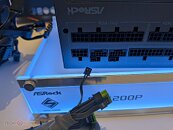
ASRock at the 2026 International CES showed off its latest PSUs. Starting things off is the new ASRock 12V-2x6 L-type modular PSU cable. This cable comes with 16 AWG wires for its main power lines, and is 70 cm in length. It is capable of 12V-2x6 with 600 W continuous output and meets ATX 3.1 and PCIe 5.1 CEM specs. Besides its 12 power pins and 4 sensor pins, there are two additional detachable pins, which connect a compatible PSU to a thermal diode located in the VGA-end of the cable. When it senses that temperature within the connector has crossed a certain safety threshold, the PSU's over-temperature protection (OTP) kicks in and turns off your machine. You will lose work, but might end up saving your high-end graphics card. The cable's temperature pins work with ASRock's Taichi, Phantom Gaming, and Steel Legend Platinum series PSUs).
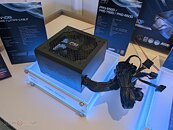
ASRock PRO series PSUs are the company's mainstream non-modular (fixed cable) PSU lineup, these come in 850 W (600 W 12V-2x6), 750 W (450 W 12V-2x6), and 650 W (450 W 12V-2x6) models, and meet ATX 3.1 and PCIe 5.1 specs, offering 80 Plus Gold switching efficiency. The Steel Legend Platinum series are a premium line of PSUs positioned above, with full modular cabling. These can be had in 850 W, 1000 W, and 1200 W models, each of which have 600 W-capable 12V-2x6. The 1200 W model in fact comes with two 600 W 12V-2x6). You get 80 Plus Platinum switching efficiency, along with Cybenetics Platinum switching and Cybenetics A acoustics. The Phantom Gaming (SFX) series comes in 850 W and 1000 W, featuring not just 600 W 12V-2x6, but also connector OTP, 92 mm cooling fans, and 5 V rail power boost.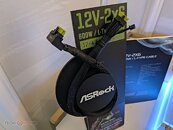
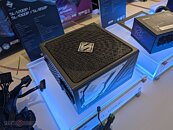
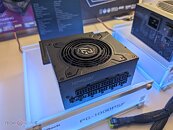
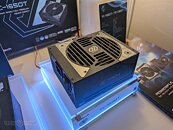 Leading the pack are the ASRock Taichi Titanium series, including 1600 W and 1300 W models. Both these offer 80 Plus Titanium, Cybenetics ETA Titanium, and Cybenetics Lambda A++ (1300 W) or A+ (1600 W) switching efficiency. They both come with two 600 W 12V-2x6 with OTP, and a premium cooling solution using a 135 mm fan, and an aggressive fan management curve that keeps the fan off over a wider temperature range.
ASRock PRO series PSUs are the company's mainstream non-modular (fixed cable) PSU lineup, these come in 850 W (600 W 12V-2x6), 750 W (450 W 12V-2x6), and 650 W (450 W 12V-2x6) models, and meet ATX 3.1 and PCIe 5.1 specs, offering 80 Plus Gold switching efficiency. The Steel Legend Platinum series are a premium line of PSUs positioned above, with full modular cabling. These can be had in 850 W, 1000 W, and 1200 W models, each of which have 600 W-capable 12V-2x6. The 1200 W model in fact comes with two 600 W 12V-2x6). You get 80 Plus Platinum switching efficiency, along with Cybenetics Platinum switching and Cybenetics A acoustics. The Phantom Gaming (SFX) series comes in 850 W and 1000 W, featuring not just 600 W 12V-2x6, but also connector OTP, 92 mm cooling fans, and 5 V rail power boost.


6 Comments on ASRock PSUs at 2026 CES: L-type 12V-2x6 Cable with Overheat Protection
One more thing to check and verfiy for a random reboot or power off.Which sensors?
Which curve?
Which tripping point?
Which tolerances for the sensors?
How is the trigger implemented? How long does it have over something to trip?
This is the best the industry can do after 2 years of analysing the problem. Good grief.
Notice that I say mitigation and not solution because non of those methods can a solution to a problem that fundamentally stems from
the connector design itself. If you want solution you need a new connector completely redesigned (people would suggest going back to 3 or 4 8 pin connectors but they also melt from on those high power cards).
What can Nvidia do?
The standard's now public. Whoever can contribute, why not.