Thursday, January 29th 2026
Qualcomm and AMD to Adopt SOCAMM2 Memory in AI Products
Qualcomm and AMD are reportedly considering the integration of SOCAMM2 memory into their AI product lines to enhance memory capacity and speed. Following NVIDIA's "Vera" CPU, which features LPDDR5X memory on the SOCAMM factor, offering 1.2 TB/s of memory bandwidth and supporting up to 1.5 TB of LPDDR5X memory, Qualcomm and AMD aim to pursue a similar strategy to achieve high-speed, high-capacity AI systems. These systems require fast memory close to AI accelerators, and SOCAMM can complement the extensive HBM memory on the accelerators. It acts as a fast memory pool with sufficient capacity to store entire models in memory, reducing the need for data transfer to SSD flash storage.
NVIDIA's SOCAMM approach involves surrounding the CPU with multiple SOCAMM modules, a strategy Qualcomm and AMD are expected to adopt in their AI solutions. AMD's Instinct MI accelerators, paired with EPYC CPUs, might be the next candidates for this integration, or AMD may develop a completely new system. Qualcomm already offers AI solutions like the AI200 and AI250 inference accelerators, which include up to 768 GB of LPDDR5 per card. These could soon be complemented by SOCAMM, allowing for standardized memory expansion based on the SOCAMM standard rather than soldering individual memory modules. This approach would enable manufacturers to offer various system versions and solutions by simply adding or removing SOCAMM modules, without the need for extensive PCB soldering work.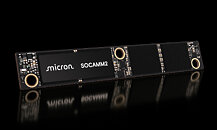
Source:
Hankyung
NVIDIA's SOCAMM approach involves surrounding the CPU with multiple SOCAMM modules, a strategy Qualcomm and AMD are expected to adopt in their AI solutions. AMD's Instinct MI accelerators, paired with EPYC CPUs, might be the next candidates for this integration, or AMD may develop a completely new system. Qualcomm already offers AI solutions like the AI200 and AI250 inference accelerators, which include up to 768 GB of LPDDR5 per card. These could soon be complemented by SOCAMM, allowing for standardized memory expansion based on the SOCAMM standard rather than soldering individual memory modules. This approach would enable manufacturers to offer various system versions and solutions by simply adding or removing SOCAMM modules, without the need for extensive PCB soldering work.

12 Comments on Qualcomm and AMD to Adopt SOCAMM2 Memory in AI Products
But yea, I get ya....seems as if stuff isn't related to AI, there would be hardly anything to write about anymore......
Maybe the mods can create a subforum/category called "everything else except AI crap" :D
SOCAMM2 was going to be the next step for the darn laptops! Now we won't even get that?!
What do you mean "but now", the main benefit of Strix Halo is huge shared memory for CPU and GPU for AI.SOCAMM2 was never intended for Laptops until now, but solely for Nvidia Workstations.
This frankly is GREAT news if it sees adoption. The current generation of chips are gimped by memory, the 780m was fast enough to see a substantial ~30% performance bump from having LPDDR5x speed memory, and that was 12 CUs. The 890m in the HX370 is 16 cores and on the faster rDNA 3.5 arch, but it's stuck with the same slow arse DDR5 so dimms, or with LPDDR5x which is fast enough to feed it, but is soldered, therefore non upgradeable AND restricted to capacities offered by the manufacturer. Dell wont sell you 64GB of RAM on a HX370 unless you buy their precision line, for example.
Putting LPDDR5x on a removable form factor and making that the standard is the best of both worlds.