Monday, March 23rd 2026

LG Display Becomes World's First to Mass-Produce 1-120 Hz Laptop Panel
LG Display, the world's leading innovator of display technologies, today announced that it is beginning the world's first-ever mass production of an LCD panel for laptops equipped with its Oxide 1 Hz technology.
The panel's core feature is its ability to intelligently detect the usage environment. It automatically switches the refresh rate down to 1 Hz when the screen is static and up to 120 Hz when needed. For example, when performing tasks involving primarily still images—such as checking emails or reading e-books and research papers—the panel operates at the lowest refresh rate of 1 Hz. Conversely, it runs in high-refresh-rate mode at up to 120 Hz when streaming content such as movies or sports as well as playing games with frequent screen changes.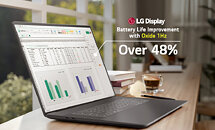 Refresh rate refers to the number of times a screen is redrawn per second. A higher refresh rate reduces flickering, delivering smoother and clearer visuals. However, maintaining a high refresh rate on a static screen results in unnecessary power consumption due to continuous circuit operation.
By ushering in the unprecedented mass production of a laptop panel that flexibly adjusts the refresh rate based on on-screen activity, LG Display is able to offer a product that boasts greater power efficiency.
In order to achieve this world first, the company developed its own circuit algorithms and panel design technology, discovering new materials and applying the oxide with the lowest power leakage during low-refresh-rate mode to the display's thin-film transistor (TFT).
The result is dramatically improved battery efficiency, including 48% more use on a single charge compared to existing solutions.
Considering mobility is a key purchasing factor for laptops, extending usage time with a high-efficiency battery is expected to significantly enhance consumer freedom and convenience. Furthermore, with the recent increase in AI computational tasks driving up power consumption, laptops incorporating Oxide 1 Hz are anticipated to rise to even greater prominence.
LG Display will be supplying the Oxide 1 Hz laptop panel to global PC manufacturer Dell for its flagship premium XPS lineup. Dell unveiled new XPS models featuring the panel at CES 2026 in January.
In addition, LG Display is preparing to begin mass production of a 1 Hz OLED panel incorporating the same technology from 2027.
The company will continue to develop and apply energy-saving technologies such as Oxide 1 Hz to advance its "Carbon Emission Reduction Project," which aims to reduce carbon emissions during the product usage phase by up to 10%.
"We will deliver differentiated customer value through a 1-120 Hz variable refresh rate that integrates world-class technology," said Jae-won Jang, Head of LG Display's Medium Display Product Planning Division. "This unique value includes maximizing laptop battery efficiency for consumer convenience in the AI era."
Source:
LG Display
The panel's core feature is its ability to intelligently detect the usage environment. It automatically switches the refresh rate down to 1 Hz when the screen is static and up to 120 Hz when needed. For example, when performing tasks involving primarily still images—such as checking emails or reading e-books and research papers—the panel operates at the lowest refresh rate of 1 Hz. Conversely, it runs in high-refresh-rate mode at up to 120 Hz when streaming content such as movies or sports as well as playing games with frequent screen changes.

By ushering in the unprecedented mass production of a laptop panel that flexibly adjusts the refresh rate based on on-screen activity, LG Display is able to offer a product that boasts greater power efficiency.
In order to achieve this world first, the company developed its own circuit algorithms and panel design technology, discovering new materials and applying the oxide with the lowest power leakage during low-refresh-rate mode to the display's thin-film transistor (TFT).
The result is dramatically improved battery efficiency, including 48% more use on a single charge compared to existing solutions.
Considering mobility is a key purchasing factor for laptops, extending usage time with a high-efficiency battery is expected to significantly enhance consumer freedom and convenience. Furthermore, with the recent increase in AI computational tasks driving up power consumption, laptops incorporating Oxide 1 Hz are anticipated to rise to even greater prominence.
LG Display will be supplying the Oxide 1 Hz laptop panel to global PC manufacturer Dell for its flagship premium XPS lineup. Dell unveiled new XPS models featuring the panel at CES 2026 in January.
In addition, LG Display is preparing to begin mass production of a 1 Hz OLED panel incorporating the same technology from 2027.
The company will continue to develop and apply energy-saving technologies such as Oxide 1 Hz to advance its "Carbon Emission Reduction Project," which aims to reduce carbon emissions during the product usage phase by up to 10%.
"We will deliver differentiated customer value through a 1-120 Hz variable refresh rate that integrates world-class technology," said Jae-won Jang, Head of LG Display's Medium Display Product Planning Division. "This unique value includes maximizing laptop battery efficiency for consumer convenience in the AI era."
16 Comments on LG Display Becomes World's First to Mass-Produce 1-120 Hz Laptop Panel
If anything, I doubt the LCD panel itself is doing the heavy lifting. It's likely a natural extension of Dynamic Refresh Rate or whatever it's called in other systems.
But here's the gist of how it works from their words:So basically, from the app's point of view, nothing's changed. I'm guessing Core Animation handles the equivalent of desktop compositing and that's what decides the refresh rate. I think there are some potential lag concerns. But since iPhones still feel responsive, I think that's not really an issue.
It might be even better than what it has, with OLED being pixels individually controlled, it could even put certain parts of the screen to 1Hz so that the rest stays fluid, but that same improvement might be visible, so I'm going to suggest checking the lit off pixels, so that after one second, the black parts that stay black stay at 1Hz. I think that it would be cool to have it, but I don't think that there are so many OLED laptops, which I guess are the target audience for this.