Tuesday, March 31st 2026
Toshiba Begins Sampling of 30-34 TB SMR Nearline Hard Disk Drives
Toshiba Electronic Devices & Storage Corporation ("Toshiba") has announced the M12 Series of 3.5-inch nearline hard disk drives (HDDs) for hyperscale and cloud service providers operating large-scale data centers. The new series uses Shingled Magnetic Recording (SMR) technology to deliver storage capacities ranging from 30 to 34 TB. Sample shipments have begun and Toshiba also plans to begin sample shipments of M12 drives that use Conventional Magnetic Recording (CMR) to deliver capacities of up to 28 TB in the third quarter of 2026.
Today is World Backup Day, the annual international initiative to remind companies and individuals of the importance of backing up and protecting their data. That need is now greater than ever, as the constant expansion of digital services and video content distribution, the widespread adoption of cloud services, and, most recently, the increasing use of data-hungry AI and data science, are driving forward immense growth in the volumes of data generated and stored worldwide.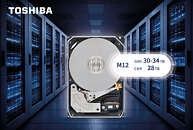 The requirement from data centers, the repositories for most of the world's digital data, is for higher-capacity, better-performing HDDs to support more efficient system configurations. The M12 Series is designed to address this demand by significantly increasing storage capacity in the standard 3.5-inch nearline HDD form factor.
M12 Series drives leverage Toshiba's proprietary design and analysis technologies cultivated through the development of slim and compact products. They surpass previous generations (CMR MG11 and SMR MA11 Series) by incorporating an additional magnetic disk, for a total of 11 disks. Additionally, the recording media used in the M12 Series replaces the usual aluminium substrate with glass, which offers higher durability and enables a thinner design. Their enclosures are helium-filled, and the drives combine Toshiba's proprietary Flux Control Microwave-Assisted Magnetic Recording (FC-MAMR) technology with SMR, achieving storage capacities of 30 to 34 TB.
SMR technology increases recording density by overlapping data tracks in a manner similar to roof shingles. However, because of the data track overlap, random write operations can result in performance degradation. The M12 Series HDDs adopt a host-managed SMR architecture, in which the host system manages data placement and rewriting within the drive. This approach enables more efficient data handling and reduces performance degradation in server and storage system environments.
The new SMR HDDs reach a maximum data transfer rate of 282 MiB/s, an improvement of approximately 8 %, while power consumption per terabyte (W/TB) is approximately 18 % lower than that of the previous generation of products. Designed for continuous 24/7 operation, the M12 Series supports an annual workload rating of 550 TB and offers an MTTF/MTBF of 2.5 million hours, an annualized failure rate (AFR) of 0.35 %.
Looking ahead, Toshiba plans to further increase HDD capacity through the adoption of next-generation recording technologies, including Heat Assisted Magnetic Recording (HAMR), and products featuring a 12-disk configuration. Increasing HDD capacity is key to addressing the constantly growing storage demands of data centers.
Source:
Toshiba
Today is World Backup Day, the annual international initiative to remind companies and individuals of the importance of backing up and protecting their data. That need is now greater than ever, as the constant expansion of digital services and video content distribution, the widespread adoption of cloud services, and, most recently, the increasing use of data-hungry AI and data science, are driving forward immense growth in the volumes of data generated and stored worldwide.

M12 Series drives leverage Toshiba's proprietary design and analysis technologies cultivated through the development of slim and compact products. They surpass previous generations (CMR MG11 and SMR MA11 Series) by incorporating an additional magnetic disk, for a total of 11 disks. Additionally, the recording media used in the M12 Series replaces the usual aluminium substrate with glass, which offers higher durability and enables a thinner design. Their enclosures are helium-filled, and the drives combine Toshiba's proprietary Flux Control Microwave-Assisted Magnetic Recording (FC-MAMR) technology with SMR, achieving storage capacities of 30 to 34 TB.
SMR technology increases recording density by overlapping data tracks in a manner similar to roof shingles. However, because of the data track overlap, random write operations can result in performance degradation. The M12 Series HDDs adopt a host-managed SMR architecture, in which the host system manages data placement and rewriting within the drive. This approach enables more efficient data handling and reduces performance degradation in server and storage system environments.
The new SMR HDDs reach a maximum data transfer rate of 282 MiB/s, an improvement of approximately 8 %, while power consumption per terabyte (W/TB) is approximately 18 % lower than that of the previous generation of products. Designed for continuous 24/7 operation, the M12 Series supports an annual workload rating of 550 TB and offers an MTTF/MTBF of 2.5 million hours, an annualized failure rate (AFR) of 0.35 %.
Looking ahead, Toshiba plans to further increase HDD capacity through the adoption of next-generation recording technologies, including Heat Assisted Magnetic Recording (HAMR), and products featuring a 12-disk configuration. Increasing HDD capacity is key to addressing the constantly growing storage demands of data centers.
14 Comments on Toshiba Begins Sampling of 30-34 TB SMR Nearline Hard Disk Drives
- the storage industry is historically the most ignorant of binary prefixes
- transfer rates are always given in decimal units, for all purposes, I've never seen an exception
- and now Toshiba discovers MiB?
Pretty much all the players are still using the metric prefixes to inflate their product specs for size.
Pouring one out for a real one. We keep losing them left and right.
I better not hear a streamer lose their data today. It's too much.