Tuesday, May 5th 2026

Apple Eyes Intel and Samsung Foundries for Chip Production in the U.S.
Companies like Apple are always seeking top-tier manufacturing for their Apple Silicon products, which range from the A-Series chips in iPhones and low-power MacBooks to the more powerful M-Series SoCs that power iPads and higher-end Macs. Manufacturing these custom processors has traditionally been handled by TSMC, but Bloomberg now reports that Apple has been in talks with both Intel Foundry and Samsung Foundry to manufacture some of its chips in the coming months. It has been known for some time that Apple is exploring Intel's 18A-P process design kits (PDKs). Apple has used version 0.9.1 of the PDK designed for Intel's 18A-P node. With performance, density, power, and other metrics meeting expectations, Intel could become Apple's source for advanced node production by 2027.
Additionally, Apple is reportedly waiting for Intel to release the 18A-P PDK version 1.0, which is on track to launch in the first half of 2026 or may have already been released to partners. Once available, Apple plans to start with the lowest-end M-series chip, used in MacBook Air and iPad Pro devices, as previously mentioned. This node is particularly interesting due to its performance characteristics, as the 18A-P can deliver a 9% performance increase at the same power level or achieve 18% power savings at the same performance level compared to the standard 18A. This is exactly what Apple is looking for. Coupled with better thermal conductivity, these designs should offer improved heat dissipation and performance compared to what Apple currently achieves with TSMC's 3 nm process in the M5 SoC.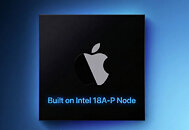 Finally, the Bloomberg report highlights Samsung Foundry as a viable alternative to TSMC with its SF2 2 nm designs. While Samsung is not particularly known for advanced packaging like Intel, Apple could potentially use their dies and package them with their partner Amkor. For designs sourced from Intel, the company might utilize technologies like EMIB and Foveros 3D packaging to achieve new design goals. This could lead to a more diversified supply chain and, importantly, greater geopolitical resilience by manufacturing a large part of its product portfolio in the United States.
Source:
Bloomberg
Additionally, Apple is reportedly waiting for Intel to release the 18A-P PDK version 1.0, which is on track to launch in the first half of 2026 or may have already been released to partners. Once available, Apple plans to start with the lowest-end M-series chip, used in MacBook Air and iPad Pro devices, as previously mentioned. This node is particularly interesting due to its performance characteristics, as the 18A-P can deliver a 9% performance increase at the same power level or achieve 18% power savings at the same performance level compared to the standard 18A. This is exactly what Apple is looking for. Coupled with better thermal conductivity, these designs should offer improved heat dissipation and performance compared to what Apple currently achieves with TSMC's 3 nm process in the M5 SoC.

22 Comments on Apple Eyes Intel and Samsung Foundries for Chip Production in the U.S.
i saw a youtuber talk about a mac neo, basically a mac mini but with an a(x) soc like the macbook neo
a cheap mac mini would very welcome since the full blown one is going for €1000 for some insane reason
The post talks about GAA-FET transistor (18A-P) printed by Intel, because if it is, then I'm wondering
- when Intel begins to print CFET, isn't CFET supposed to come right now or it's coming in 2029 after GAA-FET?
I wonder how tsmc is faring with it.
I think Apple wil not be designing and ordering the same type of chip at both foundries. That would be too much even for them. However, Intel seems happy to sell their package-fu separately to anyone, even for putting together non-Intel chips.
My intentions for the future is to buy my first ever Mac Book Pro, but only on GAA-FET, otherwise nope.
Samsung's exynos 2600 (galaxy s26) is GAA too.
intel A18 is both GAA and backside power
TSMC and Samsung will only be releasing that in their node refinement later this year
M7 or M8?
But now they are being out bid by the likes of nvidia, google, amazon.
Times are weird, if you need a new laptop get one now. I think the m6 devices will see a serious price increase so +$2K for the base macbook pro wouldn't be all that odd given the ram prices and the adoption of cowos for the basic chips
I don't think it's wise to skip this incredible leap only because of prices (that are bad even today...)
but I'm fairly certain that it won't be as big of an improvement over the m5, even if it's 30% more efficient by the m7 it's not unlikely apple will start sourcing those Si-C batteries that are now being used in recent phones by Honor, one plus xiaomi...
Those have triple the charging cycles and store 50% more energy per volume.
if your current device looks like this
and you have the funds don't wait. there will be something better after the next thing too.
But we are talking about the next generation transistor — this stuff is not your typical annual performance increase of 2% or 3%.
With GAA-FET lithography we are talking about a 32% performance increase in a single leap and because of this
I personally find it very stupid to buy something on planar transistors when GAA-FET is already pretty near, basically just around the corner.
Regarding the late introduction of Si-C batteries, they are just delayed for the reason that:
China is beta-testing this stuff first for the rest of the world, only than big brands will follow this trend, but for now China will remain the main betatester for Si-C batteries.
so where that 30% is very impressive it's not unlikely that 30% will only be reached refinement 3 or 4
like intel is claiming with a18p
Otherwise... It makes no sense wasting money on already depleted technology like FinFET - especially if it’s not an emergency.
I also don’t really know what the future has in store for us.
Maybe in 2027 the prices will start to drop for everything?
Cant remember them ever getting socs from 2 for the same product.
14nm Samsung and 16nm TSMC.
Yeh ... it seems like no mac book pro for me this year ...
I just have one question - what makes you think we care if you get a Mac?