Saturday, June 20th 2026

AMD to Restore TSME (Memory Encryption) on Consumer Ryzen Processors After Backlash

AMD backpedaled on its recent decision to remove Transparent Secure Memory Encryption (TSME) feature on its consumer Ryzen processors, which was typically enabled by default. The company had, in April, quietly disabled the feature for Ryzen consumer processors through an AGESA update encapsulated into motherboard firmware updates. The idea probably was to restrict TSME to Ryzen commercial-segment processors, sold under the Ryzen PRO brand, besides Ryzen Threadripper WX workstation processors, and EPYC server processors. For reference, Intel offers a similar feature, TME-MK (Total Memory Encryption-Multi-Key) on even its consumer Core processors, and not just its commercial Core vPro processors.

AMD said that it has decided to restore TSME "based on valuable community feedback," and end-users should expect UEFI firmware updates that restore the feature starting next month (July 2026). TSME is a hardware-based feature that leverages fixed-function hardware on the silicon to encrypt the contents of the memory, providing an additional layer of security. Since AMD shares a common IOD design across its Ryzen consumer and Ryzen PRO commercial product lines, the feature is physically present.
In a statement to Tom's Hardware, AMD said:
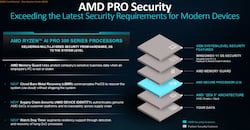
AMD Memory Guard (Transparent Secure Memory Encryption, or TSME) is a hardware-based memory encryption technology available on our Ryzen PRO desktop and mobile processors where supported in silicon. It is a foundational security feature, and we have no plans to remove support from our Ryzen PRO lineup. This commitment holds now and in the future.

Regarding certain non-PRO Ryzen 9000-series desktop processors, a BIOS option to enable Memory Guard was previously available but was removed in a recent update. Based on valuable community feedback, we will reinstate this option in an upcoming BIOS release in July."
Source: Tom's Hardware
Add your own comment

90 Comments on AMD to Restore TSME (Memory Encryption) on Consumer Ryzen Processors After Backlash

#51
MTS-C
R-T-BSo this is kind of a storm in a teacup tbh.
Of course.
Posted on Reply
#52
AntiX3DGlazer
Tek-CheckIs that true for home users?
Was this a storm in a cup of tea or the feature is genuinely useful?
For home users it doesn't matter. For everyone else, it's probably a nice-to-have.
Posted on Reply
#53
AsRock
TPU addict
just like that Ta Daaa
Posted on Reply
#54
azrael
R-T-BIt adds a few ms to memory latency. Nearly all concerned with just performance shut it off, as such. So this is kind of a storm in a teacup tbh.


Since full-on ECC is pretty ineffective against rowhammer, I'd be outright shocked if this does anything against it. But yes it does have use cases.
Memory error correction and memory encryption are two very different things. You cannot compare them. However, the latter helps protect the former from attacks like RowHammer. Since apparently TSME was disabled in AGESA 1.2.7.0 it seems like a completely asinine move to "solve" the latest RowHammer attack against specifically SK Hynix memory by nerfing memory speed. Enabling TSME would be much more useful.
Posted on Reply
#55
Space Lynx
Astronaut
I'm looking forward to Nova Lake upgrade, I have no brand loyalty anymore. All these companies are the same, so pick what you like the most, it's that simple.
Posted on Reply
#56
Grimling
kimbentsenWhat arrogance from AMD. You paid for a feature, and then they silently remove it. Someone would call that fraud.
Lets assume you specifically got this CPU because of TSME. If AMD then silently removes the feature you specifically wanted, it seems very likely to me, that you could return the product and get your full money back!
Because AMD changed the product significantly, changed the contract and reduced the features of the product in such a way, that you would have never got it in the first place!
Would be interesting to hear from a lawyer about this.
Posted on Reply
#57
CyberPomPom
GrimlingLets assume you specifically got this CPU because of TSME. If AMD then silently removes the feature you specifically wanted, it seems very likely to me, that you could return the product and get your full money back!
Because AMD changed the product significantly, changed the contract and reduced the features of the product in such a way, that you would have never got it in the first place!
Would be interesting to hear from a lawyer about this.
It would be hard to argue in good faith that you were wronged by AMD at the time of purchase. Or even that you paid for this feature.

Those security and stability RAM features are not advertised in those CPUs but on the PRO version of them.
It was available to whoever wanted to tinker with but it was never officially supported.

Either you are a "naive" customer and got TSME (and ECC) for free because it's on your CPU even though you didn't shop for it, so it was nice while it lasted but your purchase wasn't made around this feature.

Or you searched for TSME / ECC and bought this CPU even though it's not an official feature of it but a hack. AMD could argue very easily that someone looking specifically for this feature couldn't ignore that the PRO version is the one they offer for this purpose.

Still, it was an ass move of AMD to remove and at least they caved in to the backlash.
It's a demonstration that their "laissez-faire" philosophy of a few years ago was mostly a marketing stance that would change when they fill they could extract more value from us, their consumers.
Posted on Reply
#58
Wirko
R-T-BSince full-on ECC is pretty ineffective against rowhammer, I'd be outright shocked if this does anything against it.
My quick assumption would be that memory encryption does help against rowhammer attacks. An attacker would be sending sequences of 0s and 1s to memory cells, but they wouldn't know when (for which bits) the sequence is inverted. This should make it harder for them to predict the outcome of the attack. It also depends on the implementation details - for example, whether the encryption function is the same for all rows or not.
Posted on Reply
#59
GamerTom
I was not even aware of this feature before. It is useless for home users and slows down the computer without advantage. I will switch it off.
Posted on Reply
#60
wolf
Better Than Native
It's lovely to see more and more people accepting that this backlash can and does work, at least on a case by case basis. The real tell will be if it keeps happening.

Give them an inch and they'll take a mile.
Posted on Reply
#61
Tek-Check
kondaminIt’s a vunrerability and there is ai that can find ways to exploit flaws at a rate undreamed of for the history of computing.
Yes, AI could role play a burglar who could enter your house and take RAM sticks out of PC at the point of you shutting down the system. It will be Judgement Day...
shuffy_losysbut I imagine some people would find this useful.
You would need to be at the point of shutting down the system and police, or burglar, would need to have liquid nitrogen with them for data decay to be prevented on the spot. Is this a screenplay for a low budget, conspiracy driven tech movie in Hollywood?
shuffy_losysAt the end of the day, the bigger issue is AMD removing a feature and not telling anyone about it.
I agree with this.
Posted on Reply
#62
shuffy_losys
Tek-CheckYou would need to be at the point of shutting down the system and police, or burglar, would need to have liquid nitrogen with them for data decay to be prevented on the spot. Is this a screenplay for a low budget, conspiracy driven tech movie in Hollywood?
Then you have to ask why bother with whole memory encryption and preventing cold boot attacks at all for anyone.

Or for that matter, patching any security vulnerability where the only practical method of exploitation is physical access.
Posted on Reply
#63
kondamin
Tek-CheckYes, AI could role play a burglar who could enter your house and take RAM sticks out of PC at the point of you shutting down the system. It will be Judgement Day...
or you could have a compromised assembly line that added hardware that reads out memory and sends interesting things over the internet.
far to much work for human operatives, easy work for AI.
Posted on Reply
#64
A Computer Guy
Tek-CheckYes, AI could role play a burglar who could enter your house and take RAM sticks out of PC at the point of you shutting down the system. It will be Judgement Day...
Even without AI a burglar who could enter your house and take RAM sticks out of PC will most likely just be cashing in on the stolen product rather than trying to read the content of the RAM.
Posted on Reply
#65
CityCultivator
Tek-CheckYes, AI could role play a burglar who could enter your house and take RAM sticks out of PC at the point of you shutting down the system. It will be Judgement Day...


You would need to be at the point of shutting down the system and police, or burglar, would need to have liquid nitrogen with them for data decay to be prevented on the spot. Is this a screenplay for a low budget, conspiracy driven tech movie in Hollywood?

I agree with this.
Laptops gets stolen often, why you think of the non-obvious when the simpler case of someone stealing a laptop while you are outside with laptop on bag, or a bench, with said laptop on, or on on modern standby?
Posted on Reply
#66
Dukenukemx
TheGeekn°72it is a moral obligation to bully megacorps into not bullshitting us
in the world we live in, we NEED MORE security, NOT LESS of it
Specifically more security without government intervention that isn't for the children. Anytime you hear "for the children", panic. Alarm bells should ring.
Posted on Reply
#67
Steevo
To be fair this protects against physical attack, so if someone were present to attack the machine they could also just turn this feature off…. So….

Can anyone think of a scenario where it actually protects a user?
Posted on Reply
#68
kondamin
SteevoTo be fair this protects against physical attack, so if someone were present to attack the machine they could also just turn this feature off…. So….

Can anyone think of a scenario where it actually protects a user?
As i wrote above, a manufacturer installs hardware that monitors what is written to ram.
The user can do their due diligence and install a fresh clean OS but still have a compromised system because at a low level everything is monitored
Posted on Reply
#69
Dr. Dro
GamerTomI was not even aware of this feature before. It is useless for home users and slows down the computer without advantage. I will switch it off.
It is not useless, and it does not slow the computer down. The impact is very minimal even on earlier generation products. As mentioned by someone earlier, probably on the other thread, arguing against this is like arguing against KASLR or no-execute bit capability.

It's a security feature and one that should be standard and... transparent, which it was, given most of you have no idea what it is for and what does it do.
Posted on Reply
#70
Raiden85
That was a dick move to remove it in the first place.
Posted on Reply
#71
shuffy_losys
SteevoTo be fair this protects against physical attack, so if someone were present to attack the machine they could also just turn this feature off…. So….

Can anyone think of a scenario where it actually protects a user?
It's to protect against cold boot attacks.
Posted on Reply
#72
Ols-Hol
When I looked into this, total memory encryption on Intel processors was in fact only supported on vPro motherbaords/platforms, contrary to what the article says. Intel doesn't have ana nalogue of Ryzen Pro processors (besides Xeon SKUs), they segment vPro based on motherboard chipsets (though some cheaper SKUs are then ineligible for vPro even if motherboard is).
Posted on Reply
#73
Steevo
kondaminAs i wrote above, a manufacturer installs hardware that monitors what is written to ram.
The user can do their due diligence and install a fresh clean OS but still have a compromised system because at a low level everything is monitored
You realize the size, price, and functionality reduction or reading from the RAM constantly? Also that windows uses random locations for program information, so the hardware would have to interface with the OS, then how would that data make it out of the hardware, a connection to the internet sending GB of data per minute?
Posted on Reply
#74
kondamin
SteevoYou realize the size, price, and functionality reduction or reading from the RAM constantly? Also that windows uses random locations for program information, so the hardware would have to interface with the OS, then how would that data make it out of the hardware, a connection to the internet sending GB of data per minute?
local embeded specialised AI looks for known patterns and a basic OS sends what it tags as interesting,
yes far fetched and unlikely for now
Posted on Reply
#75
shuffy_losys
Ols-HolWhen I looked into this, total memory encryption on Intel processors was in fact only supported on vPro motherbaords/platforms, contrary to what the article says. Intel doesn't have ana nalogue of Ryzen Pro processors (besides Xeon SKUs), they segment vPro based on motherboard chipsets (though some cheaper SKUs are then ineligible for vPro even if motherboard is).
It's available regardless of platform, but the motherboard manufacturer or system builder may not enable it for non vPro systems.
Posted on Reply
Add your own comment
Nov 11th, 2026 23:56 CST change timezone

New Forum Posts

Popular Reviews

TPU on YouTube

Controversial News Posts