Monday, July 13th 2026

Intel 18A Silicon Goes to Space with "Starfire" Processors
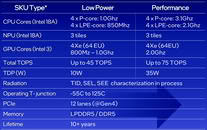
Intel's 18A node is officially space-grade, according to documentation on Intel's website. A document that initially went unnoticed has been published, detailing a new "Starfire" generation of processors built on the 18A node and designed for space operations. Intel has designated two SKUs for orbital computing, each equipped with four P-Cores and four LPE-Cores, resulting in an eight-core SoC design. One is optimized for low-power operations with clocks adjusted for efficiency, while the other is designed for performance. The Low Power edition tunes its four P-Cores to 1.0 GHz, while the four LPE-Cores run at 850 MHz. For the Performance version, Intel has increased the frequency of P-Cores to 3.1 GHz, with LPE-Cores reaching up to 2.1 GHz.
Both SKUs feature a GPU tile built on the Intel 3 node, which includes 4 Xe cores with 64 EUs. On the Low Power SKU, these Xe cores operate between 800 MHz and 1.0 GHz, while the Performance SKU boosts this to 2.0 GHz. The total package for the Low Power version remains at 10 W TDP, while the Performance SKU is capped at 35 W TDP. Additionally, Intel includes an NPU on both versions, with a compute capability of 45 TOPS on the Low Power version and up to 75 TOPS on the Performance SKU using INT8 precision. Beyond specifications, "Starfire" can operate within a T-Junction range from -55°C to 125°C. This range, alongside TID, SEL, and SEE radiation hardening certifications, introduces the first 18A silicon to space, ideal for orbital computation. Intel targets this quarter, Q3, for samples.
 For those unaware, space computing requires additional radiation hardening for processors before they are deployed. Space is an unpredictable environment full of ionizing radiation that can penetrate CPUs, causing sudden bit-flips, which jeopardize data integrity and computation accuracy. Therefore, every silicon chip destined for space must undergo radiation hardening to prevent degradation from long-term radiation exposure and protect against short-term high-energy particles impacting the CPU.
Sources:
Intel, via x86deadandback on X
Both SKUs feature a GPU tile built on the Intel 3 node, which includes 4 Xe cores with 64 EUs. On the Low Power SKU, these Xe cores operate between 800 MHz and 1.0 GHz, while the Performance SKU boosts this to 2.0 GHz. The total package for the Low Power version remains at 10 W TDP, while the Performance SKU is capped at 35 W TDP. Additionally, Intel includes an NPU on both versions, with a compute capability of 45 TOPS on the Low Power version and up to 75 TOPS on the Performance SKU using INT8 precision. Beyond specifications, "Starfire" can operate within a T-Junction range from -55°C to 125°C. This range, alongside TID, SEL, and SEE radiation hardening certifications, introduces the first 18A silicon to space, ideal for orbital computation. Intel targets this quarter, Q3, for samples.


19 Comments on Intel 18A Silicon Goes to Space with "Starfire" Processors
Seems that word hasn't gotten out to everyone about *just how harsh* space is to electronics. Folks tend to assume vacuum is the only hazard in space - boy, is it not. Radiation-induced bit errors is the main reason that the mounted compute on even the newest space probes is so feeble compared to any modern smart phone. Better that than really fast with tons of cosmic-ray-induced bit-flip errors! "What? It didn't boot AGAIN??? That's 22 times in a row?!? It was just fine right after main engine cut off!!!"
Mostly that I don't think this processor is going to be used on things actually making sure the thing in space doesn't fall back down prematurely and can maintain communication with mission control. Or with things that have people in them, any life support equipment. It'll likely be used on the application side of the thing in space so if fails, it won't turn the thing into more space junk (well, depending on how much its owner cares about disposing of it)
GPU tile is made on Intel 3.
Which may or may not be the Plain Xe3 and not Xe3P.The compute tile may be Panther Lake or Wildcat.
As it is 4P + 4 LPE .. its more like Wildcat.
I thought the older, way bigger nodes are preferred due to the radiation sensitivity of the transistors.
It's the external causes, meaning all the radiation and particle bombardment, which is the problem.
Single incoming cosmic ray proton can cause cascade of "secondary radiation" being released capable to causing whole bunch of bit errors or straight damage.
And vulnerability to that increases propably something like exponentially when transistors etc components of circuiry get smaller.
Only Koolaid drinker would use any "modern" node IC in pretty much anything above 1% important in space.
Already passenger jet cruise altitude is enough to start increasing dose of radiation coming from space.
And achieving any good degree of protection from radiation is one of the biggest challenges for manned long term space flights outside Earth's magnetic field.
Bigger eruption in Sun can be huge issue for astronauts on Moon flight and even on ISS (inside Earth's magnetic field) astronauts move into specific module during stronger "space weather".Weight is at extreme premium in things sent to space.
And that cosmic ray doesn't really care if it hits that IC directly or acceptable weight casing around it. That cascade of secondary radiation particles can be released either way.