Thursday, July 16th 2026
TSMC's 2 nm Node Gains Momentum with Fourfold Increase in Tape-Outs
TSMC's 2 nm node has reportedly attracted significant client attention, as the company's Senior Vice President, Kevin Zhang, confirmed that the N2 node has four times the number of tape-outs compared to its previous leading-edge 3 nm N3 node. This indicates that many of TSMC's customers, who are also long-time partners, have focused their resources on 2 nm chip designs instead of the 3 nm node PDKs. The driving force behind the fourfold increase in chip tape-outs is the impressive power and performance improvements achieved by the company's first gate-all-around FET nanosheet transistor. With GAAFET, TSMC's N2 delivers up to a 15% performance increase at the same power level, or up to a 30% power reduction at the same speed. This means designers can achieve much higher switching performance within the same power budget as the previous N3E, or reduce power consumption by nearly a third while maintaining the same performance target. Additionally, the transistor density increase is about 15%, allowing for smaller dies with the same functionality or larger dies with more performance.
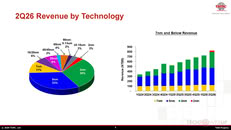
Interestingly, TSMC began high-volume production of its N2 node in Q4 2025. Fast-forward two quarters to today's date, and the 2 nm node now accounts for only 3% of the company's revenue, while the 3 nm node commands 30%, and the 5 nm node holds the top spot at 33%. However, in the coming quarters, the situation is expected to change as TSMC's customers start receiving more 2 nm chips, and the node's revenue generation grows. Among the N2 customers are AMD with its EPYC "Venice" server CPUs, Apple with its A20 Pro chips for the iPhone 18 Pro series, and others. With four times as many customers using the 2 nm node compared to its 3 nm lithography, TSMC's record-breaking quarterly reports are likely to intensify. Each new node generation brings more expensive wafers due to the increasing complexity of developing a new node, so more tape-outs will significantly boost TSMC's revenue. We are yet to see just how substantial the changes will be in the next few quarters.
 For N2 node variants, we expect to see N2P following the N2 rollout starting in the second half of this year, likely towards the end, with another wave of performance and power improvements. In 2027, the company plans to introduce the N2X node, while N2U is scheduled for 2028. More details about their exact use cases will emerge as we approach their launch, but in the meantime, the company plans to ensure the 2 nm node family remains a long-lived process that will feature more prominently in quarterly reports.
Source:
DigiTimes
Interestingly, TSMC began high-volume production of its N2 node in Q4 2025. Fast-forward two quarters to today's date, and the 2 nm node now accounts for only 3% of the company's revenue, while the 3 nm node commands 30%, and the 5 nm node holds the top spot at 33%. However, in the coming quarters, the situation is expected to change as TSMC's customers start receiving more 2 nm chips, and the node's revenue generation grows. Among the N2 customers are AMD with its EPYC "Venice" server CPUs, Apple with its A20 Pro chips for the iPhone 18 Pro series, and others. With four times as many customers using the 2 nm node compared to its 3 nm lithography, TSMC's record-breaking quarterly reports are likely to intensify. Each new node generation brings more expensive wafers due to the increasing complexity of developing a new node, so more tape-outs will significantly boost TSMC's revenue. We are yet to see just how substantial the changes will be in the next few quarters.


2 Comments on TSMC's 2 nm Node Gains Momentum with Fourfold Increase in Tape-Outs
This is the most recent revenue by platform graph from TSMC.